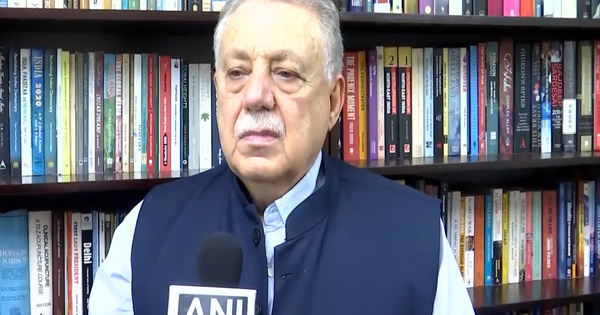
New Delhi [India], April 29 (ANI): Waiel Awwad, Foreign Affairs Expert, said that without an end to hostilities, there cannot be any negotiations between the US and Iran.
Awwad, while speaking to ANI, said that the US has no intent to stop the blockade as it rejected Iran’s proposal.
‘Without ending hostilities, other issues cannot be negotiated. The rejection of Iran’s proposal is a clear indication that the United States, which created this problem, intends to continue this blockade, which will cause further danger to global trade,’ he said.
Awwad said that Iran disallowed the passage of ships completely owing to the operations by the US and Israel.
‘The closure of the Strait of Hormuz was a consequence of the continuous war by the Americans and the Israelis against Iran. Iran initially closed it partially, but after the United States besieged all Iranian ships leaving the shore, Iran closed the entirety of the Strait. Now, anyone wishing to pass must obtain prior permission,’ he said.
Awwad said that the US rejected Iran’s proposal because they wish to impose a toll on ships intending to cross the Strait of Hormuz.
‘To end the global crisis, Iran proposed a discussion: they would open the Strait if the siege was lifted and all hostile activities were permanently ceased. The United States rejected this because Iran wanted to ensure they took a toll, while also requiring that compensation for the war be taken into consideration. Furthermore, the Iranians expressed concern that the Americans might use the opening of the Strait to establish military bases,’ he said.
Awwad further said that Iran can pressure the US by blocking the Strait of Hormuz, and the US should not create more issues.
‘This is exactly what is happening now; the United States is acting like a pirate in international waters. Iran’s oil exports cannot be stopped, and the Americans cannot achieve their objectives by applying ‘madman tactics.’ Iran will never surrender and has many ways of creating problems for the United States and global interests by continuing the blockade of the Strait of Hormuz. Instead of finding a solution, the United States should not take measures that harm international trade and relationships, as these issues now affect everyone in the world,’ he said.
Awwad said that the nuclear issue was resolved in Geneva earlier, but the US still chose to attack it.
‘As you know, the nuclear issue was already discussed in Geneva between the Americans and the Iranians, with interlocutors from Oman and the National Security Advisor of the UK present. Although they had agreed on documented terms, the United States then went to war with Iran. Consequently, Iran does not want to discuss this matter right now because the immediate action required is the opening of the Strait of Hormuz,’ he said.
The expert said that Iran intends to continue the enrichment of uranium at a low percentage for research and energy purposes, which is their right under international law.
‘Regarding the nuclear issue, Iran had previously agreed to all demands except for those concerning enriched uranium, which they refuse to hand over to the United States. They intend to continue the enrichment of uranium at a low percentage for research and energy purposes, which is their right under international law. The United States wanted to take the existing stockpile of approximately 450 kilograms of 60% enriched uranium. Iran suggested they could downgrade it or involve a third country, such as Russia, as they had offered earlier. If these issues return to the negotiating table, many problems can be solved. At the moment, however, there is a sense of pessimism, even as the ceasefire holds,’ he said.
Meanwhile amidst intensifying maritime friction, Iran has lodged a formal complaint with the United Nations, accusing the US of engaging in ‘piracy’ following the seizure of Iranian vessels. According to the Iranian state media Tasnim News Agency, the protest was detailed in a letter sent by Iran’s UN envoy, Amir Saeid Iravani, to the UN Secretary-General, Antonio Guterres, and the Security Council.
The envoy argued that Washington’s justification for the maritime interceptions lacked any standing under global statutes. ‘Reliance on domestic arrangements, which are inherently illegal, can under no circumstances justify such an abhorrent crime committed through the use of force,’ he stated in the correspondence. (ANI)