The United States and Iran exchanged fresh attacks overnight as tensions over the Strait of Hormuz escalated further, with US forces launching another wave of strikes on Iranian targets and Tehran attacking two tankers linked to the United Arab Emirates (UAE).
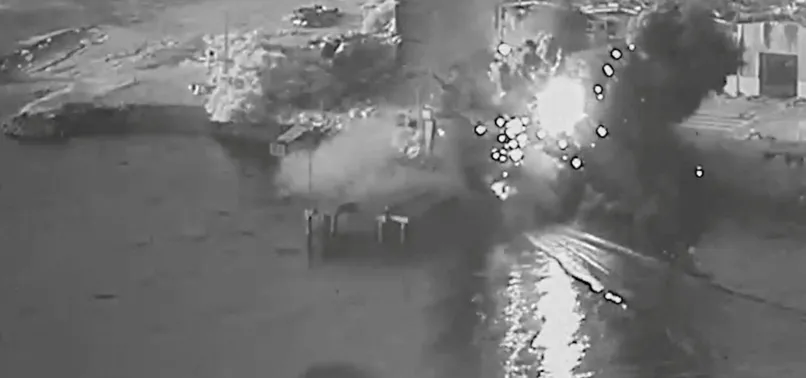
The UAE Defence Ministry said two cruise missiles struck the tankers as they transited the southern shipping lane through Omani territorial waters.
An Indian crew member was killed and eight others were injured, the ministry said.
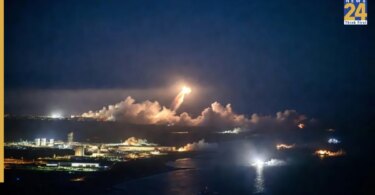
Meanwhile, Iranian media reported explosions at several locations along the country’s southern coast after the US military launched a third consecutive night of strikes.
US President Donald Trump had earlier announced further heavy strikes on Iran for late Monday and Tuesday, as well as the resumption of a naval blockade on ships sailing to or from Iranian ports. According to the US military, the blockade is due to take effect at 2000 GMT on Tuesday. Oil prices rose sharply following the announcement.
In a radio interview, Trump also suggested the US could target a deeply buried facility in central Iran known as Pickaxe Mountain. Its purpose has long been the subject of speculation because of its proximity to the Natanz nuclear site. One theory is that Iran plans to build a secret uranium enrichment facility there capable of producing material for nuclear weapons.
Trump described Pickaxe Mountain as a possible target and said the US would probably strike it “relatively soon.”
The US military later declared the new wave of strikes against Iran over. Earlier, Iranian media had reported explosions on Kish Island in the Gulf, near the port city of Bushehr, on Qeshm Island in the Strait of Hormuz and in the southern city of Bandar Abbas.
Meanwhile, Iran attacked two tankers, which the UAE said were sailing through Omani territorial waters along the southern shipping route.
Iran’s Islamic Revolutionary Guard Corps (IRGC), quoted by Iranian media, said the US military had attempted to divert several ships onto an “illegal route.” It said the two tankers had switched off their navigation systems and ignored repeated warnings before being fired upon and disabled.
Meanwhile, Jordanian state television, citing the military, reported that four missiles launched from Iran had been intercepted.
Air raid sirens also sounded again in Bahrain, another US ally in the Gulf. The Interior Ministry urged residents on X to remain calm and seek shelter but gave no further details.
Bahrain and Kuwait had both reported hostile missile attacks the previous night.
The US military said its latest strikes were intended to further degrade Iran’s ability to attack commercial shipping in the Strait of Hormuz, a vital route for global trade in oil, gas and fertilizers.
In a post on his Truth Social platform, Trump said the US will be known as “THE GUARDIAN OF THE HORMUZ STRAIT,” and charge cargo ships a 20% fee, or any costs deemed necessary “to do the job of providing safety and security to this very volatile section of the World.”
US Secretary of State Marco Rubio said in late June no country had the right to charge for the use of international waters because they did not belong to any one state. Such a demand, he said at the time, could never form part of an acceptable agreement.
Iranian Foreign Minister Abbas Araghchi mocked the proposal on X, saying Trump was “absolutely right” and that “whoever provides secure and safe passage of commercial vessels through the Strait of Hormuz should be compensated for this service.”
“Iran has always been the GUARDIAN of the Strait and will remain so FOREVER. 20% is of course too much. We will be fair,” he added.
US forces have repeatedly struck Iranian targets in recent days, saying the strikes were a response to Iranian attacks on shipping in the Strait of Hormuz.
Iran has retaliated with strikes of its own, including attacks on Gulf states. The escalating exchanges have fuelled fears of a full-scale resumption of the war in the region, particularly after Trump declared the ceasefire with Tehran over last week.