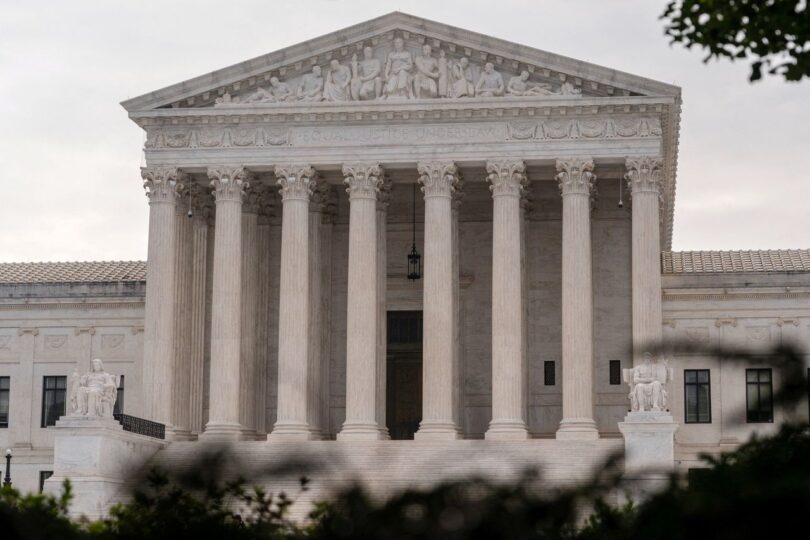
The 14th Amendment has long been interpreted as guaranteeing citizenship for babies born in the United States, with only narrow exceptions such as the children of foreign diplomats or members of an enemy occupying force.
The provision at issue, known as the Citizenship Clause, states: “All persons born or naturalised in the United States, and subject to the jurisdiction thereof, are citizens of the United States and of the state wherein they reside.”
The administration has asserted that the phrase “subject to the jurisdiction thereof” means that being born in the United States is not enough for citizenship, and excludes the babies of immigrants who are in the country illegally or whose presence is lawful but temporary, such as university students or those on work visas.
Citizenship is granted only to the children of those whose “primary allegiance” is to the United States, including citizens and permanent residents, the administration has argued.
Such allegiance is established through “lawful domicile,” which lawyers for the administration define as “lawful, permanent residence within a nation, with intent to remain.”
When the Supreme Court considered the case on April 1, Trump made history as the first sitting president to attend arguments before the top US judicial body, though he left midway through, not long after the lawyer arguing against the administration had begun.
During the arguments, US Solicitor General D. John Sauer, representing the administration, said the promise of citizenship for virtually any baby born on US soil has spawned what he called a sprawling industry of “birth tourism.”
Sauer said that “uncounted thousands of foreigners from potentially hostile nations have flocked to give birth in the United States in recent decades” to secure citizenship for their children. Asked to explain how serious an issue “birth tourism” has become, Sauer primarily cited media reports and conceded that “no one knows for sure.”
The 14th Amendment was ratified in 1868 in the aftermath of the Civil War of 1861 to 1865 that ended slavery in the United States, and overturned a notorious 1857 Supreme Court decision that had declared that people of African descent could never be US citizens.