Follow our live coverage here.
NEW YORK – The US military has introduced Ukrainian counter-drone technology in recent weeks at a key US air base in Saudi Arabia, according to five people with knowledge of the matter, as it seeks to stem attacks that have destroyed aircraft and buildings, and killed at least one service member.
The deployment of a Ukrainian command-and-control platform called Sky Map at Prince Sultan Air Base, which has not previously been reported, is a sign of how Ukraine’s military has surged ahead in drone and counter-drone technologies that have been battle-hardened in its four-year war with Russia.
Ukrainian military officials arrived at the base in recent weeks to train US warfighters with Sky Map, which is used widely by the Ukrainian military to detect incoming drone threats – including Iranian-developed Shahed drones – and launch counter-attacks with interceptor drones.
As cheap, mass-produced drones play a large role in Russia’s war in Ukraine, the Pentagon has ramped up investments in counter-drone technology. But the use of Ukrainian technology at Prince Sultan, which is about 640km from Iran and has endured waves of drones and missiles since the war began, highlights vulnerabilities in US air and missile defence, analysts say.
“There’s been longstanding gaps in US air missile defense coverage around the world,” said senior fellow Timothy Walton, of Washington-based Hudson Institute think-tank. “This has been well understood. However, it hasn’t been addressed.”
The development comes a month after US President Donald Trump publicly rejected an offer from Ukrainian President Volodymyr Zelensky to provide help in combating Iranian drone strikes. “We don’t need their help in drone defence,” Mr Trump told Fox News on March 6.
The White House and the Pentagon directed questions to US Central Command, which oversees Prince Sultan. Central Command declined to comment.
Sky Fortress, the Ukrainian company that owns Sky Map, declined to comment. Mr Zelensky’s office did not respond to a comment request.
In March, the Pentagon’s counter-drone unit announced it had committed US$350 million (S$445.6 million) to bolster defences against drones in support of Operation Epic Fury. Mr Adam Scher, a spokesperson for the unit, known as Joint Interagency Task Force 401, said the unit was providing an array of new technologies, including sensors, cameras and interceptors.
“There is no ‘silver bullet’ tool that will stop every drone threat,” Mr Scher said.
Sky Map has emerged as a primary command-and-control platform used by the Ukrainian military, according to three people with knowledge of the matter. This type of platform, typically a dashboard featuring maps and video feeds, synthesizes data from radars and sensors to detect incoming threats.
Sky Fortress, which makes Sky Map, was launched in 2022 by Ukrainian engineers linked to the military who deployed more than 10,000 acoustic sensors across Ukraine to detect Russian drone attacks, according to a person familiar with the company.
The company, which received funding from the Ukrainian military’s innovation unit, Brave1, developed Sky Map as a software platform to coordinate counter-drone attacks, the person said.
Sky Map is one of a suite of new counter-drone technologies that have been deployed at Prince Sultan base during the war. Merops interceptors – a drone developed by Project Eagle, a US-based company backed by former Google chief executive Eric Schmidt – have been used at the base, according to three people with knowledge of the matter.
Officials have faced some early testing challenges involving the new counter-drone systems, the people said. Earlier in April, during a test at Prince Sultan, a Merops counter-drone interceptor lost control and crashed into a toilet block on the base, two of the people said.
A spokesperson for Mr Schmidt declined to comment.
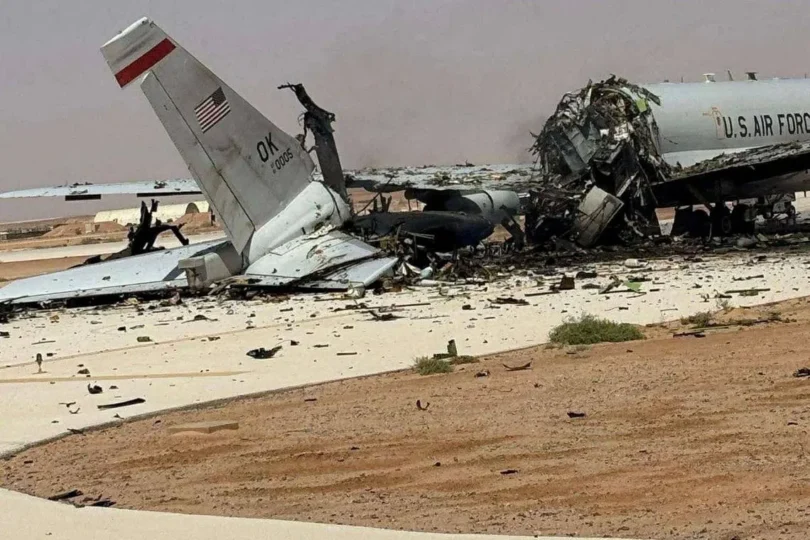
In the weeks after the war started, Prince Sultan faced waves of Shahed drone and missile strikes. One of the Air Force’s E-3 AWACS radar planes was destroyed during an attack on March 27 and multiple KC-135 refuelling tankers were damaged in another strike. In one case, a tent believed to be housing a radar system used to support the base’s counter-missile battery THAAD system was destroyed, according to CNN.
The technologies the base has used to defend against missile and drone strikes include a Northrop Grumman command-and-control platform called Forward Area Air Defense, or FAAD, according to three sources. The platform, which was first deployed by the US Army in the 1990s, provides tracking data to help warfighters combat incoming threats, spanning mortar and rocket strikes to drones.
To combat short-range drone attacks, the base largely used RTX-made Coyote interceptors, two of the sources said. The winged drones, for which the company signed a US$5 billion agreement with the US Army in September 2025, can be used as one-way attack drones with warheads or with a microwave capability to fry the electronics in adversary drones.
A spokesperson for Northrop Grumman said the FAAD system “is consistently dependable in theatre today and we are confident in the competitive advantage FAAD provides to the warfighter”.
Mr Chris Johnson, a spokesperson for RTX, said the Coyote interceptor has “proven highly effective, defeating hundreds of aerial threats during combat operations”. REUTERS