A Professor of Urban and Regional Planning at Bayero University, Kano (BUK), Aliyu Salisu Barau, has urged journalists and media professionals to investigate the management of ecological funds and strengthen scrutiny of duty-bearers amid growing climate and environmental challenges in Nigeria.
Barau said journalists have the power to scrutinise, investigate and hold governments and corporations accountable, particularly on issues affecting communities vulnerable to climate change.
He urged reporters to document the impacts of climate change on frontline communities, investigate the management of ecological funds and give greater attention to women and youth in pastoralist and farming communities who are often vulnerable to climate impacts but underrepresented in decision-making.
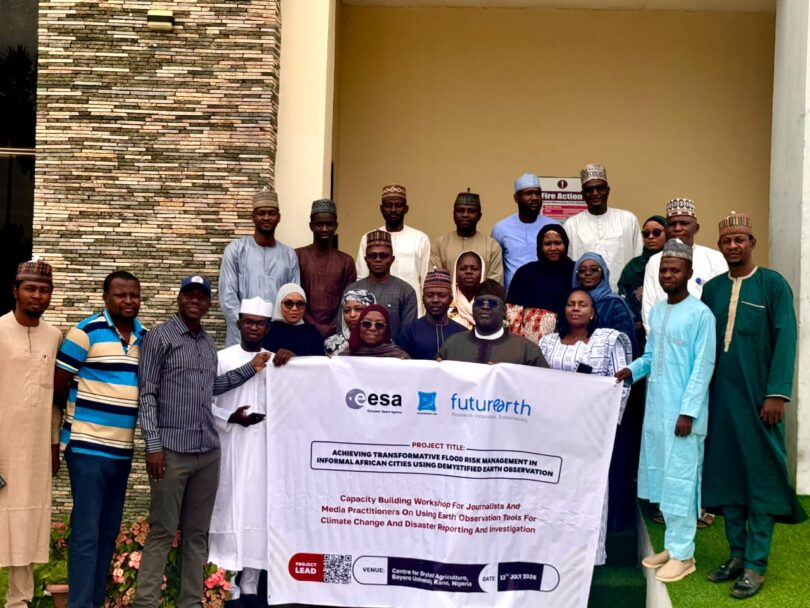
The professor spoke on Monday during a capacity-building workshop for journalists and media practitioners on the use of Earth Observation tools for climate change and disaster reporting and investigation, held at the Centre for Dryland Agriculture, BUK.

Read Also:Katsina audit flags abandoned N2bn Ajiwa dam project, N1.89bn housing loan arrears, N594m water debts
The workshop was held under a research project at BUK titled “Achieving Transformative Flood Risk Management in Informal African Cities Using Demystified Earth Observation,” funded by the European Space Agency (ESA) and Future Earth, with Barau serving as the Project Team Lead.
SolaceBase reports that the Ecological Fund is a Federal Government intervention mechanism for addressing ecological challenges across Nigeria, with intervention areas covering erosion and flood control, pollution, drought and desertification, among others.
The mandate of the Ecological Project Office includes the judicious and equitable management of the fund, while its procurement responsibilities cover maintaining records for auditing, conducting due diligence on projects to ensure value for money and reporting acts of procurement corruption.
Barau warned that Nigeria and other African countries were increasingly exposed to serious environmental challenges, including climate change, land degradation, desertification, drought, soil erosion and violent windstorms.
“These are problems that are recurrent, and they are overpowering and overstretching our capacity to cope with them. So, we need new adaptation strategies that are novel,” he said.
Read Also:Despite receiving N5.8bn ecological funds in six months, northwestern states are not prepared for flooding-Report
He also expressed concern that Nigerian climate reporting often focuses on environmental developments in other parts of the world while paying inadequate attention to climate-related problems closer to home.
According to him, issues such as the shrinking Lake Chad, the slow progress of the Great Green Wall, loss of livelihoods, displacement and food insecurity deserve sustained media scrutiny.
Read Also:Despite high alert, Kaduna receives N3.017bn ecological fund in one year, spends only N178m on flood control
Barau described the media as a bridge between science, society and policy, noting that scientific findings are often communicated in technical language that members of the public may find difficult to understand.
He said exposing journalists to scientific information in simplified language would enable them to translate research into reports that directly relate to people’s environment and livelihoods.
“Climate change is not just an environmental issue; it is a development issue, a justice issue and a human security issue,” he said.
Speaking on how technology could strengthen such investigations, a remote sensing and Geographic Information System researcher in BUK’s Department of Geography, Dr. Murtala Uba Muhammad, said Earth Observation allows journalists to use satellite imagery as evidence in environmental reporting.
Muhammad explained that journalists could compare satellite images of an area taken years apart to establish changes in the physical environment and support investigative findings.
“Using that picture, we can see the area 10 years ago and see the situation now. You can be able to see how buildings are encroaching on water bodies or how forest is gradually being eaten up by other activities, let’s say farming,” he said.
Read Also:Sokoto received N2.54bn ecology fund in 2025, yet spent poorly on flood control despite disasters
He noted that satellite imagery could help reporters communicate what words alone may fail to show, describing pictures and images as a universal language capable of strengthening evidence-based journalism.
“We can use it to reconstruct our story in a way that people can understand,” Muhammad added.
Earlier speaking, the Deputy Vice-Chancellor, Research and Development. BUK, Prof. Amina Mustapha, welcomed participants to the university and highlighted the importance of strengthening the capacity of media practitioners in climate change, disaster risk management and environmental sustainability reporting.