By Yusuf Aminu Yusuf
Every morning, traders across northern Nigeria unlock their shops, hoping customers will walk in. For many, that hope fades by the close of business as they return home without making enough money to cover the day’s expenses. Some have rejected job offers because transport costs would consume most of their wages, while others now survive on borrowed money just to feed their families and keep their businesses afloat.
For countless households, the soaring cost of petrol is no longer just another economic statistic—it has become a daily struggle that is forcing painful choices about food, transportation, work and survival. Traders say customers have disappeared, transport fares have become unbearable, profits have shrunk and businesses built over many years are now fighting to stay alive.
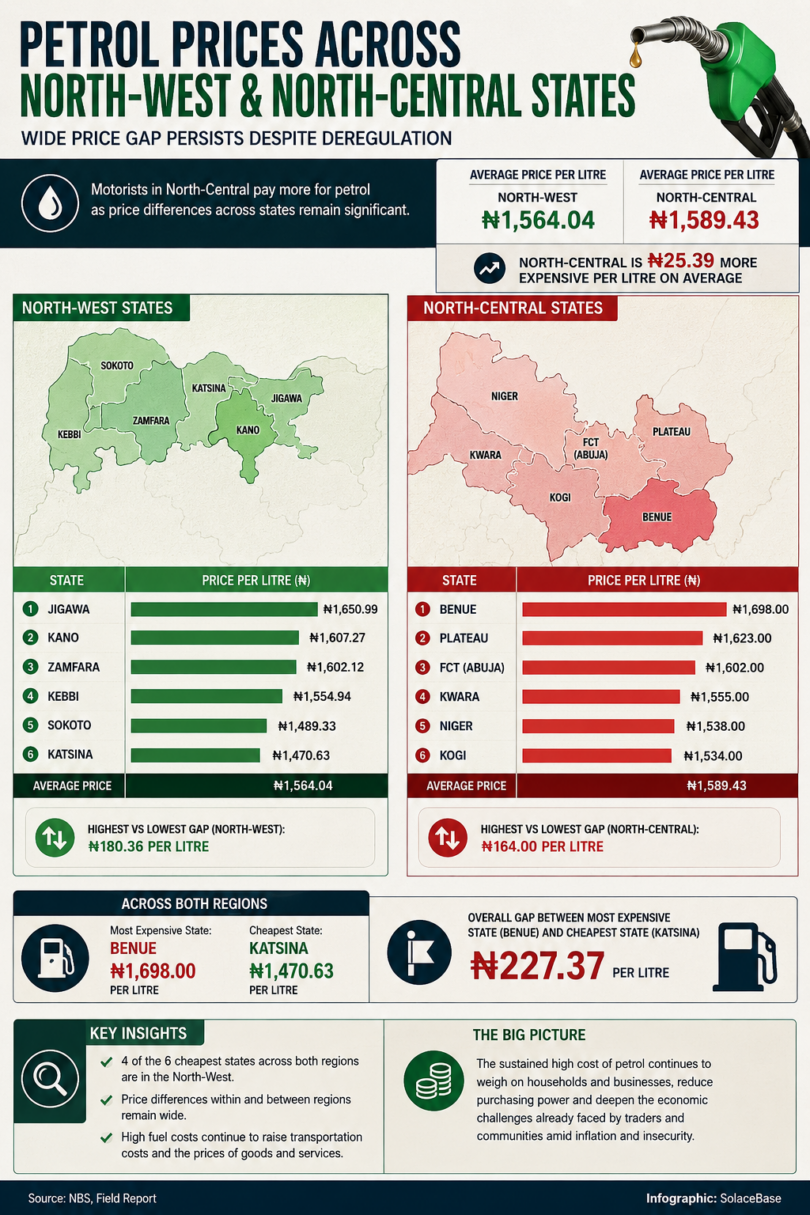
The high cost of petrol, following the removal of the fuel subsidy by President Bola Tinubu shortly after assuming office in 2023, has continued to affect businesses and livelihoods across Nigeria, particularly small-scale enterprises. The recent U.S./Israel-Iran conflict has further compounded the situation by contributing to volatility in global oil markets, worsening the pressure on fuel prices.
Read Also:Jigawa Local Governments receive ₦158.8bn as federal allocations in 2025
During a visit by SolaceBase to the Farm Centre and Yankura GSM phone markets in Kano, the human toll of the crisis was evident.
Traders spoke of deserted shops, disappearing customers and dwindling sales, saying every increase in petrol prices pushes survival further out of reach.
Halifa Lawan, a phone accessories dealer at Farm Centre in Kano, said the increase in petrol prices has created serious challenges for their business, especially for traders who transport goods from Lagos.
Read Also:Sokoto neglects Primary Healthcare, disburses just 5% of capital budget in 2025
Lawan said there is a direct relationship between the current economic hardship and the removal of fuel subsidies during the president’s first year in office. He added that the U.S./Israel-Iran conflict has further worsened the economic situation by contributing to rising fuel costs. According to him, many regular customers, especially those travelling from distant areas, can no longer afford the cost of transportation to visit the market.
“Many of our customers who usually buy goods are no longer coming, especially those from neighbouring states,” he said.
Similarly, Aliyu Yusuf, a phone dealer at Yankura GSM Market, said high fuel prices and insecurity have negatively affected business, adding that many of their customers from Niger, Chad and Cameroon no longer come to the market.
“I had customers who came from neighbouring countries, but they have stopped coming because transportation has become difficult and expensive.
“We hope that one day things will return to normal because most of our customers are also traders,” he said.
Auwal Muhammad, a trader at Madina Market in Farm Centre, also described the difficulties traders are experiencing, saying many traders now come to the market only to return home without making any sales.
He explained that although the prices of many goods have dropped compared to previous years, customers are still not coming to the market in large numbers because their purchasing power has declined.
Read Also:Northwest states received over N589.8bn in six months as Kano tops allocation chart
“Most goods are now cheaper, but people still cannot afford to buy them,” he said.
He also commended traders, particularly those who continue to persevere despite the economic challenges.
“I commend traders for their resilience, especially at this time when the cost of living has become very high,” he said.
The impact of rising petrol prices is not limited to Kano State. In parts of Niger State and the Federal Capital Territory (FCT), residents also lamented that the high cost of fuel has made daily living increasingly difficult, forcing many to make painful sacrifices just to survive.
One resident narrated to SolaceBase how he secured a job offer in the city centre of the Federal Capital Territory but was forced to reject it after calculating the cost of transportation and feeding.
“I got a job in FCT, and by the time I calculated the cost of transportation and cost of feeding, I had to reject it,” the respondent, identified as Olawale Saheed, noted.
“By the time you ask the transport owners why they are increasing transportation, they would tell you it’s because of fuel cost.”
Traders at the popular fruit market in Zuba, Federal Capital Territory, also expressed concern over the rising cost of petrol and its impact on their businesses.