BEIRUT – US President Donald Trump’s announcement on April 23 of a three-week extension to the ceasefire in Lebanon preserved a much-needed pause in a war that has killed nearly 2,500 people, displaced hundreds of thousands more, and destroyed homes, bridges and basic infrastructure.
The ceasefire has proved fragile. Although the large-scale Israeli bombing of recent weeks has halted, hostilities have simmered in persistent lower-level violence between Israel and the Iran-backed Lebanese militant group, Hezbollah.
Neither Israel nor Lebanon, despite having engaged in rare diplomatic talks in Washington, has commented publicly on the ceasefire extension. Hezbollah, which was not directly involved in the US-mediated talks, has signalled that it would reluctantly abide by the truce, so long as Israel does.
The continued violence and the grudging acceptance of terms, analysts say, suggest the deal falls short of a true ceasefire and is vulnerable to unravelling altogether.
“This is not so much a ceasefire as a limited de-escalation,” said Mr David Wood, a senior Lebanon analyst at the International Crisis Group, a conflict-prevention research organisation.
Under the terms of the truce, as published by the US State Department after it was first announced in mid-April, Israel has the right to act in self-defence “against planned, imminent, or ongoing attacks”. It has cited that as a justification for continuing to carry out strikes inside Lebanon. In recent days, its attacks have been concentrated in the south, a Hezbollah stronghold where the group has long exercised de facto control and enjoys broad support.
Israeli forces heavily bombarded the region during the war and now occupy a sizable stretch of territory there, where they are carrying out widespread demolitions.
On April 25, the Israeli military said that overnight, it had struck rocket launchers outside the Israeli-occupied zone in southern Lebanon, and it renewed its warning to displaced families not to approach areas under its control.
Israel also said it had killed more than 15 Hezbollah militants over the weekend, including four in Yohmor, a town in southern Lebanon. It said two projectiles were launched from Lebanon toward northern Israel, one that was intercepted and another that fell in an open area.
Hezbollah, for its part, has continued attacks on Israeli forces and says it has downed Israeli drones.
Mr Ali Fayyad, a lawmaker affiliated with Hezbollah, said in a statement on April 24 that the three-week ceasefire extension did not hold “any meaning” because of continued Israeli attacks. It was the group’s first public response since the extension was announced.
Mr Fayyad criticised the agreement for “imposing no obligations, even minimal ones, on the Israeli side”.
Lebanon’s ceasefire is deeply linked to broader tensions with Iran, Mr Wood said, meaning that if talks between Washington and Tehran were to collapse, Lebanon could quickly become a flashpoint.
“One factor that makes the truce incredibly shaky is that it’s largely contingent on President Trump’s attention,” Mr Wood said. “President Trump forced through this ceasefire largely because he didn’t want continued fighting in Lebanon to scupper negotiations with Iran.”
The current standoff echoes the dynamics of the last nominal ceasefire between Israel and Hezbollah, which took effect in late 2024. Israel continued striking Hezbollah infrastructure and killing its fighters and commanders in an effort to degrade the group’s military capacity.
Hezbollah largely held its fire. After the US-Israeli war with Iran began, the group fired rockets into northern Israel, surprising many by showing that it still retained the ability to fight.
By continuing its attacks under the current ceasefire, “Hezbollah wants to establish the principle that as long as there’s Israeli occupation in Lebanon that they have a right to fight back,” said Mr Paul Salem, a senior fellow at the Washington-based Middle East Institute.
They also want to find a more durable truce than the current arrangement, Mr Salem said. With the help of Iran, they want “to put pressure on the US and Israel to get a full ceasefire”, similar to what they got in wars in 1996 or 2006, he added.
Israel’s latest moves in Lebanon mirror tactics it has used against Hamas in the Gaza Strip, experts say, including occupying territory and continuing deadly strikes and military operations despite an officially declared ceasefire. Israeli officials have said the destruction of towns and villages along the Lebanese border forms part of an intentional strategy modeled on its onslaught on Gaza.
On April 24, Israel appeared to intensify its campaign in Lebanon, warning residents to evacuate the southern town of Deir Aames before carrying out airstrikes. The town sits outside the 6-mile-deep “forward defence line” that Israel said it would hold during the ceasefire, raising concerns that its operations were expanding.
The Israeli military said that a day earlier, Hezbollah had fired rockets from the area toward northern Israel.
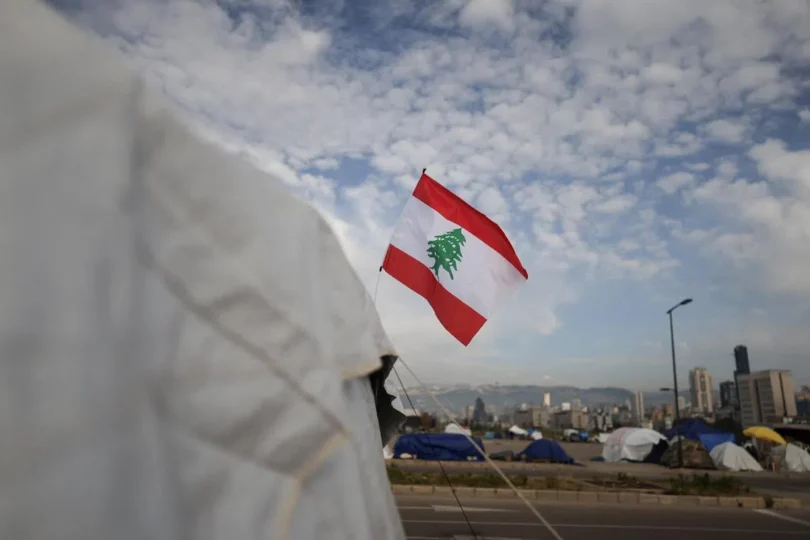
Many of those still displaced from southern Lebanon say the ceasefire has brought little tangible relief. Kamil Mohamed Mansour fled the village of Tallouseh after the war began and now lives in a tent at a stadium in Beirut after losing his home, savings and farmland.
“What ceasefire are you talking about?” Mr Mansour, 78, asked on a recent afternoon. “I have lost everything and am sitting here alone.” NYTIMES