
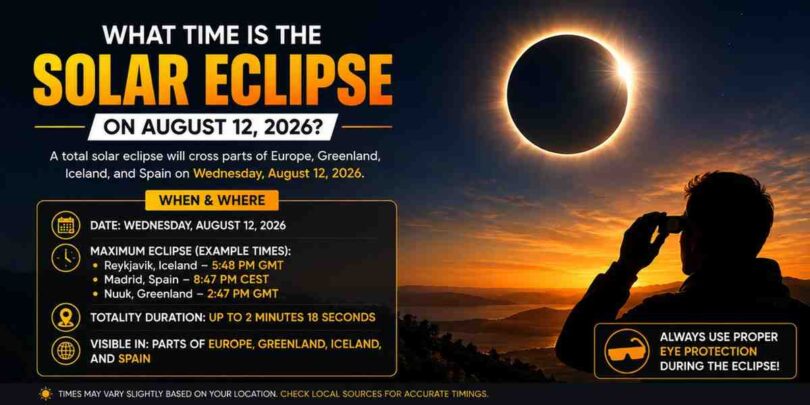
On Wednesday August 12, the only total solar eclipse of 2026 will cast darkness across a portion of the Northern Hemisphere, drawing attention to the sky.
First, if you’ve never seen a solar eclipse, you’re watching the moon move in front of the sun. It happens once every 18 months someplace on Earth, yet it could happen hundreds of years apart in any given location.
Here’s all you need to know about when and where to watch the total solar eclipse:
Where will the solar eclipse be visible?
Many of the finest areas to see totality are uninhabited, such as northern Greenland. However, western Iceland and northern Spain are also on the path of totality, providing a peak eclipse experience.
Spain has not had a total solar eclipse since 1905. Although totality will only be visible in a few populous areas, a partial solar eclipse will be visible across a far larger area.
According to data from Columbia University’s Center for International Earth Science Information Network, around 230 million individuals will be able to view 90% totality.
Most major cities in Europe will see at least 90% totality, including Madrid, London, and Paris.
Even some of North America will get the opportunity to watch a partial solar eclipse, however it will be far less dramatic than the total solar eclipse that occurred in the United States in 2024.
The greatest site to see it in the United States is Fairbanks, Alaska, where it will be 37% totality.
Boston will experience 16% totality, while New York City will see roughly 9%, Toronto about 8%, and Philadelphia about 7%.
What time will the eclipse happen?
Because the eclipse will only be seen in the northern hemisphere, the path of totality will be rather brief, lasting around an hour and 45 minutes.
The total eclipse will initially be visible in far northern Russia at 17:00 UTC (1 p.m. Eastern time).
The storm is expected to hit northeast Greenland around 1:30 p.m. ET and western Iceland around 1:45 p.m. ET, with a total intensity of 5:48 p.m. local time in Reykjavík.
After crossing the northern Atlantic for 45 minutes, it will be most visible in the United Kingdom, with London hitting a high of 91% at 2:13 p.m. ET (7:13 p.m. local time) – totality will reach northern Spain about 2:30 p.m. ET (exactly 8:32 p.m. local time in Valencia).
The entire trail will be completed by 2:45 p.m. ET. The path of totality for the 2026 solar eclipse crosses Greenland, Iceland, and northern Spain.
In North America, the partial eclipse will be most visible in Toronto around 1:40 p.m. and New York City at 1:54 p.m. local time. In Fairbanks, you’ll need to get up early to catch it at its peak at 8:27 a.m. local.
How do I watch the eclipse in person?
If you are fortunate enough to be in one of the areas where the solar eclipse reaches totality, it will last approximately two minutes.
To avoid retinal injury, you must wear solar eclipse glasses when viewing the sun during the event. You can remove your spectacles for two minutes during totality.
If you’re not in the path of totality but are lucky enough to see a partial eclipse, you’ll need to wear your glasses the entire time to protect your eyes.
When is the next total solar eclipse in the USA? Hearing about the total solar eclipse in Europe makes you excited for the next one in the United States; you have some time to wait.
The next total solar eclipse over the United States will occur in 2044, but it will be viewable only in three states: Montana, North Dakota, and South Dakota.
Next year, another opportunity will be visible in many states when it travels from coast to coast. The eclipse will begin in Northern California and continue eastward in an arc, ending in Florida, like it did in 2017.
The total eclipse will be visible from many places in the United States, including Reno, Nevada; Colorado Springs; Tulsa, Oklahoma; Little Rock, Arkansas; Jackson, Mississippi; and Orlando, Florida.
Another will be held in 2052, crossing the Southeast throughout Florida, Georgia, and South Carolina.
To observe a total eclipse in the northeastern United States, you must wait until May 1, 2079.
How to watch coverage of the 2026 total solar eclipse
What: Total solar eclipse across parts of the Northern Hemisphere
- Date: Aug. 12, 2026
- Time: Live coverage begins at 2 p.m. ET
- Location: The road of totality extends from extreme northern Russia to Greenland, Iceland, and Spain. Most major cities in Europe will see at least 90% totality, including Madrid, London, and Paris. Rob Marciano will be featured on CBS News live streaming coverage from Mallorca, Spain, where totality will occur about 2:30 p.m. ET.