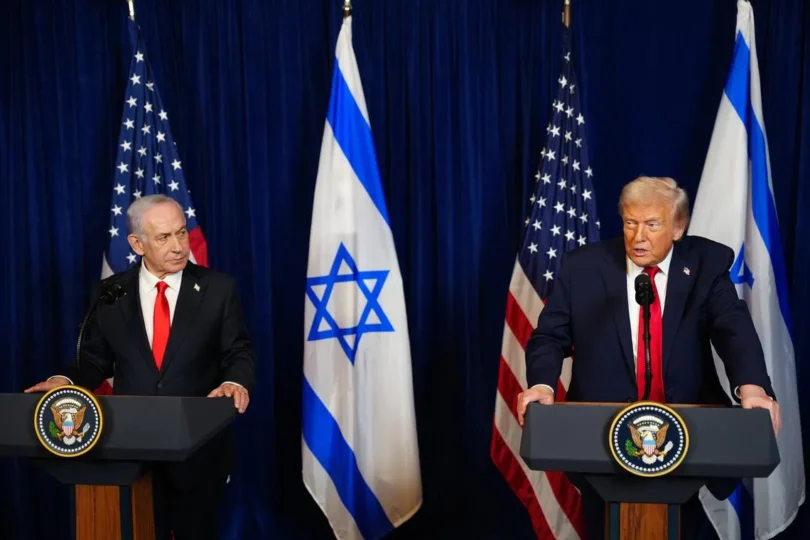
Israel’s Prime Minister Benjamin Netanyahu underscored the importance of maintaining close ties with the United States on June 18, saying Washington had stood by its ally during the Middle East war.
“The struggle is not yet over, and further challenges lie ahead. They require calm judgement, steadfast defence of Israel’s security interests, and at the same time the preservation of our vital relationship with our American friends, who stood shoulder to shoulder with us in this fight – a partnership we deeply appreciate,” Netanyahu said at a function, according to a statement issued by his office.
Netanyahu has still not commented directly on the deal, though some of his coalition members dismissed it even before the text’s details were released on June 17.
READ MORE HERE
PHOTO: REUTERS
The US-Iran agreement — the first signed by an American and an Iranian president since Iran’s 1979 Islamic Revolution — is being hailed by its backers as the deal of the century.
But for Tehran’s adversaries across the Middle East — from Israel to Gulf states and factions in Lebanon — it looks more like the curse of the century: an accord that could leave Iran more secure, more legitimate and ultimately more influential.
US President Donald Trump and Iranian President Masoud Pezeshkian signed the interim deal on June 17, ending a three-month war. Trump chose to formalise it at Versailles, on the sidelines of the G7 summit — a setting widely seen as symbolic of the remaking of international order after conflict.
READ MORE HERE

PHOTO: REUTERS
Ukraine and Germany signed an agreement on anti-ballistic capabilities, President Volodymyr Zelensky said on June 18, calling on other Western allies to join the effort and deliver results by winter.
Speaking at a meeting of the Ukraine Defence Contact Group, known as the Ramstein group, Zelensky said Ukraine urgently needed long-range artillery and unmanned vehicles. He also asked to develop additional financial instruments to finance the Ukrainian army long-term.
“Russian ballistic missiles remain a problem, and we need an answer to that problem,” Zelensky said.
READ MORE HERE

PHOTO: REUTERS
The US Centers for Disease Control and Prevention said on June 18 it would make available US$107 million (S$138.09 million) in emergency funding to strengthen its domestic and international response to the Ebola outbreak in the Democratic Republic of Congo and Uganda.
The agency currently has 23 field staff supporting epidemiological investigations and the DRC health ministry, Dr. Satish Pillai, the incident manager for the CDC’s Ebola response, said in a briefing. There are over 125 CDC staff across the DRC and Uganda working on the response, he said.
A month after the World Health Organization declared an international emergency, the outbreak of the rare Bundibugyo strain has grown to 875 confirmed cases, including 202 deaths, with warnings mounting that it could become the worst Ebola outbreak on record — surpassing the 2014 to 2016 West Africa epidemic that killed more than 11,000 people.
READ MORE HERE

PHOTO: REUTERS
South Africa scored a penalty seven minutes from fulltime as they fought back to draw 1-1 with the Czech Republic at the World Cup on June 18 after falling behind early in the Group A clash.
The result effectively left the two sides, who both lost their opening fixtures, likely requiring a win in their last group game to keep alive their hopes of reaching the knockout rounds.
Teboho Mokoena slotted home the late spotkick which gave South Africa a lifeline as they were staring at potential early elimination, after the Czechs had led from the sixth minute through Michal Sadilek.
READ MORE HERE