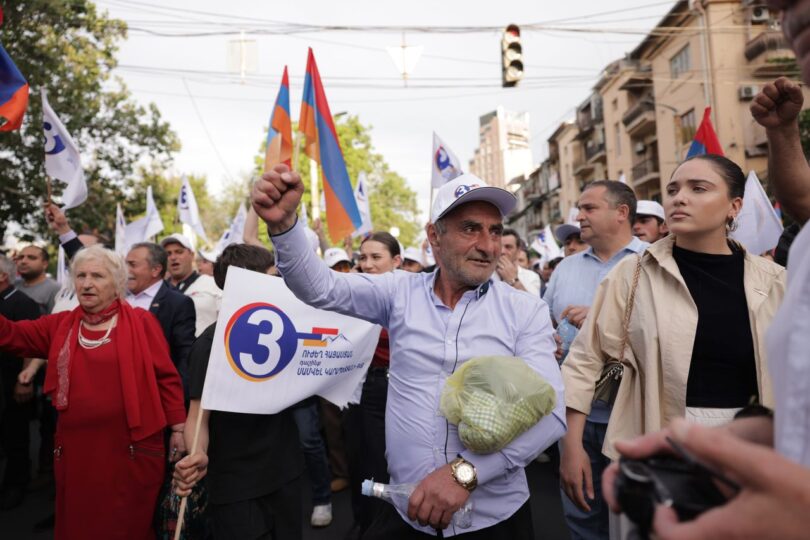
Armenia, a former Soviet republic, has long been one of Russia’s closest allies in the Caucasus.
For decades, this relationship helped Moscow maintain its influence across the strategically important region.
However, that dynamic has gradually shifted in recent years as Yerevan has sought closer ties with the West.
Analysts view this weekend’s parliamentary election as a crucial test of Armenia’s geopolitical future. The vote pits incumbent Prime Minister Nikol Pashinyan’s pro-Western Civil Contract party against a range of opposition forces that favour maintaining closer relations with Moscow.
Polls indicate that Pashinyan remains the frontrunner. The Armenian leader has increasingly signalled his intention to deepen ties with Western institutions, most recently by hosting an EU summit in Yerevan. The EU and the Trump administration publicly endorsed Pashinyan against his opponents with pro-Russia positions.
However, Russia has shown growing discomfort with Armenia’s evolving foreign policy orientation.
Days before the election, Moscow recalled its ambassador to Yerevan for consultations following the European gathering, a move widely interpreted as a sign of disapproval.
“The recalling of the ambassador from Yerevan is one of many moves that are designed to signal Moscow’s desire to put pressure on the Pashinyan government and boost the morale of his opposition on the eve of the parliamentary election,” Giorgi Badridze, an expert on Caucasian politics, tells TRT World.
“This election will serve as a referendum for the course charted by PM Pashinyan and his team – away from the unilateral dependence on Russia, toward the normalisation with its neighbours Azerbaijan and Türkiye, and the approximation with the Western political and economic structures.”
In recent years, Pashinyan has sought to reduce Armenia’s dependence on Moscow, including by suspending the country’s participation in the Collective Security Treaty Organization (CSTO), the Russia-led security bloc that spans parts of Eurasia.
At the same time, he has pursued efforts to normalise relations with Armenia’s neighbours, Azerbaijan and Türkiye. That policy has included attempts to bring a lasting end to the conflict with Baku over the Karabakh region, which has fuelled several wars between the two South Caucasus states since the 1990s.
“I knew they would call me a traitor, a land-giver, everything. But today I am very glad I found that strength, stood up, faced the truth, and brought Armenia out of the trap,” Pashinyan said, referring to his government’s recognition of Karabakh region under Azerbaijani sovereignty despite opposition parties’ fierce criticism.
Russia vs the West
Opposition parties with close ties to Russia have criticised both Pashinyan’s decision to suspend Armenia’s participation in the CSTO and his efforts to swiftly normalise relations with Türkiye and Azerbaijan.
The Armenian leader has framed reconciliation with the two neighbouring Turkic states as part of a broader peace agenda, arguing that it could help unlock economic opportunities for the landlocked country, including access to European markets through the proposed international Zangezur Corridor.
Despite the opposition’s criticism, analysts say many Armenians believe Russia failed to provide sufficient support to Yerevan during the Second Karabakh War, particularly when compared with Moscow’s backing during the first conflict in the 1990s.
That perception, combined with economic considerations, has helped generate support for Pashinyan’s pro-peace agenda.
Due to this perception, a significant portion of the Armenian population does not see “any rationale for maintaining their traditional dependence” on Russia, Badridze, a former Georgian ambassador to the UK, says.
“For Moscow, this means the loss not only of Armenia as an ally (in reality, a vassal) but also of its influence across the entire South Caucasus.”
Joshua Kucera, a senior analyst on the South Caucasus at the International Crisis Group, also assesses that the post-Second Karabakh environment was a watershed moment for Armenia-Russia ties.
“This led Armenia to start to try to reduce its longtime dependence on Russia and to diversify its relations with other partners. The most controversial of these other partners, from Moscow’s point of view, are European countries and the US,” Kucera tells TRT World.
Following Yerevan’s hosting of the EU summit early this month, Moscow imposed broad restrictions on imports from Armenia, affecting products ranging from fruits and vegetables to fish, mineral water, wine, brandy and flowers.
Russia remains a crucial economic partner for Armenia, accounting for roughly a third of the country’s exports.
Moscow also supplies more than 80 percent of Armenia’s gas imports at discounted prices.
As tensions have grown over Yerevan’s closer ties with the West, Russia has warned that those energy arrangements could be reconsidered, raising concerns about the potential economic consequences for Armenia.
“The immediate cause of Russia’s recent threats and actions, including the recall of the ambassador, was the summits of the European Political Community (EPC) and EU in Yerevan.
“Also, Russia is trying to send a message to Armenian voters ahead of the election that breaking ties with Russia would come at a cost,” Kucera says.