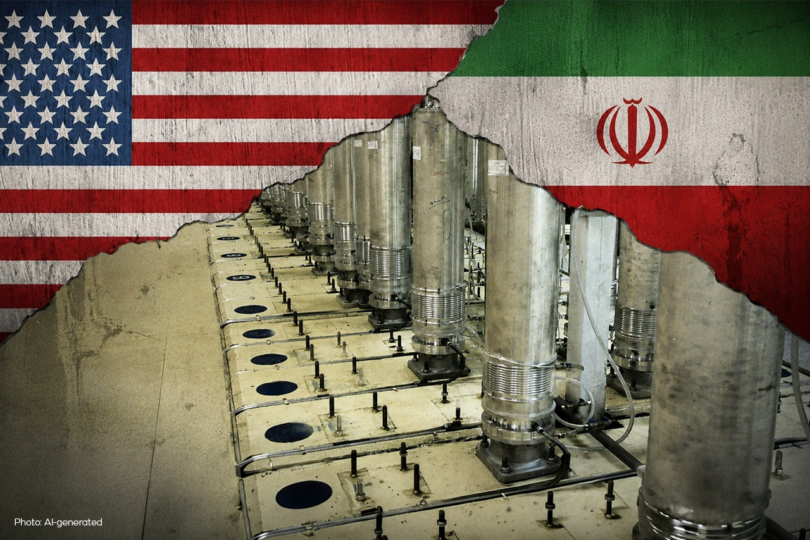
The joint US-Israeli strikes during the 12-day war in June last year, and the subsequent tensions, were claimed to have severely damaged Iran’s nuclear infrastructure and depleted significant portions of its enriched uranium stockpile.
Yet despite repeated assertions by the Trump administration that Iran’s nuclear programme has effectively been dismantled, ongoing negotiations between Washington and Tehran continue to centre on a central question: the future of Iran’s enriched uranium.
For months, Washington insisted that any agreement must include zero enrichment, a position President Donald Trump repeatedly reiterated. Tehran, however, has consistently rejected that demand.
According to experts, the focus of the talks has now shifted toward reducing and managing Iran’s uranium enrichment program in accordance with the memorandum of understanding (MoU) signed by both sides.
An agreement on Tehran’s enrichment programme, which has reached 60 percent purity, just a technical step below weapons-grade levels, remains possible, though far from guaranteed, says Oral Toga, a researcher at the Ankara-based Centre for Iranian Studies.
A weapon-grade nuclear material typically requires enrichment levels of around 90 percent. According to estimates by the International Atomic Energy Agency, Iran possessed at least 440 kilograms of uranium enriched to 60 percent before the US-Israeli strikes in June.
Even after the attacks, IAEA chief Rafael Grossi has said that “a bit more than 200 kg” of the 60 percent stockpile likely survived within Isfahan’s tunnel complex.
Related
The IAEA also estimates that Tehran held around 184 kilograms of uranium enriched to 20 percent purity and more than 6,000 kilograms enriched to five percent.
Taken together, Iran’s stockpile contains enough nuclear material that, if further enriched to weapons-grade levels, could theoretically be used to produce at least 23 nuclear weapons, according to the agency’s calculations.
“The June 17 Islamabad MoU already built the architecture for one, with a 60-day window to negotiate the final terms and a clause committing both sides to resolve the fate of the enriched stockpile through on-site downblending under International Atomic Energy Agency (IAEA) supervision as the baseline method,” Toga tells TRT World.
Under such an arrangement, Iran’s nuclear material would remain within the country, while IAEA inspectors would monitor and verify the downblending process, which would reduce enrichment levels to those deemed acceptable under a future agreement.
However, Toga notes that a significant gap remains between the memorandum itself, which envisions dilution rather than destruction of Iran’s enriched uranium, and what he describes as Washington’s continued “public maximalism” regarding the future of the program.
“The question is less whether a deal is technically reachable, since the dilution compromise already exists on paper, and more whether the US will honor what it signed or keep treating the memorandum, as Trump has, as merely an option it can discard,” he says.
“A framework on the stockpile is moderately likely; a deal that also ends enrichment outright is not.”
What will happen to Iran’s uranium?
Trump has previously asserted that Iran would deliver its uranium to the US, accepting its destruction.
“We will get it. We don’t need it, we don’t want it. We’ll probably destroy it after we get it, but we’re not going to let them have it,” he said.
But according to Toga, there is little chance that Tehran will agree to hand over a stockpile that has become increasingly intertwined with questions of national security, sovereignty, and political prestige within the Iranian establishment.
Iran is unlikely to give up its enriched uranium “in the sense Washington’s rhetoric demands, meaning physical surrender” to a third country or outright destruction, says Toga.
A May directive reportedly attributed to Supreme Leader Mojtaba Khamenei stated that the stockpile must not leave the country under any circumstances.
“The Supreme Leader’s directive, and the consensus within the establishment, is that the stockpile of enriched uranium should not leave the country,” an anonymous Iranian source told Reuters in May.
Instead, Tehran has indicated that it could accept downblending.
“What Iran has signaled it can accept is dilution. Even before the February strikes, Tehran had already offered during informal talks to downblend its 60 percent material to reactor grade,” says Toga.