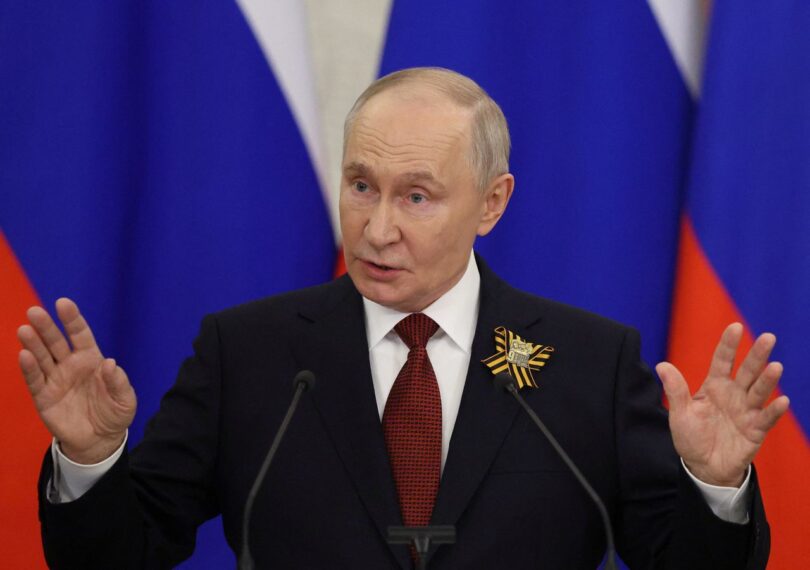
In 2025, Moscow rejected Trump’s proposal for a trilateral meeting of the US, Russian and Ukrainian leaders — a format Putin is now openly suggesting as a possibility.
“It’s not clear why Vladimir Putin is saying this at this particular time. No official explanation has come to clarify his statement yet,” says Sergei Markov, a former advisor to Putin and a leading Russian academic, highlighting the surprise within Russian political circles.
While Putin does not trust the West, Markov suggests the Russian leader may be signalling goodwill.
“Maybe with his recent statement, Putin wants to show that peace is possible from the Russian perspective, but if Ukraine escalates and Europeans support this, the continuation of the war can not be blamed on Moscow,” Markov tells TRT World.
Could peace finally come?
Before Putin’s ceasefire announcement, Ukrainian President Volodymyr Zelenskyy also proposed his own ceasefire on May 6, signalling that both sides are not only engaged in military confrontation but also in a parallel race of diplomatic gestures aimed at shaping perceptions of who holds the initiative, either in war or in peace.
Despite Putin’s rare peace signalling, experts remain cautious about the prospect of a near-term end to the conflict.
Beyond deep mutual mistrust, Markov suggests that European states may be preparing to target Russia’s so-called shadow fleet, which transports sanctioned oil exports. He also argues that Ukraine could be planning new waves of drone strikes against Russian territory, potentially launched from Baltic and Polish-linked routes.
Amid ongoing Russia–Europe tensions, the Financial Times reported last week that Brussels is considering renewed contacts with Putin, a possibility also being communicated to Kiev raising the prospect that Moscow and EU leadership could still find a negotiating channel.
Putin, meanwhile, has pointed to former German Chancellor Gerhard Schroder as a possible intermediary capable of engaging directly with him.
By suggesting Schroder as the European negotiator, Putin aims to secure “a more amiable counterpart at the table,” according to Martins, who says EU leaders such as Ursula von der Leyen, European Commission President, and Kaja Kallas, Brussels’s top diplomat, are “too ideologically anti-Russia-driven to cut any possible deal.”
However, Martins argues that Brussels could still be drawn into Ukraine-related negotiations, noting that Putin’s reference to Schroder and the negative immediate reactions it triggered in Europe suggest the EU risks being sidelined from any eventual peace framework.
Other analysts are similarly sceptical about the EU’s potential role as a mediator.
“I don’t believe Europeans will be great mediators. Within Europe itself, there are strong proponents of an aggressive policy towards Russia, and they continue to advocate for this. Currently, there is no European leader from a ‘strong country’ who advocates for or actually implements measures to ease tensions with Russia,” Cabanas says.
As Cabanas notes, there is no unified European approach to Russia. While countries such as Belgium and France argue that Europe should either open a channel with the Kremlin or secure a seat at any US–Russia peace talks, others continue to advocate a harder line against Moscow.
“Europeans can not be mediators because they are alongside Ukraine, but they can be participants in peace talks,” Markov says. But he doubts the EU can reach a durable agreement with Russia, especially as Trump’s US distances itself from Europe, which in turn is pushing to heavily arm Ukraine as a long-term military buffer against Moscow.
What is the best scenario?
The grinding war, marked by heavy human casualties and rising economic costs, has produced what many analysts describe as an effective stalemate across multiple fronts, from the Black Sea to eastern Ukraine, with no clear short-term victory for either side.
“It is difficult to say, but as of today the most probable scenario seems to be a lose-lose situation for both sides, with Russia being a lesser loser since it would most likely keep de facto control over some parts of de jure Ukrainian territories,” says Kolesnyk.
However, he argues that such an outcome would not resolve the conflict, but instead risk freezing it temporarily and laying the groundwork for renewed hostilities in the future. “It could be months or years before a new war between Russia and Ukraine starts without NATO membership for Ukraine,” he predicts.
“By all means, any ceasefire would only freeze and postpone the conflict, while a peace treaty that would provide Russia with de jure control over parts of Ukrainian territories would mark the end of an already dying world order and, therefore, dangerous for European security.”
Yet even a formal Russian acquisition of legal control over some occupied territories may fall short of what parts of the Russian establishment consider acceptable.
Markov, a former Putin adviser, is among those arguing that the Kremlin has not achieved its core objectives in Ukraine, citing the continued presence of Russian-speaking populations under Kiev’s control, Ukraine’s ongoing military capacity, and its unresolved orientation towards Western institutions such as NATO and the EU.
He also argues that this situation ‘compromises Russian security’. In addition, he notes that Russia has not secured full control over the annexed territories, including Donetsk, Kherson and Zaporizhzhia.
From this perspective, Markov suggests that the most viable end-state would be political normalisation between Kiev and Moscow, resembling the period before 2014, with Ukraine maintaining friendly relations with Russia and abandoning any prospect of joining NATO or other Western alliances.
But even in this scenario, he argues, annexed territories would still remain under Russian control. As long as Kiev were under a government with a similar philosophy to Zelenskyy, Moscow would reject any settlement that leaves key Black Sea regions, including Odessa and other strategically important areas like Kharkiv with large Russian-speaking populations, under the Ukrainian leadership, he adds.