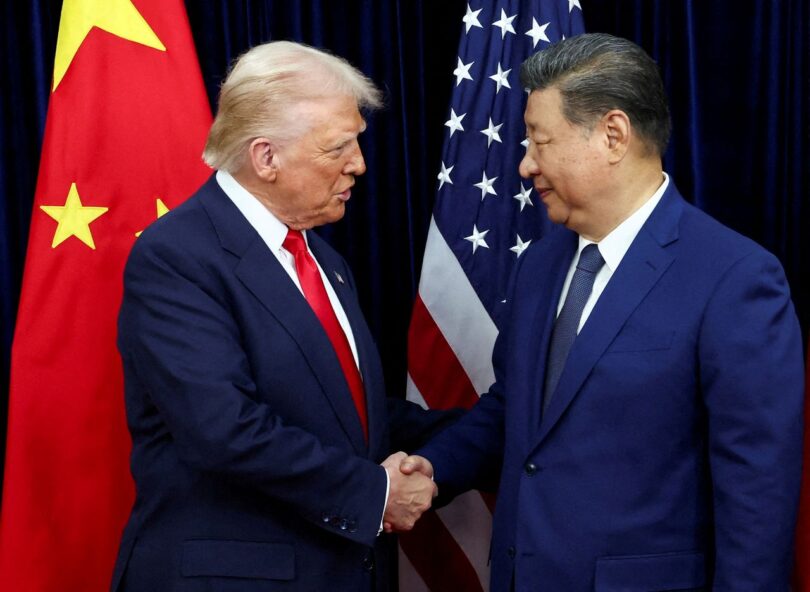
President Donald Trump is reportedly racing to settle the war with Iran before his May 14-15 summit with Chinese President Xi Jinping in Beijing.
That is because he views the ongoing Iran war as a threat to the negotiating leverage of the US on issues like trade, tariffs, and rare earths, experts say.
Originally planned for March but postponed because of the Iran war that began on February 28, the summit will be a test of the US’s negotiating strength at a moment when price shocks from the blockade of the Strait of Hormuz – a narrow waterway that Iran and Gulf nations use to ship out the bulk of their energy exports – have disrupted global markets.
Murat Oztuna, a China analyst at the Ankara-based Centre for Middle Eastern Studies (ORSAM), tells TRT World that Trump’s motivation to settle the war before May 15 reflects a “macroeconomic necessity”, not a choice.
“Trump’s desire to ‘contain’ the war with Iran before his summit with Xi Jinping in Beijing is based on strong strategic and numerical foundations,” he says.
The containment objective is rooted in his desire to control the summit agenda, manage domestic political pressure, and ensure flexibility in negotiation, he says.
“As the war continues, the US becomes the weaker party, not militarily, but in terms of economic and political leverage. The summit becomes a more reactive platform producing more limited results,” he says.
Far from being merely a security issue, the on-again, off-again Iran war has become a global economic shock transmitted through energy prices, inflation, and supply chain bottlenecks.
The energy dimension is the most concrete indicator of Trump’s macroeconomic necessity to settle the war, Oztuna says.
Roughly 20 percent of global oil supply passes through the Strait of Hormuz. As a result, the war has caused a loss of more than 10 million barrels of oil per day, driving oil prices to a four-year high.
According to the World Bank, energy prices are projected to rise by 24 percent in 2026, the highest increase since 2022 when the Russia-Ukraine war started.
At the same time, global economic growth is expected to slow down to 2.5 percent in 2026, down from 3.2 percent a year ago.
These pressures are already visible in the US, where fuel prices have increased roughly 50 percent, pushing inflation above four percent, which is twice the Federal Reserve’s target.
Oztuna warns that a continuing war will erode US leverage in talks with China in four distinct ways.
One, high energy prices and inflationary pressures will make Washington reluctant to threaten or impose new tariffs on China – a negotiation tool that Trump has used rather freely to keep friends and foes in line since coming to power last year.
Two, the ongoing war will shift the summit’s agenda from trade and strategic competition to energy security and crisis management, turning the US into a “reactive crisis manager” rather than an agenda-setter, he says.
Related
Three, a sustained focus on the Gulf region will make it difficult for Washington to harden its position on Taiwan, which will give Beijing a “timing advantage”.
Taiwan is an island state that China says is part of its territory, but Taipei rejects this claim. Even though the US has no formal ties with Taiwan, Washington is its biggest international backer and arms supplier.
China apparently wants Trump to change the US language to “we oppose Taiwan independence”, from the current one-China policy that takes no position on the island state’s sovereignty.
Four, in a world of strained global supply chains, China’s dominance in rare earth elements will become even more effective leverage, Oztuna says.
Rare earth elements have gained centrality in global supply chains as they power permanent magnets – metals that generate a magnetic field without electricity, thus making electric motors and precision weapons more efficient.
“As the conflict continues, China can include the Iran issue in the same bargaining package as trade, technology, and security issues. The US, in turn, is forced to demand at least ‘non-obstruction’ or limited cooperation from China on the Iran issue,” he says.
“This makes it more difficult for Washington to harden its stance in other areas,” Oztuna adds.
What does Xi want?