
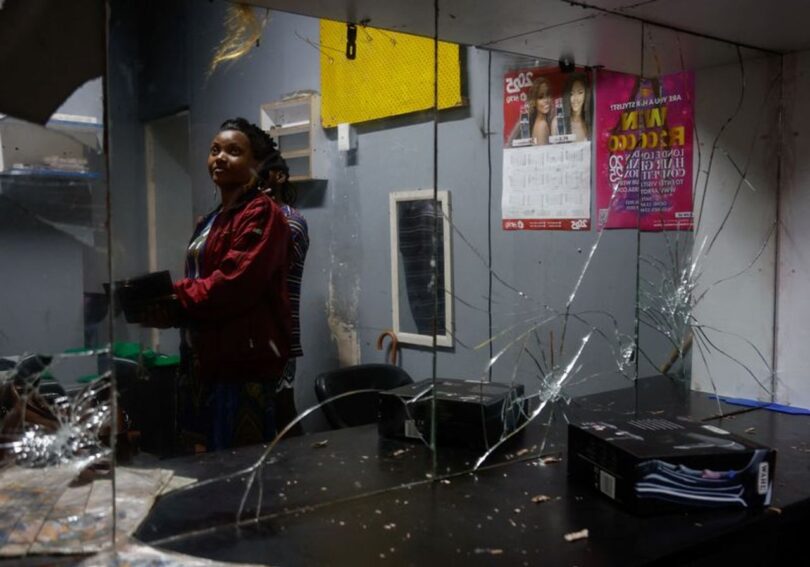
According to Phiri, anger visible in many communities does not arise in isolation. It is often shaped by political narratives that redirect frustration from government failures to vulnerable groups.
“There is a toxic electioneering that is happening,” he says.
Some political parties, he argues, have actively courted anti-migrant groups because hostility towards foreigners can translate into votes.
“If you create hate among the people and promise them a better life when foreigners leave, people will support you.”
He argues that anti-foreigner mobilisation has become a recurring feature of South Africa’s political landscape during election periods.
According to him, many participants are expressing genuine frustrations about unemployment, poverty and declining economic opportunities. Election periods provide an opportunity for these grievances to be amplified.
Phiri specifically highlights the relationship between anti-immigration activists and political organisations, arguing that politicians sometimes benefit from rhetoric that blames foreigners for broader social and economic problems.
Beyond xenophobia
Despite the violence and hostility migrants face, Phiri cautions against reducing the crisis to xenophobia alone.
“You cannot explain xenophobic or Afrophobic attitudes away,” he says. “But at the end of the day, you realise that we are fighting for the crumbs.”
His argument is that both migrants and poor South Africans are victims of wider structural failures.
“South Africans are feeling the heat of the failure of the post-colonial state,” he says.
In his view, the economic and political systems inherited after independence have failed to adequately address inequality, unemployment and exclusion.
As a result, ordinary Africans increasingly compete for limited opportunities.
“We are fighting as victims,” Phiri says.
“You and I are civil with each other now because we have eaten. But if we are brought together in the same room for one week, starved, and then someone throws in a piece of bread, what will happen?
“The problem is not that we hate each other, but someone has created a situation in which we become so desperate that we end up fighting,” he explains.
For Boakye, the hairstylist, the answer lies in greater unity across the continent.
“I really like to open our borders,” he says. “No borders for Africans. No hatred toward each other. Let’s be one Africa and do everything together.”
It is a vision that resonates with Phiri’s Pan-African outlook.
“The discourses that we have so far are discourses of separation rather than unity,” he says.
Rather than condemning South Africa outright, he believes Africans should seek to understand the country’s challenges and engage in honest dialogue about shared problems.
“We are children of the same mother,” he says, “who happen not to like each other—or who are competing with each other.”
He also notes that many South Africans actively oppose anti-migrant actions. Grassroots organisations and activists have mobilised against xenophobia and in support of migrants.
“The general South African public is not xenophobic,” he says. “There are also groups that are rising up against these actions.”
For now, Boakye is safe at home in Ghana. Yet the questions his experience raises remain unresolved.
Will future election cycles trigger another wave of anti-foreigner mobilisation? Can governments address the economic frustrations fuelling public anger? And can Africans find ways to build solidarity rather than division?
Phiri remains cautious. Following the latest demonstrations, he predicts, “things will be the same as they were before.”
Still, he believes the crisis offers an opportunity for reflection.
“We have all the answers to our problems,” he says. “The problem is implementation and political will.”
For him, the challenge facing Africa is not merely how to manage migration. It is how to build societies that offer dignity, opportunity and inclusion for all.
Until then, migrants like Boakye—and struggling citizens across the continent—will continue to bear the human cost of failures far beyond their control.
This article was first published on TRT Afrika.