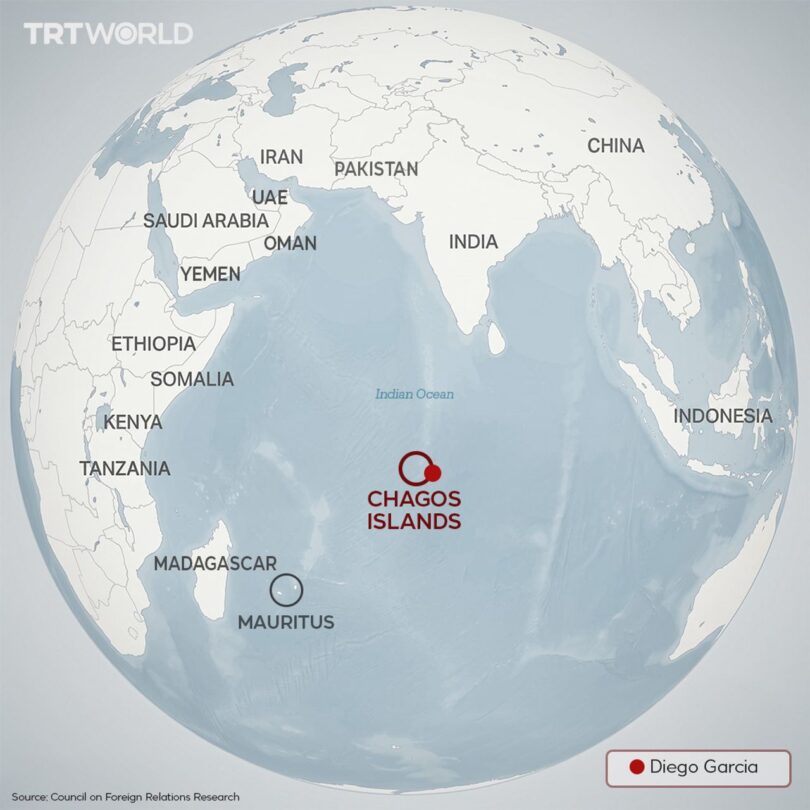
The Chagos Islands, located in the middle of the Indian Ocean, far from both East Africa and South Asia, have attracted renewed global attention since reports emerged that the Diego Garcia military base was struck by Iranian missiles in late March.
The Diego Garcia base, which hosts significant military assets ranging from B-52 bombers and KC-135 tankers to reconnaissance aircraft, transport planes and radar installations, has been jointly operated by the UK and the US since the 1960s and serves as a key hub for regional military operations.
Following the alleged attack, which Iran denied carrying out and instead described as a false-flag operation, President Donald Trump’s interest in acquiring the Chagos Islands appears to have intensified despite Britain’s recent plans to transfer sovereignty of the archipelago to Mauritius.
“President Trump has been consistent in his position that the United Kingdom should not give away the British Indian Ocean Territory, which includes our joint US-UK military facility on the Diego Garcia atoll,” a US official recently told Reuters.
The Chagos Islands were designated the British Indian Ocean Territory in 1965, following separation from Mauritius, then a British colony.
The move came amid secret US-UK negotiations to establish military facilities on Diego Garcia during the Cold War, a process that led to the forced removal of much of the native population from the islands.
In recent years, Mauritius has sought the return of the Chagos Islands, arguing that the archipelago remains part of its territory under international law.
The United Nations and many members of the displaced Chagossian community have backed Mauritius’s claim, further complicating Trump’s desire to acquire the strategically important island chain.
Like Greenland, which remains under Danish sovereignty, the Chagos Islands have a complex legal status rooted in British colonial rule. Britain created the British Indian Ocean Territory by separating the islands from Mauritius, a move intended to facilitate US military access to the Indian Ocean via the Diego Garcia base.
Related
“The US could technically purchase them – but only if Mauritius were to agree. Britain cannot sell the islands to the US because everyone knows that London isn’t the lawful owner,” Peter Harris, an associate professor of political science at Colorado State University, tells TRT World.
“So the UK and US would first have to acknowledge Mauritian sovereignty, and then Mauritius could sell the islands (or just Diego Garcia) to the US. It would have to be done via a treaty between the US and Mauritius.
“It is important to emphasise, though, that there is no indication yet that Mauritius would be interested in selling,” Harris says.
The Chagossian diaspora remains divided on whether the islands should remain under British control or be returned to Mauritius. Most Chagossians live in Mauritius, with smaller communities in Seychelles and the UK.
“Most of them located in Mauritius support Mauritian sovereignty because it would be a gateway to them resettling the islands. I’m not aware of any Chagossians who support US sovereignty of their islands,” Harris says.
Harris also points out that, from a cost-benefit perspective, purchasing the islands may not be an attractive option for Washington.
Such a move could cost US taxpayers billions, he says, while Britain’s sovereignty transfer agreement with Mauritius already secures London continued access to Diego Garcia through a 99-year lease arrangement.
Under the plan, the UK would lease Diego Garcia from Mauritius while continuing to allow US military operations at the base. Britain would pay Mauritius for the lease, while the US would retain access to the facility.