PARIS – The US attempt to pressure Iran into a quick deal by halting traffic to its Persian Gulf ports may ultimately fail, experts said, because the country systematically stockpiles spare parts, industrial components, imported necessities, food and fuel.
Hardened by decades of sanctions, Iran’s economy is built to endure tremendous stresses.
Its most crucial ports may now be blocked, but Iran has other routes, including ports in the Caspian Sea and land routes at borders with Azerbaijan, Armenia, Turkey, Iraq, Pakistan, Afghanistan and Turkmenistan.
“Iranian companies got pretty good at finding multiple supply chains with multiple layers of redundancy so that if one route broke down, they could shift to another one,” said Mr Esfandyar Batmanghelidj, founder and chief executive of the Bourse & Bazaar Foundation, a think-tank that analyses Iran’s economy.
“Unlike companies in Europe or the US, Iranian firms began to maintain larger inventories of the parts and materials that they need.”
More acutely for Iran, with its main oil export sea routes blocked, its oil storage facilities will fill up in three weeks, forcing it to make the tough decision on whether to accede to US demands or shut down oil wells that will later be costly to repressurise and resurrect to their previous output.
Granted, the ongoing US blockade on Iranian ships in and out of the Persian Gulf could eventually strangle the country’s economy, with experts saying this could happen within months.
And when that happens, it could further drag the country’s struggling merchants and middle classes into poverty and spark political unrest.
But even then, the regime may refuse to yield.
“If the blockade continues, Iran will feel real pressure, especially on revenues and currency stability,” said Mr Sina Toossi, senior fellow at the Center for International Policy, a Washington think-tank. “But Tehran has spent years preparing for this scenario, with oil at sea, alternative channels and reduced dependence on vulnerable financial routes.”
He added: “Iran believes it can absorb the pressure longer than the US and its partners can absorb the global economic fallout.”
As at 2026, the US has imposed a total of 1,200 sanctions on Iran, according to a study by Columbia University’s School for International and Public Affairs.
An assumption among many Western policymakers and lawmakers is that the Iranian regime is inordinately dependent on oil revenues for its survival. Cut off oil sales, and Iran’s economy could collapse in three months.
But experts say this is flawed, and premised on an outdated, monochromatic view of Iran’s economy.
While oil makes up between half and two-thirds of Iran’s export revenues, its isolation prompted it years ago to begin investing in other industries, including steelworks that were the largest in the Middle East until they were repeatedly bombed in the recent air strikes.
The country of 93 million has a significant consumer products market, and also exports everything from sweets to water-powered air-conditioning units to neighbouring countries, especially Iraq and Turkey.
“There’s a large domestic market, industrial base, and non-oil exports including petrochemicals, metals and regional trade,” said Mr Toossi. “Sanctions have forced a degree of economic adaptation.”
Frequent supply chain disruptions have prompted Iranian businesses to typically stockpile up to three months’ worth of supplies, raw materials and components in case a vendor abroad cuts them off over sanctions.
But Mr Batmanghelidj said Iran’s robust domestic markets depend on imports of raw materials, spare parts and specialised components arriving at Persian Gulf ports, as Iran’s ports in the Gulf of Oman – where there appears to still be shipping activity – cannot handle the container ships that such goods arrive in.
Iran also has a US$2 billion (S$2.5 billion) pipeline from its oil regions in the south-west to the port of Jask, along the country’s Gulf of Oman coast, which it could potentially launch for oil exports.
None of Iran’s measures, however, makes it immune to economic pressure, especially under strain caused by extensive war damage. Iranian officials have estimated that weeks of US and Israeli bombing have caused US$300 billion in damage.
“The damage is significant, especially to energy, transport and urban infrastructure,” Mr Toossi said.
China, Iran’s primary international patron and oil customer, has been pressuring the country to agree to a deal with Washington, worried that Tehran has bitten off more than it can chew, especially if US President Donald Trump makes good on his threat to cripple the country’s civilian infrastructure by further targeting its energy infrastructure.
“The Chinese perception is that Iran is not able to fight or resist long in such a war, and it has to find an off-ramp as much as the US is trying to find an off-ramp,” said Dr Ahmed Aboudouh, an expert on China’s relationship with the Middle East at Chatham House and the Emirates Policy Center.
“They are telling the Iranians behind closed doors, ‘We are doing this for your own good and for your own interests and security because you don’t have a chance’.”
Asked about the impact of the US blockade, Mr Abbas, a 40-something businessman in Tehran, reached via a virtual private network, said: “The average person hasn’t felt it yet… However, loads of people are losing their jobs. That’s the scary part. Every major online enterprise is getting rid of 5 per cent to 15 per cent of its workforce at least. Yes, people are worried about the blockade to some extent.”
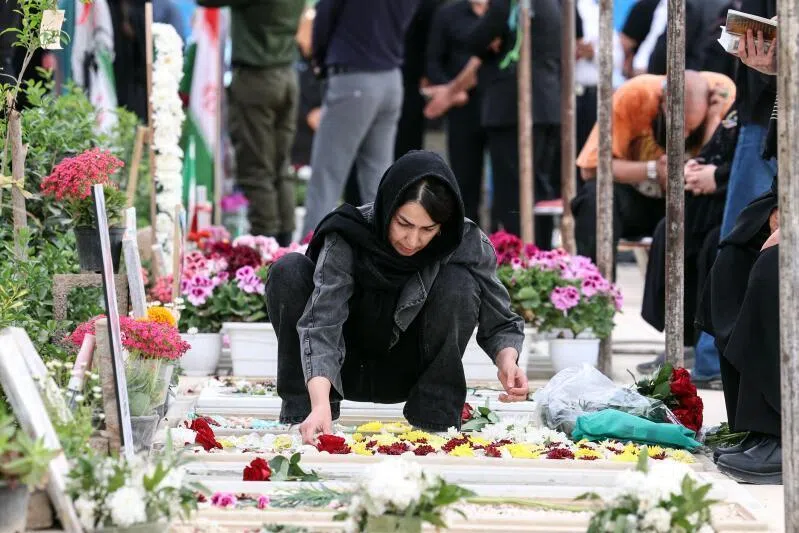
Economic pain as a result of the war has already begun to impact Iranians, who are facing runaway inflation, economic stagnation and a government-imposed internet shutdown. Digikala, an online shopping platform equivalent of Iran’s Amazon, has laid off a significant chunk of its staff.
“Economic pressure can produce concessions when there’s a credible path to mutual gain, but not (pressure) on core interests,” said the Center for International Policy’s Mr Toossi.
“On what Tehran sees as essential to its security – its nuclear programme, key military means of deterrence, regional posture, and now leverage over Hormuz – pressure tends to harden positions, not soften them.”
The Iranian regime survived eight years of war and deprivation during the 1980s, as well as Mr Trump’s campaign of “maximum pressure” that began in 2018. Its experiences have shaped the belief that giving ground invites only more pressure.
Many Iranian hardliners are calling on the authorities to respond to the blockade with escalatory action. “Continuation of the siege is no different from bombardment and must be met with a military response,” wrote Mr Mahdi Mohammadi, an adviser to the Iranian Parliament, on a post on social media platform X. “The time for Iran to take the initiative has come.”
Analysts say Iran has rarely succumbed to threats or escalation, as opposed to inducements. “This notion that adding pressure on the economy is somehow conducive to better outcomes politically, or from a security standpoint, has been proven wrong over the past eight years,” said the Bourse & Bazaar Foundation’s Mr Batmanghelidj. “It’s exactly why we’re in this crisis.”