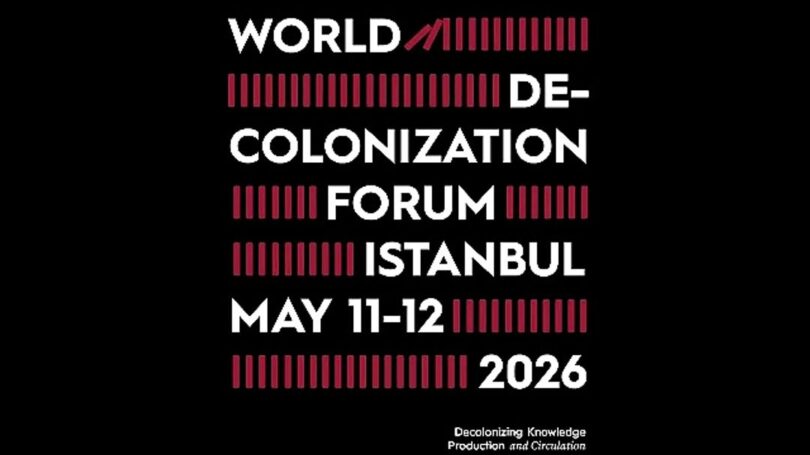
An international forum examining the legacy of colonialism and its impact on today’s global crises will bring together leading academics, journalists, and experts in Istanbul on May 11-12, according to organisers.
The World Decolonization Forum, organised by the Institute Social, will be held at the Ataturk Cultural Center, gathering participants to discuss the historical roots of contemporary global challenges and the enduring effects of colonialism, according to a statement from organisers.
Held under the theme “Decolonizing Knowledge Production and Circulation,” the forum will address issues including occupation policies, technological transformations, algorithmic and data colonialism, and inequalities in education and culture.
Experts will examine how colonial legacies continue to shape political, economic and social systems, the statement said.
Participants include decolonial theorist Walter Mignolo, international law expert Mireille Fanon, former French national footballer and anti-racism activist Lilian Thuram, China strategy expert Guo Changgang, psychiatrist and author Kemal Sayar, philosopher of physics Enis Doko, Middle East scholar Joseph Massad, historian Halil Berktay, and economist Ann Pettifor.
More equitable discussions will address colonial codes embedded in education, culture and academic systems.
Sessions will examine how colonial-era structures continue to influence contemporary crises across political, economic and social systems in a systematic way.
The first day will conclude with a concert by Tunisian singer-songwriter Emel Mathlouthi.
Organizers said the forum aims to challenge one-sided perspectives in academia, media and historiography, calling for more equitable systems of knowledge production that reflect diverse cultural contexts.
It will also explore structural inequalities in global knowledge systems, including language dominance, academic dependency and imbalances in international publishing.
The event will serve as a platform for interdisciplinary dialogue in fields such as law, media, economics and education, promoting collaborative and critical approaches to scholarship.
The forum is the first phase of a long-term, three-stage initiative running through 2030.