
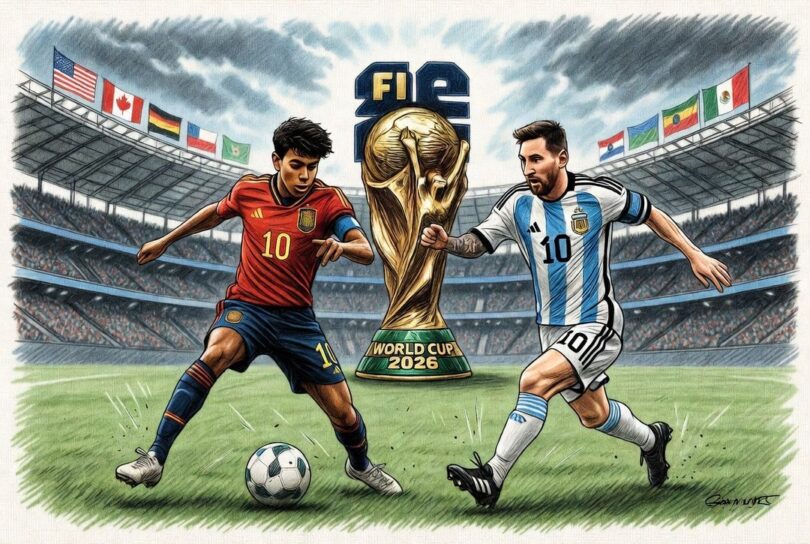
Washington, DC — Hearts pound and breaths catch in throats as the final countdown begins.
Spain and Argentina are just a day away from colliding in a blockbuster World Cup final at MetLife Stadium in New Jersey-New York, where one side will lift the trophy in glory and the other will be left with nothing but silver.
Spain cruised to the final after delivering a football masterclass against France — a powerhouse and one of the top favourites to win the tournament, defeating them 2-0.
Prior to the tournament, La Roja were TRT World’s top pick for favourites to win the World Cup.
Spain have been giving gradually convincing wins throughout the tournament after their first draw against Cape Verde, which mirrors their pathway in 2010 after their first game that ended in a draw. They ended up winning the trophy that year.
Argentina, avoiding one scare after another, crawled their way to the final at the back of yet another stunning late 2-1 comeback victory against England.
TRT World also identified Argentina as one of the top favourites to win the tournament.
However, in TRT World’s analysis, we highlighted that the Argentine squad is battle-tested enough to go far in the tournament and brushing them off would be a mistake.
As proven in the knockout stage, brushing them off was indeed a gigantic mistake for all teams, from newcomers Cape Verde, Africa’s most successful side Egypt, tactically disciplined Switzerland and powerhouse England.
All of them were minutes away from knocking out the defending champions, and all of them fell for the same mistake: letting their guard down in the dying embers.
Related
Spanish masterclass
Spain have primarily lined up in a 4-3-3, although it often morphs into a 3-2-5 in possession as one full-back moves into midfield and the other pushes high up the pitch.
Unlike most teams that have star players, the star player for Spain is the system itself, regardless of the names on the pitch, as they utilise multiple approaches that decrypt opponents’ every move through the tournament.
Possession first: Barcelona’s famous Tiki Taka heavily reflects on La Roja’s identity. Spain continue to dominate the ball, often enjoying 60-70 percent possession.
They patiently recycle play through midfield, waiting for defensive lines to open before accelerating attacks with quick one-touch passing.
Control through midfield: The midfield is the heartbeat of the team. Rather than forcing direct balls, Spain build from the goalkeeper and centre-backs, using short combinations to bypass the opposition’s press.
Their midfielders constantly rotate positions, making them difficult to mark and allowing Spain to dictate the tempo.
High pressing: When possession is lost, Spain immediately press to win it back within seconds. This aggressive counter-press often prevents opponents from launching counterattacks and keeps play confined to the opposition half.
Wide overloads: Spain use their full-backs and wingers to create numerical advantages on the flanks. Wingers frequently cut inside, opening space for overlapping full-backs to deliver crosses or low cutbacks into the penalty area.
Defensive discipline: Without the ball, Spain defend in a compact 4-1-4-1 or 4-5-1 shape. The distance between the defensive and midfield lines remains small, forcing opponents into difficult passes and limiting space between the lines.
Spain have kept the strongest defence in the tournament, having conceded only one goal against Belgium.
Speaking about the much-anticipated match, coach Luis de la Fuente says that Argentina deserve high praise and respect for reaching this far.
“Argentina are a great team with extraordinary players. They’re world champions for a reason. But we’re here because we’ve earned it too, and we’ll compete with our own football,” he promises.
For captain Rodri, Sunday’s match will be “quite different.”