
Alex Enumah in Abuja
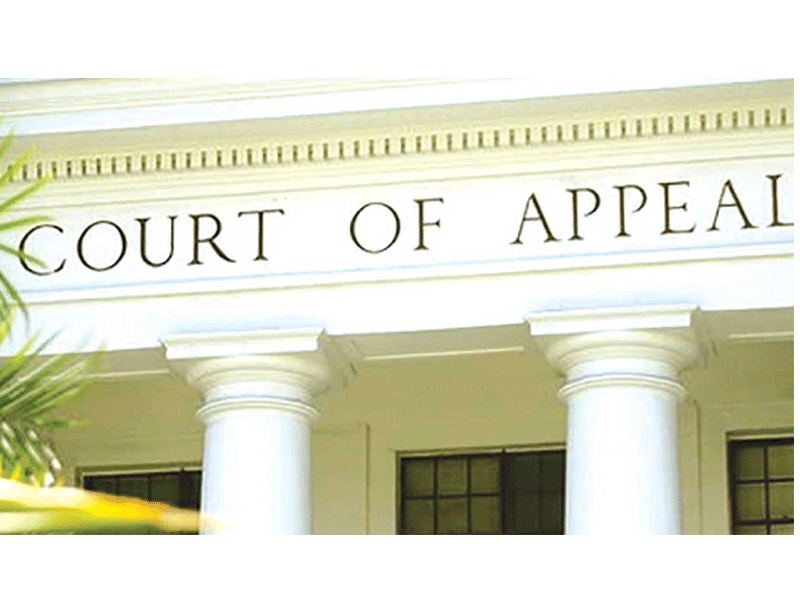
The Court of Appeal, Abuja, has upturned the judgment of a Federal High Court, Abuja, which nullified part of the election guidelines of the Independent National Electoral Commission (INEC) for the conduct of the 2027 general elections.
A three-member panel of the appellate court in a unanimous judgement held that the trial court was wrong in nullifying the guidelines which did not in any way violate the 1991 Constitution nor the Electoral Act.
Recall that Justice Mohammed Umar had in a judgement delivered on May 20, voided the Revised Timetable and Schedule of Activities of INEC, for the 2027 general election by a Federal High Court in Abuja, on the grounds among others that the time-frame “imposed” by INEC on political parties to submit their membership register, conduct primaries, and same names of candidates for the 2027 general elections, “is inconsistent with the provisions of the Electoral Act, 2026”.
Umar had voided the time-table while delivering judgement in the suit marked: FHC/ABJ/CS/517/2016, and filed by the Youth Party.
The plaintiff in the suit dated and filed on March 11, by its counsel, J. O. Olotu sought for several reliefs, including a declaration that upon a proper consideration and interpretation of the provisions of Sections 29, 82 and 84(1) of the Electoral Act, 2026, the powers of the INEC to receive notice of party primaries and the personal particulars of candidates, and its duty to attend, observe and monitor such primaries, does not extend to fixing or prescribing the timetable within which political parties may conduct their primary elections for the purpose of nominating candidates for the 2027 general elections.
Dissatisfied, the electoral umpire approached the appellate court to set aside the verdict of the trial court.
Delivering judgement on Monday, Justice Adebukola Banjoko, who delivered the lead judgement which was read by Justice Okon Abang, faulted the trial court for invalidating the administrative discretion of INEC.
While stating that, “The law gives INEC powers to conduct elections in the country”, the appellate court observed that, “There was no deposition or threat that the respondent was prevented from conducting its primaries”, adding that the respondent can only invoke the powers of the court where there are heavy threats to its participation in the election.
Justice Abang explained that where INEC acts within its power, the courts cannot get involved.
“The declarative reliefs granted by the trial court were wrongly granted and they are hereby set aside”, Abang declared.
Recall that INEC in its appeal dated May 25, 2026, and filed by its counsel, Alex Izinyon, prayed the court to set aside the judgement, claiming that the trial court erred in law when it failed to pronounce on the jurisdictional issue of the suit being hypothetic and academic, and a denial of fair hearing to the appellant.
The lawyer specifically stated that the lower court erred in law when it held: “It is clear from the wording of Sections 29(1), 82, and 84 of the Electoral Act, 2026, the following can be understood. Section 29(1) of the Electoral Act, 2026 mandates political parties to submit the names of candidates first in the prescribed forms of the candidates who emerged from its valid primaries, which such political party intends to sponsor at the elections, not later than 120 days before the date of the General election.
He said the judgement of the trial court is against the weight of evidence placed before it and therefore prayed the court for an order allowing the appeal and setting aside the Judgement delivered by the trial court.
He also prayed for an order of the court, striking out the suit as the respondent lacks the locus standi to institute and maintain the same, describing the suit as being academic.
In their unanimous judgement, the three-member panel agreed with the appellant that the Youth Party which instituted the case against INEC lacked legal power ( locus standi) to do what it did.
According to the appellate court the party did not explain how the Guidelines affected it and it’s members in the conduct of its primary election for the nomination of candidates for the 2027 poll.
The Court also held that the YP failed to establish how the Guidelines affected the submission of its nominated candidates to INEC.