By Aminu Abubakar
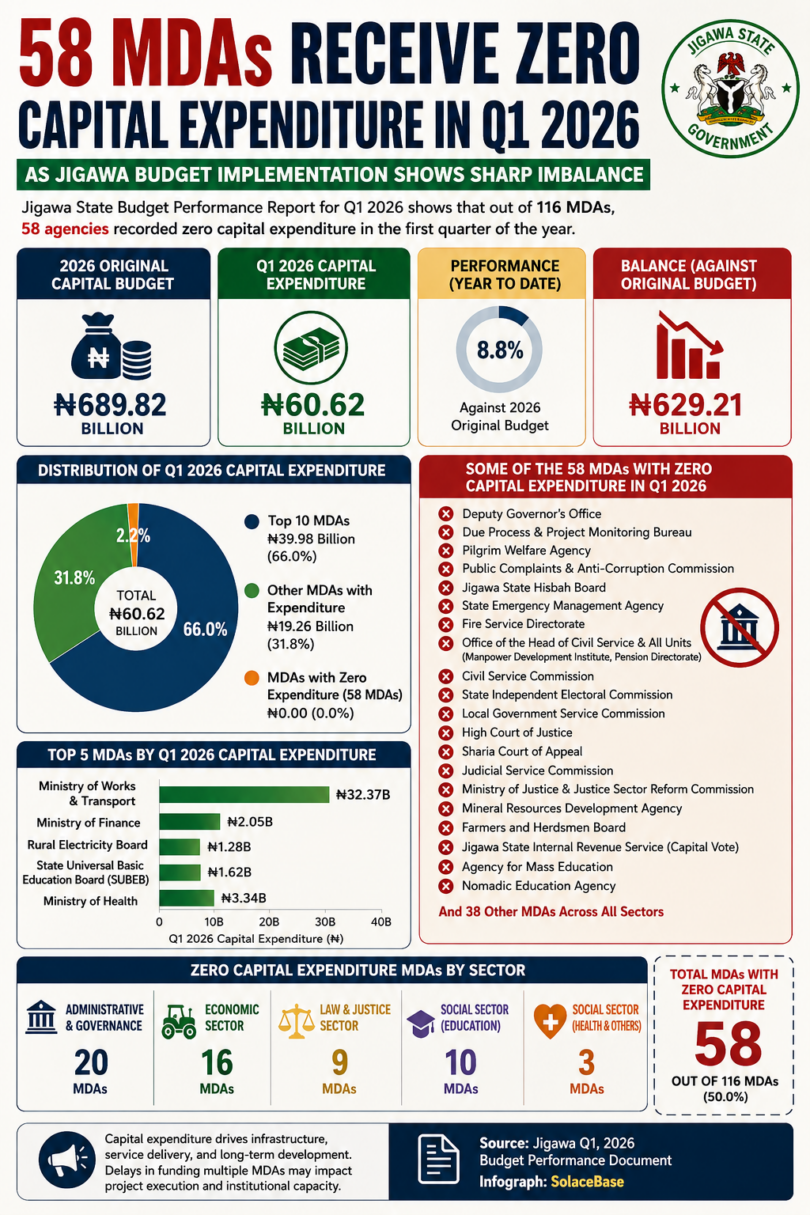
A total of 58 ministries, departments, agencies and other government institutions in Jigawa State recorded zero capital expenditure in the first quarter of 2026, according to the state’s official Budget Performance Report. The development highlights a significant imbalance in budget implementation across sectors, even as the state recorded over ₦60.6 billion in total capital expenditure during the same period.
The report shows that Jigawa State approved a total capital expenditure budget of about ₦689.8 billion for the 2026 fiscal year. Out of this, ₦60.6 billion was spent in the first quarter, representing 8.8 percent budget performance. While this indicates some level of early-year implementation, the distribution of the spending reveals that a large number of government institutions did not receive any capital releases at all within the period under review.
Capital expenditure refers to spending on infrastructure, equipment, construction projects and long-term development assets. It is the segment of the budget that directly impacts physical development and service delivery. Against this background, the absence of capital releases to 58 MDAs raises questions about project commencement, implementation capacity and prioritisation of development activities across government institutions.
The affected MDAs cut across administrative, governance, economic, justice, and social service sectors. Among them are the Deputy Governor’s Office, Due Process and Project Monitoring Bureau, Public Complaints and Anti-Corruption Commission, Pilgrim Welfare Agency, Jigawa State Hisbah Board, State Emergency Management Agency, Fire Service Directorate, Civil Service Commission, State Independent Electoral Commission, and Local Government Service Commission.
Read Also:Jigawa, Kano, Katsina top list of out-of-school children
Also included are several critical offices under the Office of the Secretary to the State Government, such as the administrative and finance directorate, research and political affairs directorate, and special services directorate. In addition, the Office of the Head of Civil Service and its related institutions, including the Manpower Development Institute and Directorate of Pension Administration, recorded no capital expenditure during the quarter.
In the accountability and oversight category, key institutions such as the Office of the State Auditor General, Audit Service Commission, and Civil Service Commission also recorded zero capital releases, with the exception of limited activity under local government audit functions. These institutions are central to financial oversight, administrative reforms and governance monitoring within the state.
The justice sector was also significantly affected. The High Court of Justice, Sharia Court of Appeal, Judicial Service Commission, Ministry of Justice, and Justice Sector Reform Commission all recorded no capital expenditure in the first quarter. This means no capital funding was released for infrastructure upgrades, facility expansion, or capital procurement within the judiciary and justice administration system during the period.
In the economic and revenue-generating sectors, several key agencies also recorded zero capital expenditure. These include the Ministry of Agriculture and Natural Resources, Jigawa Agricultural and Rural Development Authority, Farmers and Herdsmen Board, Mineral Resources Development Agency, and Jigawa State Internal Revenue Service capital vote. Other affected agencies include investment promotion bodies, industrial development institutions, and export processing structures.
The report also shows that emergency response institutions were not funded in capital terms during the quarter. Both the State Emergency Management Agency and the Fire Service Directorate recorded no capital releases, raising concerns about preparedness capacity and infrastructure development in emergency response systems.
Read Also:Audit Report exposes massive financial irregularities in Kebbi local governments
Within the governance and electoral administration framework, the State Independent Electoral Commission and Local Government Service Commission also recorded zero capital expenditure. These agencies play key roles in electoral processes and local government administration, and the absence of capital funding may affect institutional readiness and operational efficiency.
The education sector presents a mixed performance pattern. While major institutions such as the State Universal Basic Education Board, Sule Lamido University, Binyaminu Usman Polytechnic Hadejia, and the Ministry of Higher Education recorded capital expenditure, many supporting agencies did not receive any capital funding. These include the Agency for Mass Education, Nomadic Education Agency, Library Board, Islamic Education Bureau, Education Quality Assurance Agency, and several colleges and technical education institutions.
Similarly, in the health sector, although the Ministry of Health and the Primary Health Care Development Agency recorded capital expenditure, several institutions under the health education and training sub-sector, including the College of Nursing Science and College of Health Science and Technology Jahun, did not receive capital releases in Q1 2026.
The water resources sector also reflects uneven implementation. While agencies such as the State Water Board and Rural Water Supply and Sanitation Agency recorded capital expenditure, other units such as the Ministry of Water Resources headquarters and Small Town Water Supply Agency recorded little or no capital activity in the quarter.
In the information and culture sector, agencies including the State Broadcasting Corporation, State Television, History and Culture Bureau, State Printing Press, and State Sports Council recorded either minimal or zero capital expenditure. This suggests limited capital investment in media infrastructure, cultural preservation, and sports development during the period.
The women affairs and social development sector also showed limited capital performance. While the Rehabilitation Board recorded some capital expenditure, the main ministry recorded negligible capital activity, indicating restricted implementation of social development projects in the first quarter.
Read Also:Audit Report exposes massive financial irregularities in Kebbi local governments
Despite the widespread zero funding across 58 MDAs, the report shows that a small number of ministries and agencies accounted for the bulk of capital expenditure in Q1 2026. The Ministry of Works and Transport recorded the highest capital spending, with over ₦32.3 billion, largely driven by ongoing road construction and infrastructure projects. This single ministry accounted for a significant share of the total quarterly capital expenditure.
Other relatively high-performing institutions include the Ministry of Finance, Rural Electricity Board, State Universal Basic Education Board, Ministry of Health, Ministry of Environment and Climate Change, and Ministry of Power and Renewable Energy. These agencies contributed significantly to the state’s overall capital spending performance in the quarter.
For example, the Rural Electricity Board recorded strong implementation driven by rural electrification projects, while SUBEB accounted for education infrastructure development at the basic education level. The Ministry of Health and Primary Health Care Development Agency also contributed to ongoing health infrastructure and service delivery improvements.
However, the concentration of capital expenditure in a small group of MDAs contrasts sharply with the zero funding recorded by the majority of government institutions. This raises concerns about the balance of development spending across sectors and institutions within the state.
Budget implementation in public finance systems is often phased, with capital releases influenced by procurement processes, revenue inflows, project readiness, and administrative approvals. As a result, early-quarter underperformance is not uncommon. However, the scale of zero capital releases across 58 MDAs in Jigawa State suggests deeper structural issues that may require administrative review.
These issues may include delays in procurement processes, prioritisation of large infrastructure projects over institutional capital needs, or revenue constraints affecting disbursement schedules. It may also reflect strategic decisions to concentrate early funding on ongoing high-impact projects.