
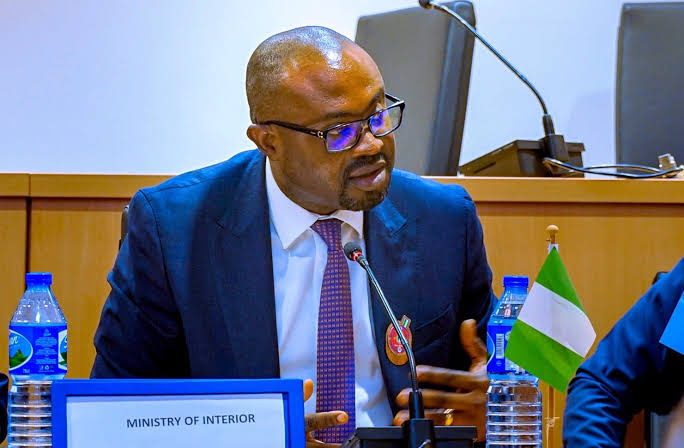
(Olubunmi Tunji-Ojo. Photo by Vanguard News)
Minister of Interior, Dr Olubunmi Tunji-Ojo, has revealed that 93 percent of inmates held in Nigerian correctional facilities are state offenders, with only 7 percent detained for federal offences, adding that a substantial share of these inmates should not be in custody at all.
Speaking on Wednesday in Abuja at the Regional Conference on the Classification of Prisoners and the Use of Technology in Prisons in Africa, jointly organised by the United Nations Office on Drugs and Crime, UNODC, and the African Correctional Services Association, ACSA.
The minister said the Federal Government had taken deliberate steps to decongest correctional facilities by focusing on inmates serving time for minor offences.
He explained that before the current administration took office, a large portion of the 93 percent of state offenders were being held for infractions that never warranted imprisonment in the first place.
He recalled that shortly after assuming office, he ordered an audit of inmates being held over minor fines and compensation judgments, directing his permanent secretary and the Controller General of the Correctional Service to produce data on individuals detained over fines or compensation amounts below roughly N500,000.
The audit revealed that more than 4,000 people fell into this category.
He said the findings exposed the pointlessness of keeping such offenders incarcerated at taxpayers’ expense, noting that the cost of feeding them for a year far exceeded the value of the fines involved, offering no real benefit to government.
Acting on this, he said the exercise led to the release of affected inmates and reduced correctional centre congestion by five percent in a single day.
Tunji-Ojo said the exercise raises a broader question that correctional authorities across Africa need to grapple with, namely whether their facilities are genuinely overcrowded for justifiable reasons.
He urged officials to examine the nature of offences behind their inmate populations, arguing that a significant share, often between 30 and 50 percent, involve offences that do not warrant incarceration at all.
He further disclosed that recidivism within Nigeria’s correctional system has dropped sharply under the current administration, falling from roughly 13,000 cases annually in 2023 to just 1,000 last year, a shift he credited to expanded access to education and vocational training for inmates.
According to him, the correctional service currently has 62 inmates enrolled in postgraduate studies, 261 in undergraduate programmes, 1,125 in formal education, 18 National Open University study centres based within correctional facilities, and 9,582 inmates participating in vocational and informal rehabilitation programmes.
The minister added that Nigeria has gone three consecutive years without recording a jailbreak or attack on any correctional facility, a feat he attributed to improved data management and stronger information sharing between security agencies.
He illustrated this with an example of an escaped inmate who was recaptured after attempting to obtain a Nigerian passport, explaining that once his fingerprint was checked at the immigration service level, the system immediately flagged him as an escaped inmate, prompting immigration officials to alert the correctional service, leading to his arrest on the spot.
Controller General of the Nigerian Correctional Service, Sylvester Ndidi Nwakuche, said Nigeria has continued modernising its correctional system through reforms built around the Nigerian Correctional Service Act, 2019.
He said effective classification of prisoners has become a strategic tool for assessing risk levels, safeguarding vulnerable inmates, allocating resources efficiently, and delivering targeted rehabilitation programmes.
He added that incorporating technology into correctional administration would strengthen record-keeping, improve information sharing, and enhance institutional accountability, stressing that no single correctional service holds all the answers to today’s security and rehabilitation challenges.
He described the conference as a valuable opportunity for participants to exchange ideas, share practical experiences, and jointly develop solutions to strengthen correctional systems across the continent.