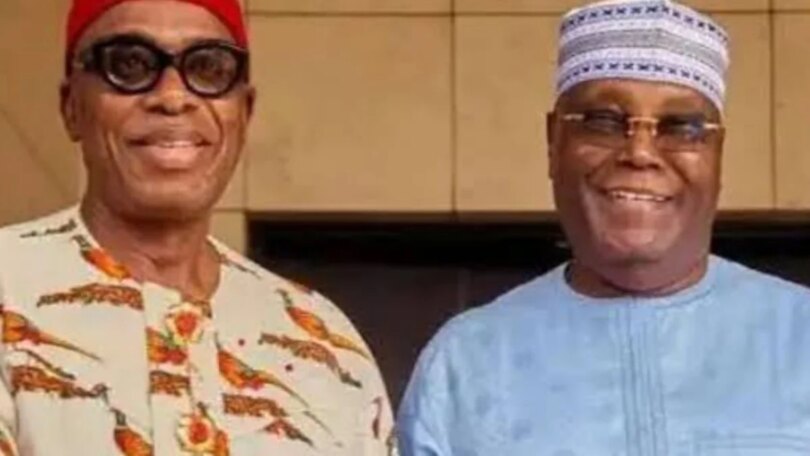
The African Democratic Congress (ADC) Vice-Presidential Candidate, Rotimi Amaechi, has clarified his position on the fuel subsidy policy being proposed by the party’s presidential candidate, Atiku Abubakar.
According to Amaechi, he did not deny that the former vice president plans to restore government support for petrol.
Amaechi’s media group, CRA Advocacy Network, made the clarification on Wednesday in a statement posted on X.
The group described as false a report which attributed a statement to the former Rivers State governor with the headline, “Atiku Did Not Propose Bringing Back Subsidy – Amaechi.”
It said Amaechi never made such a statement during the Nigerian Bar Association’s 66th Annual General Conference in Port Harcourt on August 24, 2026.
In the statement, the group said Amaechi’s comments at the NBA conference had been distorted and urged Nigerians to rely on his actual remarks rather than headlines or statements circulating online.
“His Excellency Rotimi Amaechi did not make this statement,” the group said.
It explained that Amaechi, who represented Atiku at the NBA conference, had clearly outlined the approach the ADC presidential ticket intends to take on the fuel subsidy question.
According to the group, Amaechi said: “What Vice President Atiku Abubakar is proposing is not to deviate from removal of fuel subsidy or not, ours is to provide cheap crude for them to refine and sell at a cheap cost. That way, individuals will be able to buy fuel.”
Amaechi further explained the proposed intervention. He said, “The how is we will encourage local production. We will only subsidise local production.”
CRA Advocacy said the comments showed that the Atiku-Amaechi ticket was proposing a different form of subsidy from the import-dependent system that existed before President Bola Tinubu removed petrol subsidy in 2023.
The group said the proposed policy would focus government support on domestic production by allowing local refiners to access Nigerian crude under preferential terms, with the aim of reducing production costs and ultimately lowering the price of petroleum products for consumers.
It argued that the distinction was important because the proposal was not aimed at bringing back what it described as the old “importation subsidy regime,” which it said was associated with corruption and inefficiency.
“Rather, it proposes targeted intervention (subsidy) at the Production stage, wherein domestic refiners would have access to Nigerian crude at preferential terms, subject to appropriate conditions, with the objective of lowering production costs, increasing domestic refining, creating jobs and ultimately making petroleum products affordable to ordinary Nigerians,” the statement said.
The clarification comes after Atiku recently said he would restore fuel subsidy if elected president in the 2027 election.
The former vice president made the promise during a Facebook Live session while responding to questions about the removal of petrol subsidy and the impact of the policy on Nigerians.
Atiku said his position had evolved since Tinubu announced the removal of the subsidy in May 2023. He maintained that although he did not initially oppose the policy, he was concerned about how the savings from subsidy removal had been used.
“I initially did not oppose the removal of the fuel subsidy. But now that it has been removed, where is the money? Where has the subsidy money gone? Has it been used to improve healthcare, education or security?” Atiku said.
He added, “If I win the presidential election, I will restore the subsidy. And anyone who stole Nigeria’s subsidy funds must return the money.”
The position has placed Atiku at odds with the Tinubu administration, which has repeatedly defended the decision to remove petrol subsidy as necessary to reduce pressure on government finances.
Tinubu announced the removal during his inauguration on May 29, 2023, triggering a sharp increase in petrol prices and contributing to higher transportation, food and other living costs.
The President argued that the subsidy had become too expensive for Nigeria to sustain and said money previously spent on petrol subsidies could instead be used for infrastructure, healthcare, education, transportation and security.
In a national broadcast on July 31, 2023, Tinubu said, “For several years, I have consistently maintained the position that the fuel subsidy had to go.”
He also said, “Subsidy cost us trillions of Naira yearly,” arguing that the funds could be better deployed to “public transportation, healthcare, schools, housing and even national security.”