PHILADELPHIA – It was a balmy summer day in July 2024, about 100km from Butler, Pennsylvania, where presidential election candidate Donald Trump was addressing a rally when I heard the news over the car radio.
He had been shot.
Mr Trump had a providential escape as a would-be assassin’s bullet grazed his ear.
There were two more attempts on Mr Trump’s life after he became President in January 2025, making him the most targeted leader in American history.
That extraordinary fact is perhaps the symptom of an extraordinary time, outgrowth of the charged intensity of political discourse in America today. It has inflamed an already heated debate about who is to blame for rising political violence in the United States.
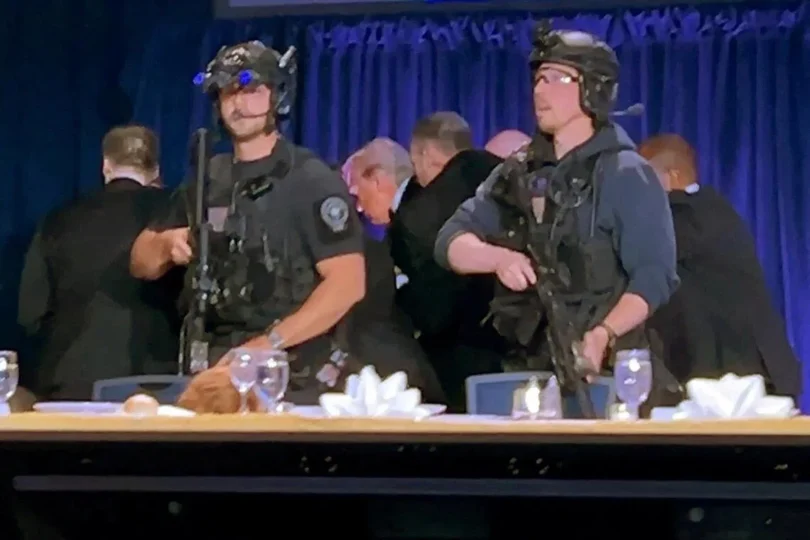
In the most recent incident, a 31-year-old tutor armed with a shotgun, a handgun and several knives, burst into the Washington Hilton hotel where Mr Trump was being entertained during the annual White House Correspondents’ Dinner on April 25.
Cole Allen shot at a Secret Service officer before being detained while Mr Trump, his wife Melania, and top members of his cabinet were whisked away.
The California Institute of Technology graduate was found to have made anti-Trump comments on social media and had told his family members he had a “plan to do ‘something’ to fix the issues with today’s world”.
He entered no plea in his first court appearance on April 27. But in a 1,000-word note written before the attack, he declared his targets were Trump administration officials, “prioritized from highest-ranking to lowest”.
“I am no longer willing to permit a pedophile, rapist and traitor to coat my hands with his crimes,” Allen wrote.
It was the most direct statement of intent to assassinate the President, who has been tainted by his association with convicted child sex offender Jeffrey Epstein.
No such declarations were part of the first assassination attempt in July 2024 or the second, two months later, foiled at the Trump International Golf Club in West Palm Beach, Florida.
At the same time, there is a parallel story of political vendetta playing out.
On the same day as Allen appeared in court, former FBI director James Comey, 65, was indicted by a grand jury for alleged threats against Mr Trump.
The indictment stemmed from a May 2025 Instagram post where Mr Comey posted a picture of shells arranged to form the numbers “86 47”. Alongside, he wrote: “Cool shell formation on my beach walk”.
The apparent reference is to Mr Trump, the 47th president. And “86” is slang for removing or getting rid of someone.
Mr Comey, a Republican who was appointed by former president Barack Obama, was fired by Mr Trump in 2017 while he was overseeing the initial investigation into the Trump campaign’s alleged ties to Russia.
He has said that it did not occur to him that the post would be read as a threat.
It was an odd juxtaposition of events in the same week; one where shots were fired and the other described in the media as a vendetta by a revengeful President.
Both served to highlight several facets of political violence in the US.
Ordinarily, crimes rooted in racial or religious hatred, including anti-Jewish hate crimes, are more numerous than incidents of political violence in any given year in the US.
But at the start of 2026, the US Capitol Police, which looks into threats against members of Congress, their families and staff, reported a startling number.
It investigated 14,939 “concerning statements, behaviours, and communications” in 2025, up 50 per cent from 2024 and nearly double since 2022.
Such figures, along with polling data, reinforce public perception that political violence is becoming more common, or at least more visible.
About 85 per cent of Americans say politically motivated violence is increasing, according to a Pew Research Center survey in September 2025. It was conducted after Christian nationalist activist Charlie Kirk, 31, was assassinated while speaking at a college campus.
Another study by Associate Professor Sean Westwood at Dartmouth College’s Department of Government suggests political violence is a fringe phenomenon that is widely abhorred and disproportionately feared.
Dr Westwood’s surveys found that about 73 per cent of Americans said political violence was a greater threat than the risk of a pandemic and around two-thirds placed it higher than the threats from China’s rise or climate change.
Although it is dangerous, political violence in America is nowhere as bad as it used to be, for instance, in the early years of the republic.
“Three of the nine presidents who served between 1865 and 1901 were murdered in office: Lincoln, Garfield, and McKinley. A comparable rate today would mean losing two or three sitting presidents since the late 1980s,” said Dr Westwood in a post on X.
The untimely deaths in the 1960s of iconic president John F. Kennedy and civil rights leader Martin Luther King Jr remain etched in the nation’s memory.
But the difference today is that threats come from angry lone wolves, noted Dr Westwood.
“In the 1960s and 70s, attacks largely came from organised groups like the Weather Underground and the Black Panthers. There was structure, there was coherence, there was leadership,” he told The New York Times in an interview.
“Today, there just aren’t networks premised on spreading violence across the country. The individuals who commit these acts are lone wolves. Largely mentally ill, largely male, largely younger. The thing that seems to connect them is not ideology – it’s anger,” he said.
But the most troubling aspect of this political violence is the moral sanction it apparently enjoys on the fringe.
Professor Robert Pape, a political scientist who runs the University of Chicago Project on Security and Threats, argues that the US is entering an era of violent populism.
A minority of Americans now see violence as politically justified under certain conditions, his research shows. In May 2025, he spotted an alarming sign in his quarterly surveys capturing attitudes towards political violence.
About 39 per cent of Democrats agreed that the use of force was justified to remove Mr Trump from the presidency and 24 per cent of Republicans agreed that Mr Trump was justified in using the military to suppress Democratic protesters.
The key factor, as he reads it, is not the fringe extremism but the perceived approval.
Sustained violence does not happen without context, said Professor Pape in a post on X after the third attempt on Mr Trump’s life.
“It requires perceived mass approval. A tiny number of actors move when they believe the masses will back them.”
Indeed, a Gallup poll, conducted in September 2025 suggested that the young have a more accepting view of political violence.
While most Americans say it is “never OK” to use violence to achieve a political goal, 16 per cent say it is “sometimes OK”, the poll said. In the latter category were those aged 18 to 29, more than other age groups.
Law enforcement personnel detain Cole Tomas Allen, a suspect in the shooting incident at the White House Correspondents’ Association dinner, on April 25.
PHOTO: REUTERS
While Allen’s age – 31 – drew attention, Mr Trump’s press secretary Karoline Leavitt blamed Democrats and some members of the news media for the violence, attributing it to a “left-wing cult of hatred against the president and all of those who support him and work for him”.
The language of politics has become sharper on both sides, but the Left is at a vulnerable moment. The Democratic Party, currently underwater in national popularity ratings, is keen to win back power and is pushing back hard against Mr Trump.
New York congressman Hakeem Jeffries, the most powerful Democrat in the House of Representatives, recently called for “maximum warfare, everywhere, all the time”.
Indeed, there seems to be a convergence, perhaps apocryphal. Left-wing violence has risen in the past 10 years, particularly since Mr Trump’s rise to political prominence in 2016.
The year 2025 marks the first time in more than 30 years that left-wing terrorist attacks outnumber those from the violent far right, noted a study by the Center for Strategic and International Studies in September 2025.
The idea of left radicalism receives strong endorsement from Mr Trump’s supporters on social media.
“At first glance, this doesn’t look like a breakdown of the system. It looks more like a product of it,” said Mr Will Ricciardella, the managing editor for politics at right-leaning Fox News.
He noted that Cole Allen wasn’t some “nut job” lurking on the fringes of society, “forgotten” by the system.
“He was well-educated, credentialed, employed and institutionally formed. Academia, media, and politics helped build the moral permission structure,” he said on X.
On the other side are those who accuse Mr Trump of being the singularly salient catalyst behind the rise in violence. Critics say Mr Trump’s rhetoric – portraying opponents as “enemies” or urging supporters to “fight” – has resulted in a combustible political climate.
His decision to pardon nearly 1,600 people connected to the Jan 6, 2021 attack on lawmakers certifying Mr Joe Biden’s victory in the 2020 elections further blurred lines around political violence.
Mr Trump has framed the attacks as a byproduct of his political significance. “When you’re a consequential president,” he said after the latest incident, “things happen”.
Is increasingly violent imagery used by leftist movements such as No-Kings responsible? Are the social media and traditional media to blame? After all, political and media ecosystems often reward outrage and confrontation.
Heavy social media users are more likely to view violence as acceptable, according to the Gallup poll.
Some also question if the Trump assassination attempts were staged, a conspiratorial minority view that I heard after the first attempt, too. This point of view is nurtured quietly, like a murmur.
“Staged or not, this keeps Trump’s misdeeds off the front page. Let’s keep talking about Iran, Epstein, gas and groceries,” said Ms Brogan Donalds, a nursing student in Philadelphia.
It’s too early to make meaningful conclusions about the April 25 attack, says Dr Michael Traugott, a political scientist who studies media and political campaigns at the University of Michigan.
“We don’t know very much yet about the motivations of the man behind the attack, but it seems at least possible that he was dissatisfied with his life and wanted to strike out at the political system and its leadership. We will have to wait until the trial opens up to learn more,” he said.
Prof Pape, who has been running national surveys on support for political violence for five years, believes that more than a specific motive, it is big social change that often leads to radical politics which then leads to political violence.
In the US, that is the transition from a white-majority democracy to a white-minority democracy. In 1990, the US population was 76 per cent non-Hispanic white, a figure that stands at around 56 per cent today.
Prof Pape has warned the violence could spiral as the Nov 3 midterm elections draw near. Given that millions of Americans on both sides are already supporting political violence, President Trump should host a White House event opposing political violence, said Prof Pape.
“We need true bipartisan investigations,” he said, “or the cycle repeats and we are all worse off.”
Reducing partisan animosity is remarkably difficult, said a study published in the Proceedings of the National Academy of Sciences in September 2025.
“As long as political and media systems reward outrage with votes and viewership – stoking division – any individual-level effort to depolarise is up against a powerful, unending tide,” said the senior author of the study, Dr Westwood.
“This isn’t a problem that can be fixed at the grassroots level alone,” he said in the study.
“Principles of civil discourse and respectful dialogue need to be embedded into the education system in the US,” said Dr Westwood.
A drift towards politics in which violence is less unthinkable needs to be reversed before it becomes normal.