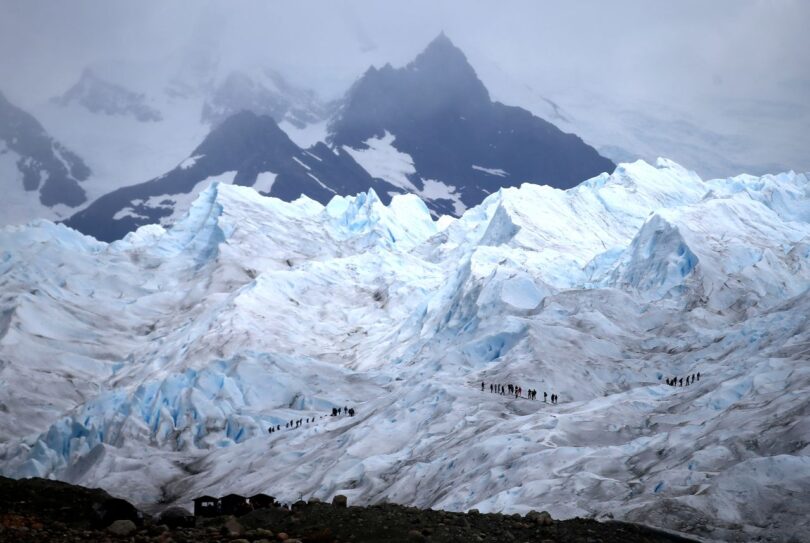
Viviana Moreno, an Argentine biochemist who has led protests against mining in Esquel for two decades, says the community’s position has remained firm as foreign companies sought to establish gold, silver, and copper extraction projects in the small Patagonian town: “The line is clear: not with water.”
For 23 years, residents in Esquel resisted mining projects over fears of water contamination, successfully blocking them through referendums and local legislation.
Now, more than two decades later, Viviana Moreno and fellow members of the “No to the Mine” Neighbourhood Assembly are raising alarm over reforms to Argentina’s Glaciers Law approved by Congress, which would allow mining activities in areas that had previously been protected.
“It’s irrational to go against the glaciers,” Moreno told TRT Espanol. “They are water reserves. Discussing this in the context of a global water crisis is anachronistic,” he pointed out.
Glacier Law: A structural reform
The original law, passed in 2010, was groundbreaking for establishing minimum protection standards and for prohibiting the exploitation of minerals and hydrocarbons in glaciers and periglacial environments, which are areas with frozen soils in high mountains and act as strategic reserves of fresh water.
Since then, the law has been challenged by international mining companies. However, in 2019, Argentina’s Supreme Court upheld its validity and halted dozens of projects seeking to drill in those areas.
Argentina has 16,968 ice bodies larger than one hectare, including glaciers and debris-covered glaciers, most of them located in the Andes Mountains, according to an inventory by the Argentine Institute of Snow Science, Glaciology and Environmental Sciences.
In addition to helping mitigate droughts, they represent a strategic source of fresh water, supplying 40 percent of water basins and providing access to the resource for more than 7 million people, according to the Environment and Natural Resources Foundation.
But under changes introduced by the government of President Javier Milei at the end of 2025, protection will no longer apply equally to all glaciers, but only to those designated as strategic water reserves, as established in Article 1.
The regulations delegate to provincial authorities the power to determine whether these ecosystems serve as strategic water resource reserves or as “water providers for recharging river basins”, or whether mining or hydrocarbon projects can instead be established there.
To do so, provinces must “base their decisions on technical and scientific studies.”
Following the enactment, the Argentine Chamber of Mining Companies welcomed the reform, saying it would bring “increased regulatory predictability”, unlock investment, and “clarify” where productive activities can be carried out.
Glaciers: regional and geopolitical impact
However, the dispute is not exclusive to Argentina.
Glaciers have become a focal point of regional tension, particularly in Andean countries such as Chile, Bolivia, Peru, and Argentina.
In these regions, the expansion of mining often clashes with communities affected by water scarcity, which has worsened in recent years due to climate change, while local governments promote mining to attract investment.
At the global level, the geopolitical dimension is increasingly prominent due to rising demand for critical minerals needed for the energy transition, such as lithium and copper, which has boosted interest from countries like China and the United States in a region rich in these resources.
In fact, the so-called “lithium triangle” — made up of Argentina, Chile, and Bolivia — concentrates more than 50 percent of the world’s lithium reserves, while Chile and Peru produce almost 40 percent of global copper, according to data from the Economic Commission for Latin America and the Caribbean (ECLAC).
Since taking office in 2023, Milei has pushed for the repeal of laws that guaranteed the protection of natural resources and, according to his government, limited development.
These resources are estimated to generate more than $36 billion in revenue by 2035 through the export of copper, lithium, gold, and silver. He has also criticised what he calls “excessive regulations” and environmentalists.