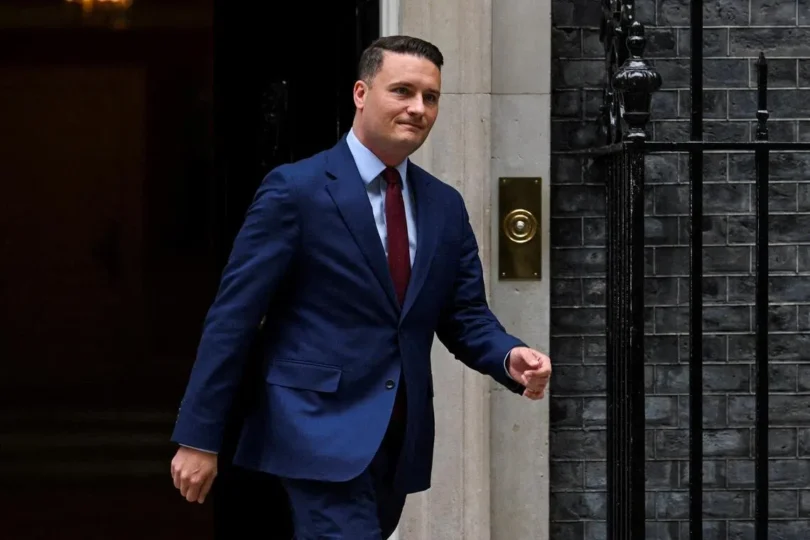
LONDON – Labour’s Wes Streeting announced his resignation as health minister on May 14, calling for a leadership contest to oust British Prime Minister Keir Starmer, who has shown no sign he is ready to step down.
Disastrous results for the governing Labour Party in last week’s local elections have plunged Britain into its latest crisis, just under two years after Mr Starmer won a large majority on a vow to bring stability and end a decade of political chaos.
After days of calls by a growing number of Labour lawmakers for Mr Starmer to either resign or set out a timetable for his departure, Mr Streeting was the first senior minister to break cover, saying he was standing down because “it is now clear you will not lead the Labour Party into the next general election”.
“It is now clear … that Labour MPs (members of parliament) and Labour (trade) unions want the debate about what comes next to be a battle of ideas, not of personalities or petty factionalism,” he wrote in his resignation letter.
“It needs to be broad, and it needs the best possible field of candidates. I support that approach and I hope that you will facilitate this.”
His announcement fell short of triggering a formal leadership contest against Mr Starmer but piles the pressure on the British leader who has so far weathered a drip feed of demands for him to step down.
Sources close to Mr Starmer, who has repeatedly said he would battle to keep his job, say he is determined to fight any leadership contest, which could see him challenged by Mr Streeting and also senior ministers on the left of the party.
Earlier on May 14, Mr Starmer’s former deputy, Ms Angela Rayner, announced she had been cleared of deliberate wrongdoing over her tax affairs, an impediment to any leadership contest, but she would not say whether she wanted to launch a formal bid.
Other potential candidates from the so-called “soft left” of the party – who favour more state involvement in key industries and are pro-workers’ rights, with several having close ties to trade unions – include Greater Manchester mayor Andy Burnham and Ed Miliband, the minister for energy security and net zero.
Mr Burnham does not currently have the necessary seat in Parliament to mount a challenge and even if a lawmaker agreed to stand down to make space for him, the process could take weeks, or maybe months, which could discount him from the race.
While members of the “soft left” have signalled they will seek to settle on one agreed candidate, Mr Starmer is not without his supporters.
The 63-year-old former lawyer has adopted a “business as usual” approach and on May 14 his finance minister, Rachel Reeves, warned lawmakers against “plunging the country into chaos” at a time when Britain’s anaemic economy was turning a corner. The economy grew unexpectedly in March.
She told the BBC that waiting lists for Britain’s public health service were falling because of government investment.
“If we put that at risk, we put at risk the investment in our public services and also the growth that is necessary to help people with the cost of living,” she said.
While the number of calls for him to resign ebbed on May 13, when his government turned to King Charles to set out its agenda for a new parliamentary term, Thursday was yet another showdown for Britain’s prime minister.
Ms Rayner, 46, said she had been cleared of tax avoidance, with no fine or penalty applied, a move she described as exonerating her “of the accusation that I deliberately sought to avoid tax”, and paving the way for a potential leadership bid.
But she refused to signal whether she would stand in a contest.
“I’ll play my part in doing everything we possibly can to deliver the change, because it’s not a personal ambition, I know the difference it makes,” she told the Guardian newspaper.
The prospect of another leadership race to choose what would be Britain’s seventh prime minister in around 10 years has angered business leaders who warn it will deter investment – something the Labour government has said must improve to turn around the nation’s fortunes.
The political instability has pushed borrowing costs higher, with some investors nervous over the possible election of a more left-wing, tax-and-spend Labour prime minister.
A poll by Survation published this week of Labour members found that a left-wing candidate would most likely win any leadership contest if the prime minister resigned.
The boss of Aviva, one of Britain’s biggest financial companies, complained on May 14 that businesses were being hammered by the political turmoil.
“There have been too many changes of government strategy, leadership, just in my six years of being CEO,” CEO Amanda Blanc told Reuters. “And I think that is harmful to a major economy such as the UK and how we are perceived abroad.” REUTERS