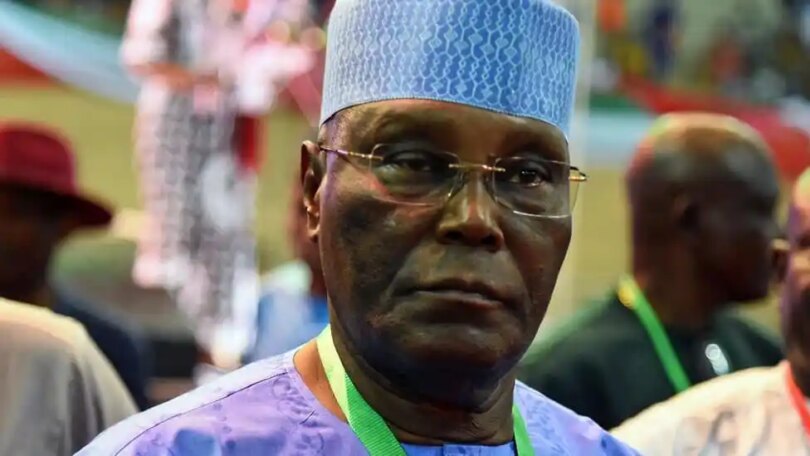
Former Vice President, Atiku Abubakar, has criticised President Bola Tinubu’s directive to the Independent Corrupt Practices and Other Related Offences Commission (ICPC) to investigate the controversial Presidential Foreign Intervention Promotion Council (PFIPC), insisting that the Federal Government cannot investigate itself in a matter in which its institutions are under scrutiny.
Naijaonpoint reports that Atiku said what Nigerians demanded was not another internal probe but an independent investigation capable of restoring public confidence.
“What Nigerians demanded was never another internal government investigation. We demanded an independent investigation. The Federal Government is itself central to this controversy because the questions being asked concern the conduct of public institutions, official processes and possible institutional failures.
“In every constitutional democracy, a party whose conduct is under scrutiny cannot simultaneously appoint itself investigator, judge and final authority over its own case,” he stated.
In a statement issued by his Senior Special Assistant on Public Communication, Phrank Shaibu, Atiku described Tinubu’s directive as a reluctant response to the seven-day ultimatum he had earlier issued.
He, however, said the move had exposed contradictions in the Presidency’s account of the scandal.
The former Vice President demanded the immediate establishment of a Special Independent Commission of Inquiry made up of 10 eminent Nigerians nominated by the Federal Government, the African Democratic Congress (ADC), the National Democratic Coalition (NDC), the Peoples Democratic Party (PDP), civil society organisations, the Nigerian Bar Association (NBA), retired judicial officers and other Nigerians of unquestionable integrity.
He said the commission should conduct a comprehensive investigation into all aspects of the PFIPC affair, review findings already compiled by the police and other security agencies, summon serving or former public officials whose testimony may assist the inquiry, and prepare a White Paper containing its findings.
Atiku also said the commission should conclude its work within one month and publish its report directly to Nigerians without requiring clearance from any organ of government.
“That is the minimum standard of transparency Nigerians should accept. Anything less will leave the unavoidable impression that the government prefers to investigate itself behind closed doors rather than submit to genuinely independent scrutiny,” he said.
Atiku said the ICPC directive amounted to an admission that the police investigation earlier cited by the Presidency was either incomplete or incapable of answering the questions raised by Nigerians.
He recalled that the Presidency had said the matter had already been investigated by the police following petitions from the Chief of Staff in October 2025.
“Only one week ago, the Presidency emphatically told Nigerians that the matter had already been investigated by the Police following petitions from the Chief of Staff in October 2025; that the suspect had been arrested; that searches had been conducted; that documentary exhibits had been recovered; that bank accounts had been traced; that statements had been obtained; and that criminal charges had already been filed before the Federal High Court,” the statement read.
“If all of that is true, what exactly is the ICPC expected to spend another thirty days investigating? If the Police investigation was comprehensive, another investigation is unnecessary. If another investigation has become necessary, then the inevitable conclusion is that the earlier investigation was insufficient. The President cannot simultaneously maintain both positions without contradicting his own government,” he added.
Atiku said Tinubu’s directive that the ICPC should probe the “wider circumstances” surrounding the alleged PFIPC contradicted the earlier impression that the controversy involved only a lone impostor.
He said, “The issue before Nigerians is no longer whether one individual allegedly forged documents. The issue is how an organisation, the Presidency insists never existed, allegedly acquired office accommodation, interacted with government institutions, sought diplomatic recognition, reportedly conducted recruitment exercises, operated multiple bank accounts and projected the authority of government over an extended period.
“Institutions do not accidentally confer legitimacy. Bureaucracies do not unknowingly sustain official-looking operations for months. Somewhere between the Presidency’s denials and the appearance of official legitimacy lies the truth Nigerians deserve to know.”
The former Vice President also described the 30-day timeline given to the ICPC as excessive, saying the commission should not need another month if the Presidency’s claim that the police had already thoroughly investigated the matter was correct.
He also pointed to what he called an inconsistency in the official chronology, noting that the father of the principal suspect was reportedly arrested only last week despite claims that the investigation had been concluded months earlier.
Atiku argued that the deeper problem was not the timeline but the structure of the probe.
He said public confidence could be undermined when officials whose names had been mentioned in connection with the controversy were assigned responsibilities of national importance without first being cleared through a transparent process.
“Accountability must not only be done but must also be seen to be done,” he said.
Atiku further accused the President of applying selective standards on transparency, saying public questions affecting confidence in leadership should be addressed consistently.
“If allegations affecting public confidence deserve urgent investigation and transparent clarification in one instance, then the same principle should apply universally. Leadership earns moral authority when it willingly embraces the standards it demands of others,” he said.
He said Nigerians would judge the PFIPC episode not by another presidential directive but by whether the government was willing to submit itself to a genuinely independent inquiry.