
By: Al Humphrey Onyanabo
In a country where traditional career paths have long dominated conversations around success, a quiet but powerful shift is taking place.
Across cities like Abuja, Lagos, and Port Harcourt, young Nigerians are beginning to look inward—rediscovering the value of practical skills that not only guarantee income but also unlock global opportunities.
One such path, often overlooked but increasingly relevant, is bartending.
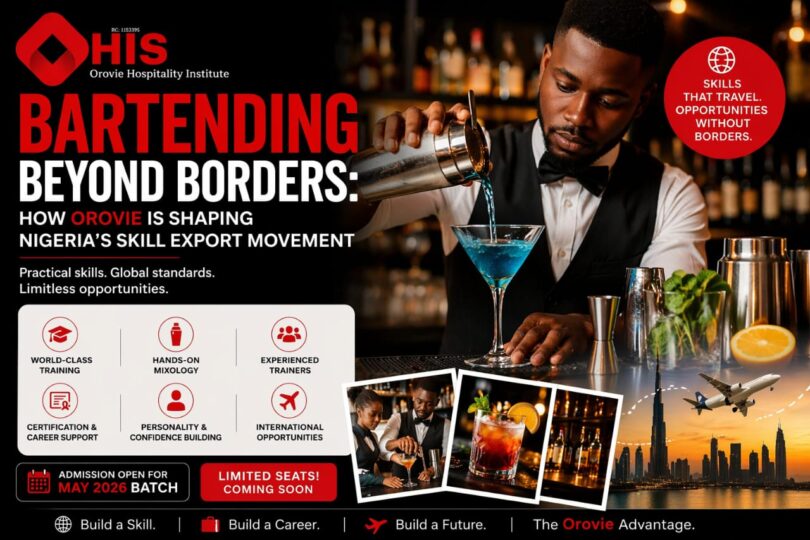
At the forefront of this movement is the Orovie Hospitality Institute (OHI), which is redefining how hospitality skills are perceived and taught in Nigeria. Its upcoming bartending course is more than just a training program—it represents a broader philosophy: that excellence, when properly cultivated at home, can compete anywhere in the world.
Bartending, in its modern form, is no longer just about mixing drinks. It is a refined craft—a blend of chemistry, artistry, communication, and speed. From luxury hotels in Dubai to cruise liners in the Caribbean, skilled bartenders are in high demand. What many Nigerians are now realizing is that this demand can be met without first leaving the country.
The beauty of initiatives like OHI’s lies in their structure. With interactive learning modules, hands-on mixology practice, and a strong emphasis on customer service and personal confidence, trainees are not just taught a skill—they are shaped into professionals.
This distinction matters. The global hospitality industry does not simply recruit workers; it seeks polished individuals who understand standards, presentation, and experience delivery.
Equally important is the institute’s focus on certification and career support.
We were also reliably informed that Experts in bartending and catering are coming in from Europe to coach students in May for the Abuja Module.
For many young Nigerians, the biggest barrier to international opportunities is not talent but validation. Structured programs like this bridge that gap, translating raw ability into globally recognizable competence.
There is also a deeper cultural significance to this shift. For years, “looking outward” has been the default mindset—seeking education, validation, and opportunity abroad. But a growing number of Nigerians are beginning to understand that the foundation for global success can—and should—be built locally. When institutions within the country rise to meet international standards, they change the narrative from dependency to self-sufficiency.
Bartending, in this context, becomes symbolic. It represents a broader class of vocational and creative skills that can thrive within Nigeria while connecting seamlessly to the global economy. It challenges the stigma often attached to non-traditional professions and replaces it with a narrative of dignity, expertise, and mobility.
Of course, the journey is not without its realities. Skill-based careers demand discipline, consistency, and a willingness to start from the ground up. Not every trainee will immediately land a job in a five-star hotel abroad. But what programs like this offer is something far more valuable—a structured pathway, a professional identity, and a chance to compete.
As Nigeria continues to navigate economic uncertainties, initiatives that empower individuals with exportable skills may prove to be one of the country’s most sustainable assets. They create not just workers, but ambassadors—young professionals who carry Nigerian excellence into global spaces.
And perhaps that is the real story here.
Not just a bartending course.
But a quiet revolution—one cocktail, one skill, one opportunity at a time.