Stakeholders of the Livestock Productivity and Resilience Support Project (L-PRES) conducted field visits to key project sites in Kano State, inspecting a range of interventions aimed at boosting livestock productivity, improving processing, and strengthening the entire value chain.
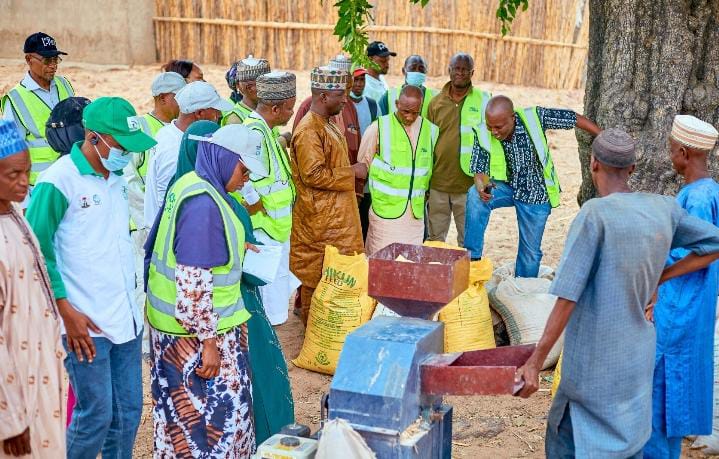
SolaceBase reports that the tour featured facilities and community-level projects, including a livestock service centre under construction, a milk collection hub linking pastoral clusters to markets, and grassroots interventions such as feed processing machines, solar-powered yoghurt processing units, boreholes, and pasture development support.
The inspection, part of the project’s ongoing mid-term review, took participants to the Livestock Service Centre in Bagauda, Bebeji Local Government Area, as well as Dan Tuben Fulani and Gamu Community in Dawakin Kudu, where beneficiaries are already experiencing the impact of the interventions.
Speaking during the visit on Thursday, the National Project Coordinator of L-PRES, Sanusi Abubakar, said the exercise was aimed at assessing progress on the ground and identifying ways to strengthen implementation in the remaining phase of the project.
He explained that the mid-term review goes beyond meetings and documentation, noting that physical inspection of project sites provides a clearer picture of ongoing activities and their impact.
Read Also:BUK inaugurates Salamatu Garba as Chair, CDA Advisory Board
“We are in Kano for our mid-term review, and part of the agenda is to visit project sites and see what is happening firsthand,” he said, adding that the team was also at a milk collection centre serving clusters in the area to evaluate operations and offer guidance.
Abubakar disclosed that the livestock service centre visited in Bagauda is designed as a hub for multiple livestock-related activities, bringing together services and facilities in one location.
According to him, construction work at the centre is about 30 per cent completed and is expected to be delivered before the end of the year.
He further revealed that the project is working in collaboration with the Kano State Investment Promotion Agency to attract investors who will drive activities at the centre and ensure that livestock farmers benefit from improved infrastructure and services.
The national coordinator noted that beyond infrastructure, L-PRES is supporting clusters with equipment and basic amenities.
He said communities visited are benefiting from interventions such as feed crushing machines, water supply, pasture development and boreholes to enhance livestock productivity.
On sustainability, Abubakar dismissed concerns about possible abandonment of projects, stressing that community ownership remains central to the initiative.
“This facility will not be abandoned. Our goal is to ensure that the cooperatives managing these centres take full responsibility for their maintenance because it is in their own interest,” he said.
He added that the government’s role is to provide enabling infrastructure such as roads, administrative buildings, security posts and veterinary clinics, while private investors are expected to drive commercial activities.
Read Also:Sasakawa Africa hosts green mega, mini field days in five states to promote climate smart agriculture
Abubakar also highlighted the strategic location of the livestock service centre, noting its proximity to a special agro-processing zone, which he said creates an opportunity for synergy and economic growth.
While responding to questions on export prospects, he said the project is currently focused on strengthening local production and meeting domestic demand, noting that decisions on export would be left to investors once the system is fully operational.
Also speaking, the Kano State Project Coordinator of L-PRES, Salisu Muhammad Inuwa, described the mid-term review as an important milestone for evaluating performance after three years of implementation.
He explained that the six-year project has reached its halfway point, making it necessary to assess achievements and determine whether adjustments are needed.
Inuwa expressed satisfaction with the level of progress recorded in the state, noting that although Kano joined the project later than some states, it has made significant strides.
According to him, Kano has spent about one and a half years on the project and has achieved between 35 and 40 per cent progress within that period.
“We are on the right course based on what we have seen on the field,” he said.
Beneficiaries who spoke during the visit also attested to the impact of the interventions on their livelihoods.