
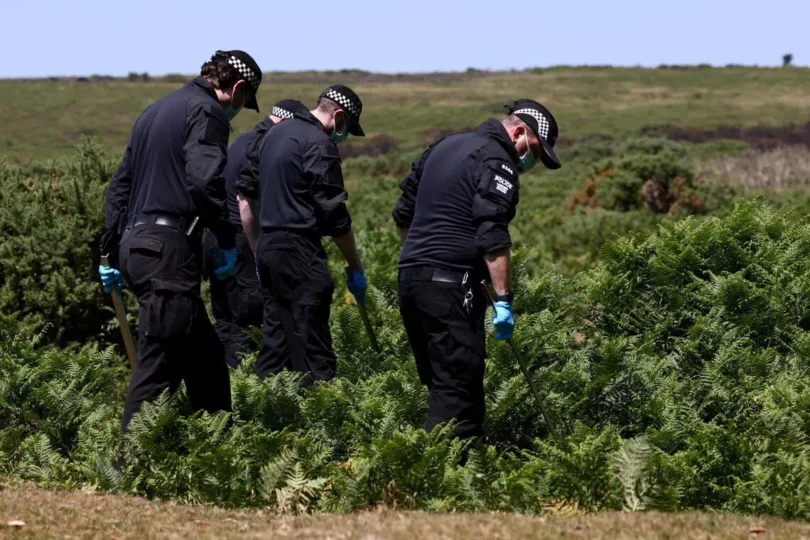
HAYTOR, England – British police said on July 11 that a 28-year-old man has been arrested in South Yorkshire on suspicion of murdering former British government minister Ann Widdecombe.
The suspect is a white British national and is now in police custody, the statement said. The police said there was no information to suggest the murder of the 78-year-old was related to terrorism or had a political motive.
Earlier in the day, the police had released a 26-year-old man who was arrested on suspicion of murdering Widdecombe and stated that the individual was no longer part of the investigation. The man who was released, a white British national, was arrested in Newton Abbot, a town about 15km from Widdecombe’s home in Haytor in rural southwest England, police said on July 10.
“Our priority remains identifying those responsible and ensuring that all available evidence is thoroughly examined,” Devon and Cornwall Police Assistant Chief Constable Matt Longman said in a statement on Saturday, adding that the enquiry was in its early stages but “moving at a significant pace”.
In another update, the police said they believed that the attack took place on July 8 at around 1130 GMT.
That was a day before ambulance workers called police to Widdecombe’s home, where she had been found dead after suffering serious injuries.
The police said they consulted counter-terrorism policing as part of their initial enquiries, but it was not supporting the investigation.
They also said that the suspect was believed to be a white male and that they did not believe there was a wider risk to the public.
A woman of strong beliefs
Widdecombe was known for her socially conservative views, first as a junior minister in Conservative Prime Minister John Major’s 1992-1997 government and latterly as an immigration and justice spokesperson for Nigel Farage’s populist Reform UK.
She converted to Catholicism partly in protest at the Church of England’s ordination of women as priests and was opposed to abortion and to equalising the age of consent for homosexual and heterosexual relationships.
She also defended a policy of shackling pregnant prisoners during childbirth to prevent their escape and viewed single mothers as poor role models, but was unusual among Conservative lawmakers in opposing the hunting of foxes with hounds.
News on July 10 of her death led to tributes from across the political spectrum in Britain, including from Prime Minister Keir Starmer and from Farage, who described her as “an extraordinary woman”.
“She stood up and fought for what she believed in – a devout Christian and somebody with strong, socially conservative views,” Farage said in a video clip posted on his X account.
Two serving British members of parliament have been killed in the last decade.
Labour lawmaker Jo Cox was shot and stabbed by a Nazi-obsessed loner during the Brexit campaign in 2016. Conservative lawmaker David Amess was stabbed to death in 2021 by a man inspired by the militant group Islamic State. REUTERS