
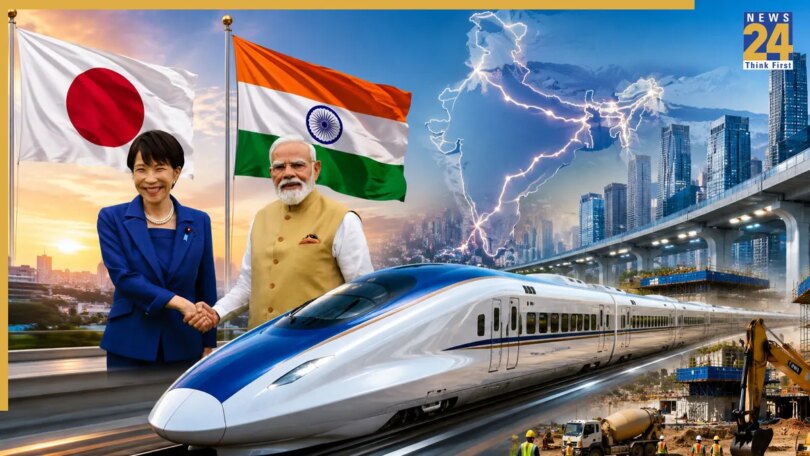
India and Japan have given a major boost to their long-standing high-speed rail partnership, with both countries reaffirming their commitment to accelerate the Mumbai-Ahmedabad Bullet Train project and expand cooperation on future rail corridors. During the India-Japan Annual Summit in New Delhi, Prime Minister Narendra Modi and Japanese Prime Minister Sanae Takaichi discussed ways to strengthen transport infrastructure, advanced mobility and economic ties. Following the talks, Japan confirmed its full support for India’s goal of starting commercial operations on the priority section of the Mumbai-Ahmedabad High-Speed Rail (MAHSR) project by 2027.
The announcement was made through a joint statement issued after the bilateral meeting. The discussions also focused on introducing Japan’s next-generation E10 Shinkansen trains and building a long-term vision for a 7,000-kilometre national high-speed rail network across India.
India, Japan Reaffirm Commitment To Mumbai-Ahmedabad Bullet Train
The Mumbai-Ahmedabad High-Speed Rail project remains the flagship symbol of India-Japan infrastructure cooperation. During the summit, both leaders reviewed the progress of the project and reiterated their commitment to ensure that the priority section begins commercial operations by 2027.

Japan pledged to continue providing technical expertise, financial support and operational assistance to help India achieve the target. The leaders also welcomed plans to introduce the advanced E10 Shinkansen trains into the network, further strengthening the partnership in modern rail technology.
The bullet train project is expected to transform inter-city travel by significantly reducing travel time while introducing world-class safety and operational standards to India’s railway system.

7,000 Km High-Speed Rail Vision And New Mobility Partnership
Prime Minister Narendra Modi invited Japanese companies to participate in India’s ambitious plan to develop a 7,000-kilometre national high-speed rail network in the coming years.
To support this long-term vision, both countries signed a Memorandum of Understanding (MoU) on Next-Generation Mobility Partnership. The agreement aims to combine Japan’s advanced transportation technologies with India’s manufacturing capabilities, engineering talent and growing infrastructure market.
The collaboration will focus on developing future mobility solutions, promoting innovation and expanding investment opportunities in India’s transport sector.
Four Major India-Japan Infrastructure Projects Making Rapid Progress
Along with the Mumbai-Ahmedabad Bullet Train project, India and Japan reviewed the progress of four major development projects being implemented with Japanese assistance. These initiatives are expected to strengthen urban infrastructure, healthcare, education and agriculture while deepening long-term economic cooperation between the two countries.

The four major projects include:
- Mumbai Metro Line 11
- Bengaluru Metro Phase 3
- Healthcare and education infrastructure projects in Maharashtra
- Sustainable horticulture project in Punjab
Officials said these projects highlight the growing India-Japan partnership beyond high-speed rail and reflect Japan’s continued commitment to supporting India’s long-term infrastructure and development goals.
Shinkansen Technology To Modernise Indian Railways
The Mumbai-Ahmedabad corridor is India’s first high-speed rail project and is being developed using Japan’s globally recognised Shinkansen technology.
The project includes advanced traction systems, modern electrification, specialised track infrastructure and internationally proven operational standards. Officials believe the project will not only improve passenger travel but also strengthen India’s domestic railway capabilities by introducing cutting-edge engineering and technical expertise.
The high-speed corridor is expected to become a benchmark for future bullet train projects planned across different parts of the country.
Broader India-Japan Cooperation Beyond Bullet Trains
Apart from the bullet train project, India and Japan agreed to expand cooperation across several strategic sectors.
Japan reaffirmed its support for infrastructure development in India’s Northeast under the Act East Policy, including roads, bridges and disaster risk reduction projects. Both nations also committed to strengthening industrial value chains connecting Northeast India with the Bay of Bengal region and BIMSTEC partners.
The two countries reviewed progress on several Japan-funded projects, including Mumbai Metro Line 11, Bengaluru Metro Phase 3, healthcare and education infrastructure in Maharashtra, and sustainable horticulture initiatives in Punjab.
The leaders also agreed to deepen people-to-people ties by promoting tourism, Japanese language education under the Nihongo Partners programme, and cultural exchanges through anime, manga, gaming and films. They welcomed the growing partnerships between Indian states and Japanese prefectures through the India-Japan Governors Network for Friendship and Exchange, which aims to encourage closer regional cooperation and long-term economic collaboration.
First published on: Jul 03, 2026 03:50 PM IST
Get Breaking News First and Latest Updates from India and around the world on News24. Follow News24 on Facebook, Twitter.
End of Article
About the Author

Sagar Puri
Sagar Puri is a seasoned Senior Sub-Editor with over four years of newsroom experience, bringing sharp editorial judgment and an eye for detail to every story he handles. Over the years, he has worked across a diverse range of beats, including sports, education, news desk, entertainment, and lifestyle, giving him a well-rounded understanding of the digital news ecosystem.
Read MoreRelated Story