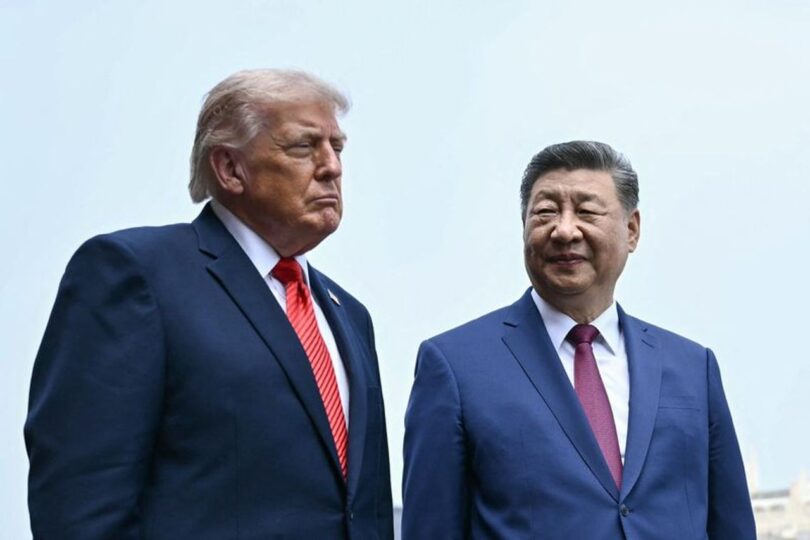
US President Donald Trump has always liked to talk about who holds the cards.
When he arrived in Beijing, Trump knew he still had leverage over Xi Jinping, but he also carried growing political and geopolitical headaches, from an inconclusive war with Iran to frustrated Americans facing high gas prices and widening fault lines within the Western alliance.
In their first meeting in Beijing, Xi, fully aware of Trump’s mounting pressures, pushed for recognition of China’s rising global status, warning of the dangers of the so-called “Thucydides Trap”.
Thucydides, the ancient Greek historian who chronicled the Peloponnesian War, argued that the conflict between Sparta and Athens was largely driven by Sparta’s fear of Athens’ growing economic and political power, which threatened Sparta’s dominance in Greece and the Aegean.
“Can China and the United States overcome the Thucydides Trap and create a new paradigm for relations between major powers?” Xi asked Trump at the Great Hall of the People, underscoring Beijing’s demand for recognition as a major power on equal footing with the United States.
Can they accept each other?
Xi’s reference to the Thucydides Trap reveals much about Chinese political psychology. But will Trump, who described Xi as “a great leader”, embrace that analogy?
“The two leaders will discuss the emerging world order under new standards. But they are also well aware of the fact that they can’t act on their own because of the nature of global politics, which makes nation-states so intertwined with each other from trade ties to technological developments,” Kadir Temiz, an expert on Chinese politics, tells TRT World.
“They will not come up with a grand bargain, but they are likely to reach a consensus on major issues,” according to the analyst, who argues that the US now appears more willing to deal with China on relatively equal terms, particularly in technology and finance.
“The other scenario is too costly for both sides.”
Temiz, who also heads ORSAM, an Ankara-based research centre, views the summit as a critical moment in an increasingly tense global environment and as an opportunity for both leaders to establish a working relationship and a broader political and economic framework that could shape future US-China ties.
Like Temiz, Hongda Fan, director of the China-Middle East Center at Shaoxing University, believes both sides have enough incentives to “reach some consensus on trade and technology.” The summit will “definitely bring something positive,” he tells TRT World.
“The Chinese leadership will first safeguard its own national interests, and then act in accordance with its responsibilities as a major world power.”
Related
Despite such optimism, some analysts remain pessimistic, arguing that Washington and Beijing are moving towards a managed separation, with major disputes still dividing the two powers, including the US-Israeli war with Iran, tariffs, and Taiwan, which Xi has repeatedly described as the most sensitive issue in US-China relations.
While Beijing may flatter Trump with grand ceremonies and lavish displays, “in terms of substance, they feel they’re winning again in the struggle against America,” Charlie Parton, a senior associate fellow at the Royal United Services Institute (RUSI), tells TRT World.
Chinese thinking increasingly follows the idea that “the east is rising and the west is falling,” says Parton, who also served as the EU’s former First Counsellor on China.
“They want as little turbulence as possible over the next several years as they build up their science and technology, ensuring their domination of new industries and increasing the dependencies of the US and the West on China while reducing their dependencies on the West and America, which is called self-reliance in their language,” he adds.
On the other hand, despite Washington’s long-discussed Pacific pivot away from the Middle East, the Trump administration still does not appear to have a coherent strategy for dealing with China, Parton argues, citing factors ranging from the fallout of the Iran conflict to internal bureaucratic and political turbulence in Washington.
Iran settlement
Some experts believe the Xi-Trump summit could also produce a framework to ease tensions over Iran. Tehran recently shared a peace proposal with Washington, which Trump reportedly dismissed as “garbage”, signalling a possible renewal of attacks on the oil-rich country.
But Temiz argues that the Xi-Trump meeting could yield an Iran settlement, with Beijing potentially emerging as the guarantor of a future deal between Washington and Tehran.
If both sides can reach an understanding over the Strait of Hormuz, including the double blockade and the wider Iran conflict, it could also pave the way for broader agreements on global issues, ranging from tariffs to energy security, according to Temiz.
Iranian Foreign Minister Abbas Araghchi visited Beijing ahead of Trump’s trip to China, reportedly holding positive discussions with Chinese officials.
According to various reports, China supported Iran during its conflict with the US through intelligence sharing and economic backing.
This gives Beijing leverage over Tehran, while China has also consistently supported Pakistani mediation efforts between the two sides. Pakistan itself maintains deep economic ties with China.