
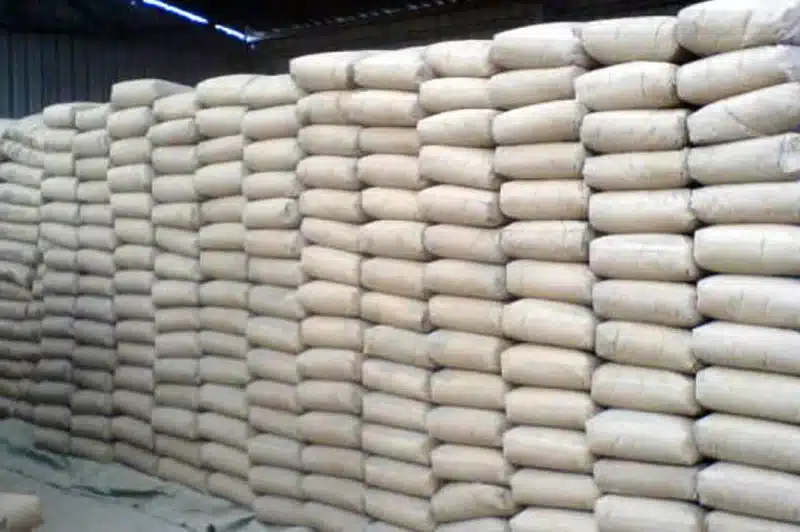
Despite Nigeria’s cement production capacity of over 60 million metric tonnes yearly, consumers continue to pay some of the highest prices on the continent, with a 50-kilogramme bag selling for as high as ₦15,000 in some parts of the country.
The country’s cement industry is dominated by three major players, Dangote Cement, BUA Cement and Lafarge Africa, recently rebranded as HBM Nigeria Plc.
Naijaonpoint reports that together, the companies have an installed production capacity estimated at between 60 million and 65 million metric tonnes yearly.
With new plants expected to come on stream, national capacity could rise to about 85 million tonnes per year in the coming years.
However, domestic consumption is estimated at only 25 million to 30 million tonnes yearly, meaning Nigeria produces more cement than it currently uses and exports part of the surplus to neighbouring countries.
Market checks across major cities, including Lagos, Abuja and Abia, showed that a 50kg bag of cement sells between ₦12,500 and ₦15,000, depending on location and distribution costs.
This is far higher than prices in several African countries.
In South Africa, a 50kg bag of cement averages between ₦6,000 and ₦7,000, while in Egypt, one of the world’s largest cement producers, prices could fall to the equivalent of ₦4,000 to ₦5,000 per bag.
In Kenya, cement sells for about ₦6,500 to ₦7,500 per bag, while in Ghana, prices range between ₦7,000 and ₦8,000, depending on exchange rates and import costs.
The price gap has raised concerns among housing experts, developers and consumers, who argue that Nigerians should not be paying nearly twice the continental average for a product produced locally at scale.
Dangote Cement controls more than half of Nigeria’s cement production, with an installed capacity of about 35 million to 35.3 million tonnes yearly across its Obajana, Ibese, Gboko and Okpella plants.
Its capacity is expected to exceed 41 million tonnes when its new plant in Itori, Ogun State, is completed.
BUA Cement, the second-largest producer, has an installed capacity of about 17 million to 20 million tonnes per year, with major plants in Obu, Edo State, and Sokoto.
Lafarge Africa has an installed capacity of about 10.5 million tonnes yearly, with plants in Ewekoro and Sagamu in Ogun State, Ashaka in Gombe State and Mfamosing in Cross River State.
Several new plants are also being planned, including MSM Cement in Kebbi State, with a proposed capacity of three million tonnes per year, and Resident Cement in Bauchi State, with a planned capacity of 10 million tonnes per year.
The three leading cement firms generated over ₦6.53 trillion in revenue in 2025, while their combined after-tax profit stood at about ₦1.65 trillion.
The figure represented a 142 per cent increase from 2024.
For critics, the profit figures have intensified questions over whether Nigerian consumers are paying more than necessary for cement.
They argue that record earnings by producers are difficult to reconcile with the country’s worsening housing deficit and rising construction costs.
Manufacturers, however, insist that cement production in Nigeria remains expensive.
They argue that cement plants require huge amounts of energy, with producers relying on gas, coal, alternative fuels and diesel to power kilns and generators.
The removal of fuel subsidies, rising energy prices and the depreciation of the naira have also increased the cost of imported equipment, spare parts, refractory materials, packaging materials and additives.
Producers also blame logistics and poor infrastructure, noting that cement plants are often located far from key consumption centres.
Industry estimates suggest that logistics alone may account for between 30 and 40 per cent of the final retail price of cement.
They also cite labour costs, financing costs, maintenance expenses and inflation as major pressures on production and distribution.