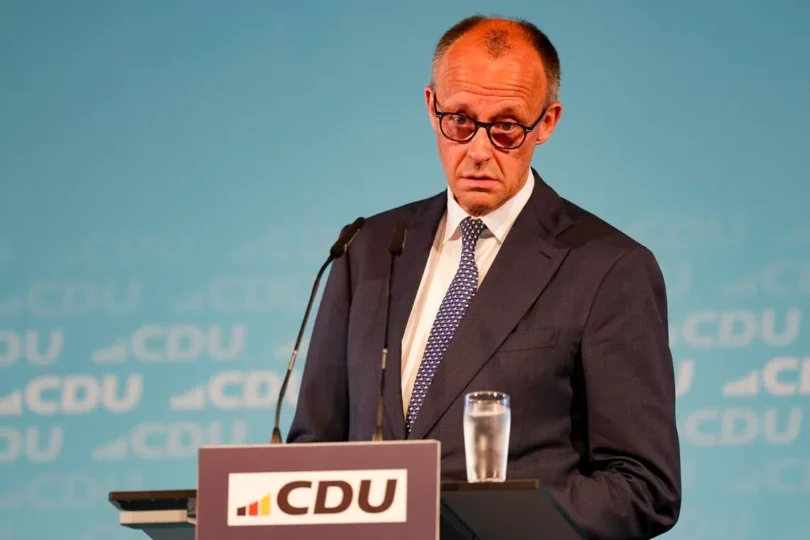
BERLIN – The German government on May 29 dismissed rumours that Chancellor Friedrich Merz’s rivals were laying the groundwork to oust him as his popularity craters, reforms stall and the far right gains in strength.
Speculation reached fever pitch this week of manoeuvring within the centre-right CDU party to potentially replace Mr Merz, Germany’s most unpopular modern-day chancellor, after just a year in office.
Dubbing the saga the “chancellor swop” debate, German media have reported the name of Mr Hendrik Wuest – the state premier of North Rhein-Westphalia – is circulating as a possible alternative.
Most commentators don’t believe Mr Merz will be dumped any time soon.
But the drama underscores how unstable once-staid German politics has become, coming less than two years since former chancellor Olaf Scholz’s coalition collapsed, precipitating early elections.
Addressing a regular press conference in Berlin on May 29, Mr Merz’s spokesman was, however, quick to dismiss the reports.
“You were right to call this a rumour, to speak of speculation – and that’s why I won’t comment on it,” a tense-looking Mr Stefan Kornelius responded to a journalist’s question.
“The mood in the chancellery is very good and constructive,” he insisted, adding the government was focused on its reform plans and that people should “avoid side debates”.
In briefings to local media, government sources have been more critical, labelling the rumours “wild speculation” – in German, “wueste Spekulation”, a word play seen as a veiled dig at Mr Merz’s potential challenger, Mr Wuest.
It shows a “a dangerous desire to play with fire” that endangers stability in Germany, one government source charged.
The turmoil comes with 70-year-old Mr Merz’s government facing criticism on all fronts.
A promised spending blitz to boost the struggling economy has moved slowly, while much-needed reforms to health care and pensions are bogged down as the CDU squabbles with its coalition partners, the centre-left SPD.
Mr Merz’s poll ratings have plummeted – a survey this week by Forsa showed only 14 per cent were satisfied with him, against 84 per cent who were dissatisfied.
“They’ve now had over a year to get policies off the ground, and in the major areas… not a great deal has happened yet,” Dr Aiko Wagner, a political scientist at the Freie Universitaet Berlin, told AFP.
Mr Merz has also failed so far to neutralise the growing threat of far-right party Alternative for Germany (AfD), which consistently tops opinion polls ahead of his CDU/CSU conservative bloc.
Mr Wuest, aged 50, is from the more centrist wing of the CDU, aligned with former chancellor Angela Merkel, Mr Merz’s long-time bitter political rival.
The leader of Germany’s most populous state has not directly commented on the rumours.
But when asked whether he wanted to be a substitute for Mr Merz, he reportedly responded only that he was “not a good football player”, without issuing a firm denial.
He has also been trying to boost his profile; he recently made an official trip to Poland, inviting along political journalists based in Berlin.
The state premier of North Rhein-Westphalia, Mr Hendrik Wuest, has been named as a potential replacement for Mr Merz as Chancellor.
PHOTO: HENDRICK WUEST/FACEBOOK
It is possible for a German chancellor to exit before the end of his term, including by resigning or facing a vote of no confidence, but the process is difficult and this seems unlikely for now.
Mr Wuest, little known at the national level, may also struggle to take on Mr Merz.
“With someone from state-level politics who has never been active in federal politics before, there is naturally still some uncertainty as to how far he can gain popularity nationwide,” Dr Peter Matuschek, a political analyst from pollster Forsa, told AFP.
But pressure is set to mount on Mr Merz, particularly when key state elections take place in September in eastern regions that are AfD strongholds.
“Things could get tricky for the chancellor if reform projects continue to stall and the AfD triumphs in the elections in Saxony-Anhalt and Mecklenburg-Western Pomerania,” said the Bild daily. AFP