
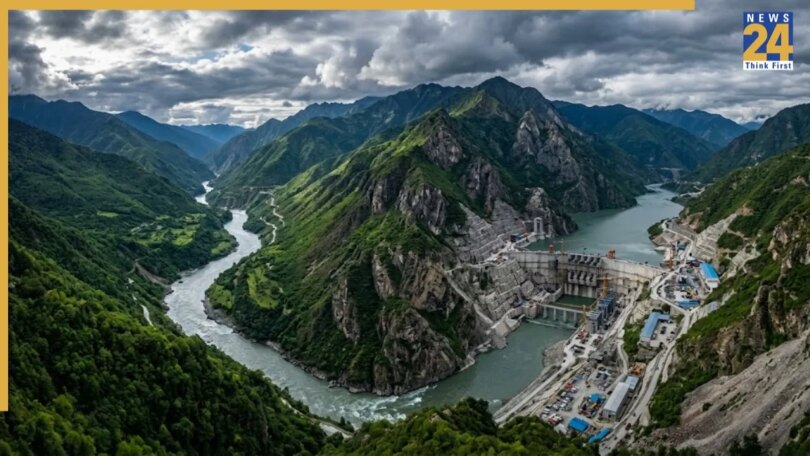
China’s under-construction mega hydropower project on the Yarlung Tsangpo River in Tibet has come under fresh scrutiny after a Beijing-backed geological study warned that an active fault line runs directly beneath the project site. The findings have raised new concerns about the structural safety of the massive dam, while also adding to existing worries in India and Bangladesh over its possible downstream impact.
The study, supervised by the state-owned China Geological Survey and reported by the South China Morning Post, found that the Paizhen Fault passes through the reservoir area of the project. Researchers said the fault has remained active since the Pleistocene, also known as the Ice Age, and could pose serious risks to major infrastructure in the region.
The Yarlung Tsangpo River flows into India’s Arunachal Pradesh and Assam as the Brahmaputra River before entering Bangladesh as the Jamuna River. Because of this, both countries have been closely watching the construction of the world’s largest planned hydropower project.
Why is the Paizhen Fault a concern?
According to the study published last month in the Chinese-language journal Sedimentary Geology and Tethyan Geology, the fault has fractured surrounding rocks and weakened their strength. This could reduce the stability of the ground supporting dams, bridges, roads and tunnels.
Researchers also warned that the reservoir area has loose soil and weak cohesion. They said earthquakes, continued fault activity and long-term water storage could trigger landslides, slope failures and ground collapses, threatening both infrastructure and workers.
Could earthquakes increase the risk?
The research pointed to geological evidence showing that the Paizhen Fault remained active even during the Holocene period, with movement recorded as recently as around 9,500 years ago.
They warned that future earthquakes could trigger landslides and damage engineering structures around the mega project.
What steps have researchers suggested?
Construction of the Yarlung Tsangpo hydropower project began last year. Once completed, it is expected to generate around 300 billion kilowatt-hours of electricity annually, nearly three times the capacity of China’s Three Gorges Dam.
To reduce risks, the researchers recommended stronger engineering measures during construction, including reinforcing slopes, improving structural stability and installing retaining barriers to minimise the chances of landslides and collapses.
First published on: Jul 11, 2026 12:14 PM IST
Get Breaking News First and Latest Updates from India and around the world on News24. Follow News24 on Facebook, Twitter.
End of Article
About the Author
Shivam Verma
Shivam Verma is a Chief-Sub-Editor at News24. A postgraduate diploma holder in Integrated Journalism from the Asian College of Journalism, Chennai, Shivam focuses on international affairs, diplomacy, defence, and politics. Beyond the newsroom, he is passionate about football, both playing and watching, and enjoys travelling to explore new places and cuisines.
Read More
Related Story