
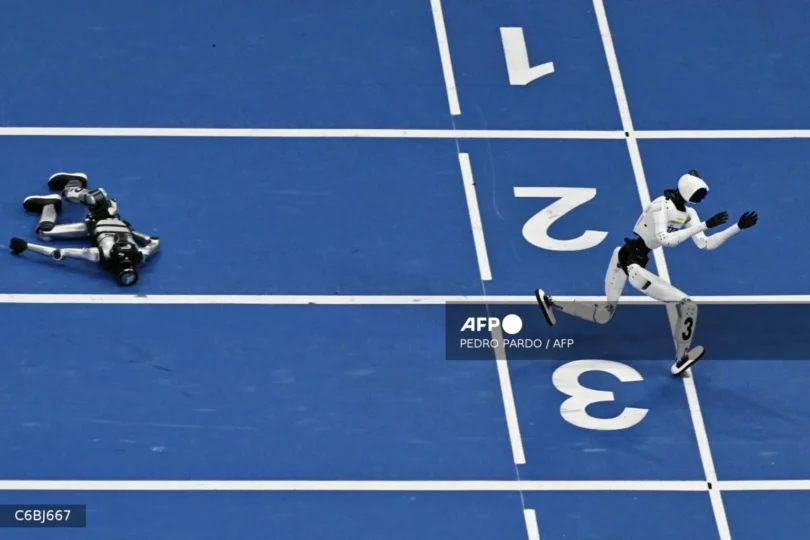
A Chinese humanoid robot has surpassed Usain Bolt’s 100-metre record at the World Robot Games in Beijing, highlighting China’s growing advances in humanoid robotics.
The robot, named Tiangong Ultra, completed the 100-metre sprint in 9.39 seconds during the competition’s opening events, according to China’s state broadcaster CCTV.
The time was faster than Bolt’s world record of 9.58 seconds, set by the Jamaican sprint legend in Berlin in 2009.
Tiangong Ultra also set a new record in the 400-metre event on Sunday, completing the race in 38.16 seconds before its time was revised to 38.15 seconds.
The humanoid was developed by a government-backed research centre in Beijing and was among dozens of robots and their human operators competing across athletics, boxing, football and martial arts.
While some robots delivered impressive performances, others struggled to complete their events. Several failed to start, while others moved around the track at little more than walking speed or fell shortly after the races began.
In one 400-metre heat, a white humanoid robot repeatedly swung its arms while running around the track and appeared close to falling as it approached the finish line. It eventually completed the race without collapsing.
The football and boxing events also produced moments of amusement, with some robots falling over or requiring human assistance to leave the competition area.
The performances drew large crowds, with spectators applauding both the successful runs and the robots’ sometimes awkward movements.
A 72-year-old Beijing spectator, Hou Yali, said she hoped future competitions would test robots against humans in areas beyond speed and physical performance.
She said she would particularly like to see robots demonstrate their ability to perform everyday household tasks, arguing that advances in the technology could eventually make such services more accessible.
The World Robot Games featured a broad range of competitions as China seeks to showcase its growing capabilities in humanoid robotics and artificial intelligence.