Chinese President Xi Jinping has called for extensive cooperation with Washington to avoid the “Thucydides trap” that could put the United States and China on a military collision course amid rising tensions over artificial intelligence, trade and Taiwan. The Guardian reported that Xi made the remarks at the start of……
Chinese President Xi Jinping has called for extensive cooperation with Washington to avoid the “Thucydides trap” that could put the United States and China on a military collision course amid rising tensions over artificial intelligence, trade and Taiwan.
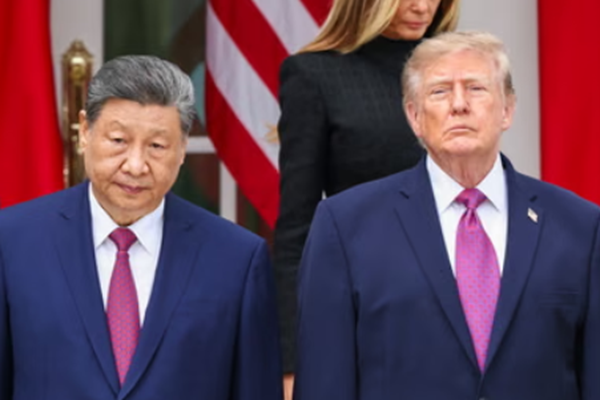
The Guardian reported that Xi made the remarks at the start of his summit meeting with US President Donald Trump at the White House, where he outlined terms for a mutual understanding that he said could steer the two competing powers away from future military conflict and towards mutual gain.
Rather than confrontation, Xi said conditions for “achieving the great rejuvenation of the Chinese nation and making America great again go hand in hand” should be the goal, citing Trump’s political catchphrase.
“We should strengthen communication. China and the United States are different in national conditions, but through candid, in-depth and continued dialog, our two countries can understand each other better, seek common ground while shelving differences, and build up mutual trust,” Xi said, with Trump looking on.
Read Also: APC Demands Peter Obi’s Exit From Presidential Race Over Anambra Record
“We should coexist in peace,” he said. “China and the United States, as two major countries, stand to gain from cooperation and will both lose in confrontation. Our two militaries should maintain regular dialog and improve mechanisms for crisis communication and prevention.”
With such conditions in place, Xi said, “the Thucydides trap can be overcome”, referring to the phenomenon, defined by the Greek historian, of tensions that arise when an emerging power challenges the dominance of an established power.
Xi had invoked the phrase during his meeting with Trump in Beijing in May, asking the US president how he planned to avoid it.
His proposals for lessening tensions included an invitation for 100,000 young Americans to visit China on student exchanges. They came amid a period of intense competition between the two countries over artificial intelligence and trade, with both sides imposing tariffs on each other.
Trump had earlier welcomed Xi and his wife, Peng Liyuan, to the White House, noting that he was the first Chinese leader to make a second state visit to the US. The previous visit occurred in 2015, when Barack Obama was president.
“President Xi and Madame Peng arrive at an important moment for America, the 250th anniversary of our founding,” Trump said.
Trump said he had forged “a truly great friendship” with Xi.
“President Xi and I have made tremendous strides on the issues facing our two countries,” he said. “Our teams have been working to encourage a more balances trading relationship, including the new market access for American farmers and ranchers.”
He said the current visit would include discussions over security, technology and AI, which he called “super intelligence”, a term he introduced in his speech to the United Nations General Assembly on Tuesday.
Xi also highlighted his personal relationship with his American counterpart, saying: “President Trump and I have respect for each other. We have built personal rapport and stayed in touch.”

Addressing Trump directly, he said: “During your visit to China this year, we agreed to build a constructive China-US relationship of strategic stability. I am ready to work with you to steer the giant ship of the China-US relationship on a steady course towards the future.”
The White House welcome ceremony came after Trump took the unusual step of going to Andrews Air Force Base in Maryland the previous evening to greet the Chinese leader and his wife on the tarmac.
Much of the same pageantry was repeated during Thursday’s ceremony, with both countries’ national anthems played. Trump was flanked by his wife, Melania, while members of his cabinet and senior aides looked on.
Trump and Xi were scheduled to hold bilateral talks after the ceremony and their welcoming speeches.
Despite the harmonious tone adopted by both leaders, analysts have expressed scepticism about the possibility of reaching long-term stable arrangements on several issues.
In the race for AI, the US has placed strict export controls on microchips, semiconductors, software and chipmaking equipment in an effort to slow China’s development.
A truce agreed between Trump and Xi in South Korea last year aimed at keeping tariffs lower had been due to expire in November but has now been extended until February, according to US Treasury Secretary Scott Bessent.
Analysts believe the extension suggests Trump remains dissatisfied with Xi’s concessions on trade and wants to maintain pressure in the hope of securing a better deal if the two leaders meet again at the G20 summit scheduled to be held in Miami in December.
Despite the trade war between the two countries, Chinese imports have continued to surge into the US, with China on course to run a $1tn trade deficit for the second year running.