
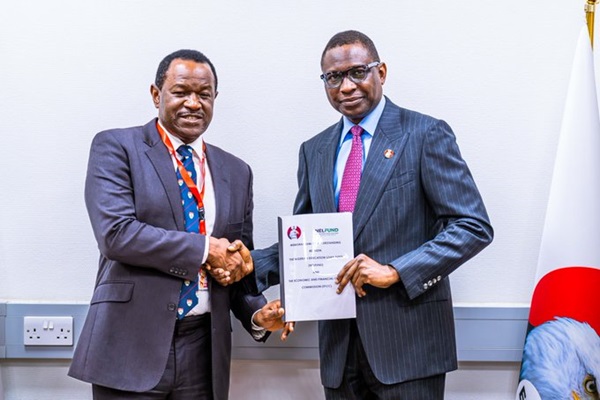
EFCC Chairman Ola Olukoyede has urged the Nigerian Education Loan Fund (NELFUND) to ensure that government-approved funds meant for student loans reach the intended beneficiaries directly, while strengthening measures to prevent diversion and other financial crimes. Olukoyede gave the charge on Wednesday, September 23, 2026, in Abuja during the signing……
EFCC Chairman Ola Olukoyede has urged the Nigerian Education Loan Fund (NELFUND) to ensure that government-approved funds meant for student loans reach the intended beneficiaries directly, while strengthening measures to prevent diversion and other financial crimes.
Olukoyede gave the charge on Wednesday, September 23, 2026, in Abuja during the signing of a Memorandum of Understanding between the EFCC and NELFUND at the Commission’s corporate headquarters.
The EFCC, which posted details of the engagement on X, said the MoU is aimed at strengthening collaboration, preventing financial infractions and ensuring accountability in the management and disbursement of proceeds of crime allocated for educational support.
Olukoyede described NELFUND as one of the major legacy projects of the Bola Tinubu-led administration and commended its management for progress in providing students with access to education financing.
He said the EFCC’s mandate extends beyond recovering proceeds of crime to ensuring that recovered funds are put to productive use for the benefit of Nigerians.
Under the agreement, the EFCC and NELFUND will establish a joint team, the ‘Fraud Assessment and Control Unit’, to ensure compliance with established guidelines.
Olukoyede stressed that the partnership should prioritise prevention rather than waiting until funds are diverted before taking action.
Read Also: EFCC Declares Ex-Pension Boss Maina Wanted Over Alleged Stolen Property
“There are certain things you might not have addressed your mind to, because that is what we do. We could give all your attention to it. We don’t have to necessarily wait for money to be stolen before we go into action. Why can’t we provide more prevention? Even if it doesn’t occur at the level of the organisation, across or along the chain, something could happen,” he said.
The EFCC chairman said the welfare of young Nigerians was a major reason for the Commission’s interest in supporting NELFUND, particularly as a significant proportion of people investigated for cybercrime are young people, including students in some cases.
“Whatever we recover from these proceeds of crime, why can’t we use it to also support them?” he asked.
He explained that using recovered proceeds to support students was intended to address some of the vulnerabilities that could expose young people to economic crimes.
Olukoyede also advised NELFUND to explore direct disbursement mechanisms, subject to appropriate verification by educational institutions.
He said universities and other institutions could help authenticate students’ identities and ensure that only genuine beneficiaries receive the funds.
“Let it go directly to the human beings,” Olukoyede said, stressing the EFCC’s interest in ensuring that recovered funds benefit the people for whom they are intended.
He urged NELFUND to access only funds legitimately due to it and ensure that such resources are promptly applied for their intended purpose.
Olukoyede expressed confidence that the MoU would strengthen risk assessment, improve accountability and establish safeguards capable of protecting the programme beyond the tenure of the current leadership of both institutions.
Earlier, NELFUND Managing Director and Chief Executive Officer, Akintunde Sawyer, commended the EFCC for its support and emphasis on preventing economic crimes before they occur.
He said the EFCC’s preventive approach had helped NELFUND establish stronger standards of transparency and accountability in the management of its resources.