
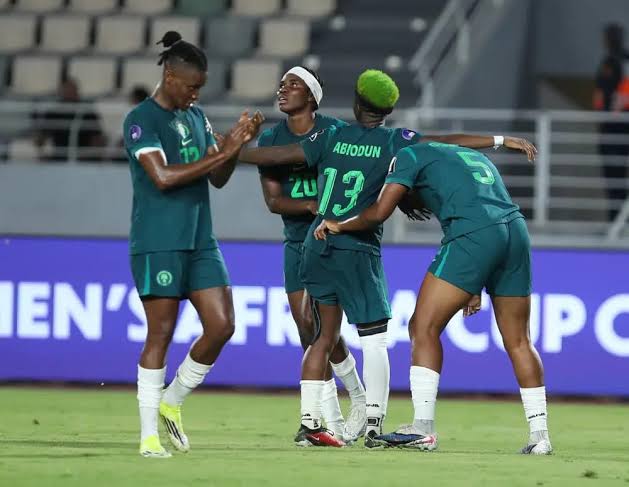
The Nigeria Football Federation’s fact-finding committee set up to investigate the Super Falcons’ disappointing performance at the 2026 Women’s Africa Cup of Nations in Morocco has identified weaknesses in player communication, camp management, technical-team structure and football administration as issues requiring urgent reform….
The Nigeria Football Federation’s fact-finding committee set up to investigate the Super Falcons’ disappointing performance at the 2026 Women’s Africa Cup of Nations in Morocco has identified weaknesses in player communication, camp management, technical-team structure and football administration as issues requiring urgent reform.
The committee, chaired by former Nigeria international and football administrator Ambassador Fanny I. Amun (MON), was constituted to investigate the root causes of Nigeria’s recent poor performances in international competitions, with specific reference to the Super Falcons’ WAFCON campaign and the country’s failure to qualify for the 2027 FIFA Women’s World Cup in Brazil.
Its report, dated August 21, 2026, examined governance, finance, technical development, grassroots football and league management.
On the Super Falcons specifically, the committee identified “challenges with players release and communication” as one of the issues affecting the team.
It also examined allegations surrounding team dynamics and the influence of players in selection. The committee, however, said it found no evidence that any individual player exercised influence over team selection.
Under its assessment of team dynamics, the committee stated that “no player’s influence was alleged”, while also highlighting the need to clarify the roles of the analyst and the hierarchy within the technical team.
Plumptre injury not selection issue
The committee also investigated the absence of defender Ashley Plumptre, whose non-participation had been the subject of questions surrounding the Falcons’ WAFCON campaign.
It said its investigation established that Plumptre had undergone surgery and was not fit to play.
The finding was reportedly corroborated by medical personnel attached to both the Nigerian team and her foreign club.
The committee therefore found no indication from the case it examined that her absence was the result of player selection interference.
Officials’ access to camp questioned
One of the sharper observations in the report concerned the management of the team’s training camp.
The committee said it “didn’t agree with the whole process of how some officials infiltrated the camp at will.”
It recommended that camp management and access be better structured, suggesting that clearer procedures should govern the involvement of officials around the national team.
The report also called for player loyalty and performance issues to be handled through the NFF’s technical department rather than through informal or unstructured channels.
According to the committee, the matter should be “streamlined through the technical department” and subsequently structured and handled by the relevant heads.
Calls for overhaul of player development
Beyond the immediate circumstances surrounding the Falcons’ WAFCON campaign, the committee linked the team’s difficulties to wider structural weaknesses in Nigerian football.
It called for a deliberate framework for team management and player development, as well as better training and retraining of administrative and technical personnel.
The report also recommended improved data technology and information verification within the NFF to address discrepancies in player records and strengthen age-verification processes.
It further called for stronger regulations and oversight covering players and training.
Women’s football needs deliberate support
The committee said the challenges facing women’s football could not be addressed in isolation from the broader football administration system.
It recommended a deliberate plan covering both male and female football, with greater emphasis on training, retraining and strengthening the administrative and technical structures of the game.
The women’s football league, it added, should be encouraged to leverage the structures and opportunities available within the men’s league.
The committee also called for government and corporate support for Nigerian football to be “highly restructured” to reflect the realities and challenges facing the sport.
Technology and funding
Technology was another major area highlighted in the report.
The committee recommended the introduction of new technological initiatives as part of efforts to attract better funding and modernise football administration.
It also urged the NFF to create the necessary outlets and avenues for better implementation of regulations across all sectors of Nigerian football.
Overall, the report presents the Super Falcons’ WAFCON failure not simply as a problem of player performance, but as part of broader administrative, technical and structural weaknesses within Nigerian football.
While the committee did not establish player interference in selection and found that Plumptre was medically unfit, it identified weaknesses in communication, camp management, technical-team hierarchy, player development, regulation and institutional support as areas requiring significant reform.
The committee said its ultimate objective was to provide “a clear roadmap for rebuilding a football system that works for Players, Clubs, and the Nation.”