
Advertisement
Advertisement
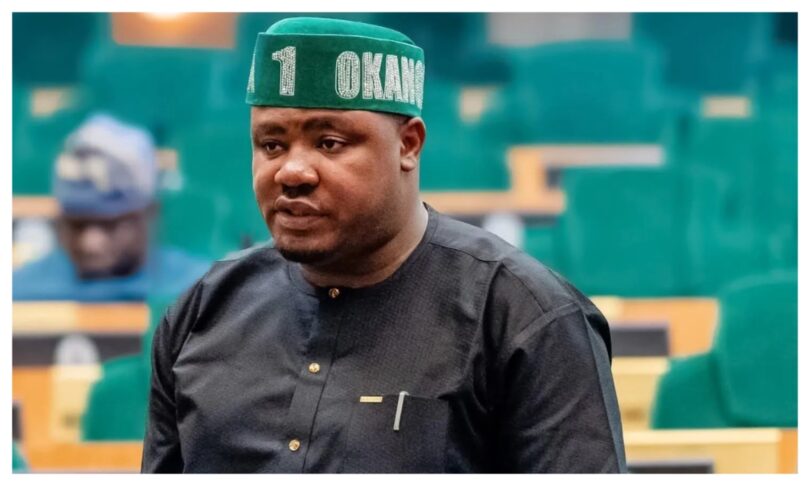
Deputy Spokesman of the House of Representatives, Philip Agbese, has faulted attempts to blame the Minister of the Federal Capital Territory, FCT, Nyesom Wike, for the recent flooding in Abuja, saying residents must also take responsibility for activities that worsen the situation.
Mr Agbese, who spoke with journalists in Abuja on Tuesday, said the criticism of Wike was unfair given the scale of infrastructure projects being executed across the FCT.
He urged residents to acknowledge the administration’s development efforts while supporting measures aimed at making Abuja cleaner and more resilient to flooding.
“Blaming Wike for the flood in the FCT is like the Israelites blaming Moses for helping them to the Promised Land. At some point, we must appreciate transformative leadership and understand that government cannot solve every problem without the cooperation of the people,” Mr Agbese said.
The Labour Party lawmaker said Wike had, since assuming office, pursued projects aimed at improving roads, transportation, drainage and other critical infrastructure across Abuja and its satellite towns.
He said the FCT minister had demonstrated commitment to extending infrastructure development beyond the city centre, citing the construction and rehabilitation of major roads, bridges and other public facilities across the territory.
According to Mr Agbese, the FCT Administration has completed 221 kilometres of roads out of the 317 kilometres awarded for construction in satellite towns since the Tinubu administration came into office, with several other projects still ongoing.
He also listed major projects completed and inaugurated in the city, including the Gwarinpa-Jahi Interchange, Airport-Kuje Road, Kuje-Gwagwalada Road and sections of the Outer Southern Expressway.
Mr Agbese described Wike as “a prophet who is not honoured at home,” saying the minister’s work in the FCT was receiving recognition while some residents continued to focus on isolated incidents and overlook what he described as the broader transformation taking place in the capital.
“Wike is like the Biblical prophet who is not honoured at home. At a time the man is being celebrated globally, some persons are still calling him names.
“We should be able to acknowledge the good works being done while also demanding that areas requiring improvement are addressed,” he said.
Mr Agbese, who represents Ado/Okpokwu/Ogbadibo Federal Constituency of Benue State, said flooding should be treated as a shared responsibility, particularly in an expanding city such as Abuja, where rapid development and human activities could place additional pressure on drainage systems and natural waterways.
He specifically blamed indiscriminate dumping of refuse for contributing to flooding in some parts of the FCT, saying residents often obstruct drainage channels and waterways with waste before heavy rainfall.
“Residents also have a role to play. You cannot dump refuse into waterways and drainage channels and then turn around to blame the minister when the rain comes and the water has nowhere to pass,” Mr Agbese said.
He urged residents to stop using drainage channels and waterways as dumping grounds and to report blocked or encroached waterways to the relevant authorities.
The lawmaker also urged the FCT Administration to sustain investments in drainage and flood-control infrastructure while strengthening enforcement against indiscriminate dumping and encroachment on waterways.
Mr Agbese said residents should regard themselves as partners in the development of Abuja rather than passive beneficiaries of government projects.
“Abuja belongs to all of us. We must work with the FCT Administration to protect the infrastructure being provided and keep our communities clean. Government has its responsibilities, but citizens also have theirs,” he said.
He urged residents to support the administration’s development efforts, stressing that constructive criticism should be accompanied by responsible citizenship.
Mr Agbese said the ultimate objective should be to build an FCT capable of coping with the pressures of population growth, extreme weather and increased human activity, rather than turning every challenge into an opportunity for political blame.