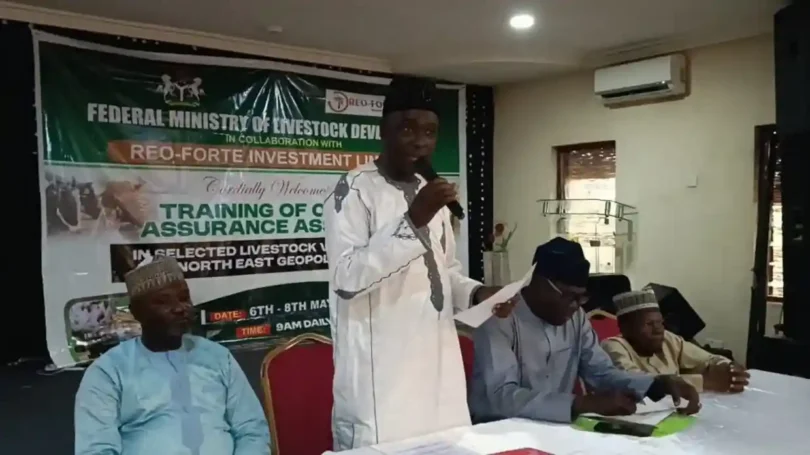
The Federal Ministry of Livestock Development has trained Quality Assurance Assessors across selected livestock value chains in the Northeast as part of efforts to improve food safety, strengthen regulatory compliance, and position Nigeria’s livestock sector for export growth.
The three-day programme, organised in collaboration with Reo-Forte Investment Limited, held in Yola, Adamawa State, from May 6 to 8, 2026. Participants were drawn from Adamawa, Bauchi, Borno, Gombe, Taraba and Yobe states.
The training focused on quality assurance systems, food safety compliance, traceability mechanisms, livestock product standards, inspection systems, laboratory testing protocols, and regulatory frameworks covering both Nigeria and ECOWAS requirements.
Speaking during the opening session, Director of Quality Assurance and Certification at the ministry, Dr. Nurallah Abubakar, said quality assurance remains critical to public health, food safety, and sustainable livestock development.
“Ensuring quality is the bottom line for all our activities, especially when it concerns animal and human health. Quality assurance is critical to ensuring safe and wholesome animal protein for consumption within Nigeria and for export markets,” he said.
Abubakar explained that the initiative forms part of a wider national strategy to increase the number of certified quality assurance assessors across the country and strengthen compliance systems within livestock production and processing chains.
“These participants will return to their respective states and train others. This is only the beginning. We will also extend the programme to other geopolitical zones to build a stronger national quality assurance system,” he stated.
He linked the training to the implementation of the National Livestock Growth Acceleration Strategy (NL-GAS), noting that quality assurance and certification are necessary for productivity, food safety, export competitiveness, and market access.
According to him, countries in the Middle East are increasingly showing interest in Nigerian livestock products due to the country’s natural livestock production systems and relatively low use of veterinary drugs.
Earlier, Director of Veterinary Services, Dr. Nyalas Bartholomew, described the programme as timely, saying many livestock activities across parts of the country have operated for years without structured quality control systems and clearly enforced standards.
“We were very intentional in selecting personnel who work directly in the field because these are the people expected to ensure compliance with standards at abattoirs, poultry markets, dairy facilities, and other livestock production centres,” he said.
Participants also visited the Jimeta Modern Abattoir where they inspected facilities and assessed compliance with sanitary and operational requirements.
During the field exercise, participants identified poor sanitation, weak record-keeping, inadequate antimortem inspection, and unsafe meat handling practices as major risks to food safety and disease control.
They recommended improved infrastructure, better waste management systems, safer transportation processes, and stronger public-private partnerships to improve standards across the livestock value chain.
What do you think about this?
Drop your opinion in the comment section.
FOLLOW US & Share this with someone who needs to see this.