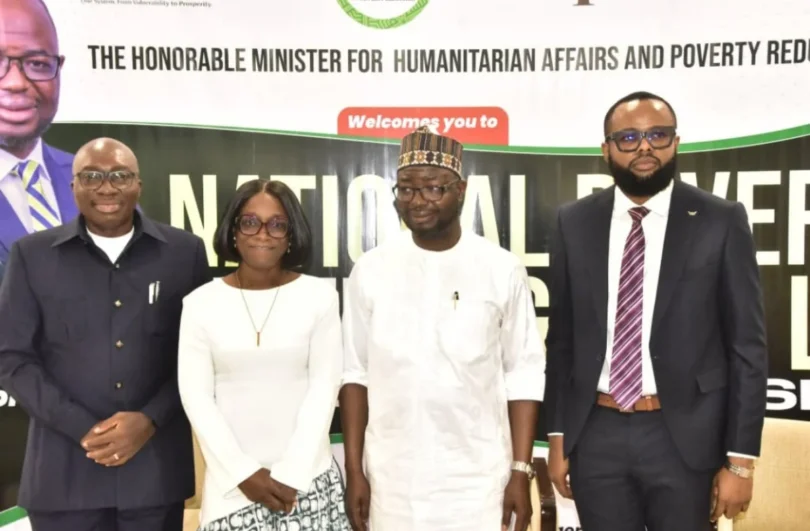
The Minister of Humanitarian Affairs and Poverty Reduction, Dr Bernard Doro, says the newly unveiled National Poverty Intelligence Lab (NPIL) will strengthen effective response to ultimately reduce poverty in the country.
Doro stated this on Wednesday in Abuja at the NPIL Project Kick-off and Monitoring, Evaluation and Learning (MEL) and Data Systems Diagnostic Workshop.
The workshop, organised by the ministry in collaboration with Innovations for Poverty Action (IPA), focused on the use of data and intelligence systems to address poverty challenges more effectively.
According to the minister, the NPIL will accelerate ongoing reforms that will transform how Nigeria understands, responds to, and ultimately reduces poverty.
“I am super excited to witness the beginning of the operationalisation of what we have long envisioned: a truly integrated national system for poverty intelligence and humanitarian response.
“What this moment demands is not more of the same. It demands systems, intelligence, evidence-driven leadership, and above all, coordinated and accountable action. That is exactly what today’s event is about,” he said.
Read Also:North-West Governors unveil regional plan to tackle multidimensional poverty
Doro said Nigeria’s poverty challenges had accumulated over decades and required deliberate, data-driven policies to achieve meaningful results.
According to him, the Federal Government is committed to ensuring that programmes and policies targeted at poor and vulnerable Nigerians deliver measurable outcomes.
“The Renewed Hope Agenda calls us to a higher standard. We are moving from palliatives to pathways, from fragmented projects to integrated systems, from measuring spending to measuring outcomes, and from dependency to dignity.
“Every household we reach through the One Humanitarian-One Poverty Response System (OHOPRS) is a household we intend to graduate from vulnerability, not just today, but permanently. That is the ambition.
“The NPIL is the engine that will tell us whether we are getting there,” he said.
The minister said poverty could not be addressed through assumptions, fragmented interventions or weak accountability mechanisms.
He explained that the OHOPRS was designed to provide the systems and intelligence needed to move Nigeria from fragmented interventions to coordinated outcomes and from vulnerability to prosperity.
Read Also:Hunger Deepens in the North as Prices Soar: Residents cry out over rising food costs, eroding incomes in 2026
According to him, the establishment of the NPIL is not merely a technical initiative but a governance, accountability and poverty reduction reform
On why the OHOPRS required the NPIL, Doro said it was founded on a fundamental realisation that poverty and vulnerability do not exist in isolation.
He noted that humanitarian assistance, social protection, resilience-building and poverty reduction must function as one coordinated system rather than separate interventions.
The minister added that the NPIL would serve as the evidence and intelligence backbone of the system, ensuring that interventions under the OHOPRS are informed, targeted and measurable.
“The OHOPRS is not another programme layered onto an already crowded landscape. It is a national operating model and a governing architecture.
“It ensures that government, development partners, humanitarian actors and the civil society organisations work within a shared framework guided by common objectives, standards, integrated data, and measurable outcomes,” he said.
Read Also:Sokoto neglects Primary Healthcare, disburses just 5% of capital budget in 2025
Doro reaffirmed the commitment of the administration of President Bola Tinubu to sustainable poverty reduction and improved living standards for Nigerians.
Also speaking, IPA Country Representative, Mrs Funmi Ayeni, said the collaboration would help identify the real needs of poor and vulnerable populations while reducing duplication of interventions.
According to her, lifting people out of poverty requires collective action and evidence-based policymaking.