
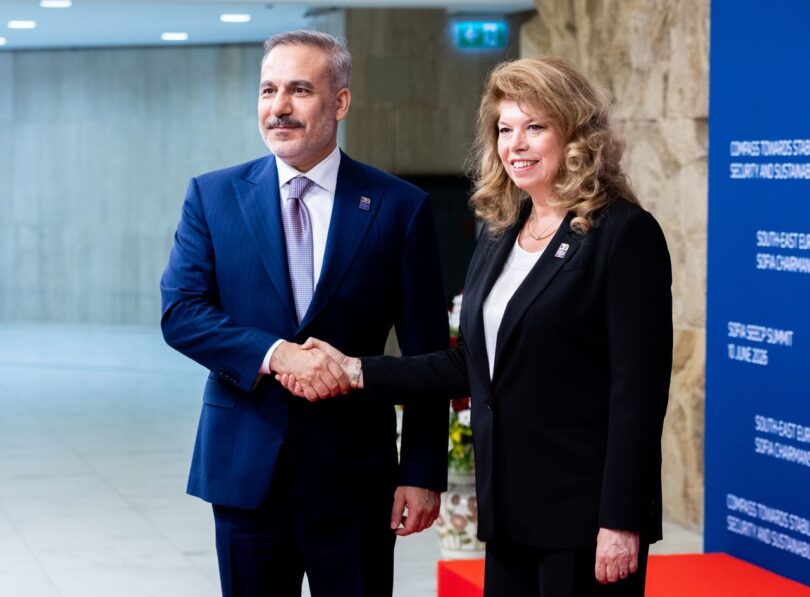
Turkish Foreign Minister Hakan Fidan has said that increasing natural gas transmission capacity from Türkiye to Bulgaria is of “strategic importance not only for bilateral relations but also for the energy security of Eastern Europe.”
Speaking in an interview with the Bulgarian News Agency (BTA) on Wednesday, Fidan emphasised close coordination between the two NATO allies on security, energy, and regional stability.
Fidan underlined that Türkiye’s role in supporting Bulgaria’s energy supply security has become increasingly significant, particularly following disruptions in regional gas flows in recent years.
“The expansion of natural gas transmission capacity from Türkiye to Bulgaria is strategically important for the energy security of Eastern Europe,” he said, adding that existing infrastructure is currently insufficient to meet rising demand and that additional investments on the Bulgarian side would be necessary.
He noted that both countries are working on updating the BOTAS-Bulgargaz agreement “in line with a win-win principle” and said Ankara aims to advance a comprehensive energy cooperation framework covering gas infrastructure expansion and interconnections.
Fidan said Türkiye attaches importance to the “Green Energy Transmission and Trade” project involving Türkiye, Bulgaria, Azerbaijan, and Georgia and expects feasibility studies to start soon and be completed quickly due to the project’s strategic value.
He added that Türkiye and Bulgaria aim to finalise new electricity interconnector projects that would increase transmission capacity by 700-1,100 megawatts. In transport, he noted plans for a second railway crossing and the Black Sea Highway Project to strengthen regional connectivity.
Fidan stressed that recent developments show uninterrupted connectivity in energy, transport, and communications is now a necessity for supply chain security, highlighting the Middle Corridor and Development Road as key routes linking Europe and Asia, with Bulgaria serving as a gateway to European markets.
Highlighting security cooperation under NATO, Fidan said Türkiye and Bulgaria are closely aligned on border security, early warning systems, and intelligence sharing.
Recent developments in the Middle East, he said, have demonstrated “how rapidly the security environment can change,” stressing the importance of NATO’s deterrence role and allied solidarity.
He added that Türkiye and Bulgaria, as key partners on NATO’s southeastern flank, remain ready to evaluate additional steps to strengthen air and missile defence capabilities.
Related
Regional initiatives and EU process
The Turkish foreign minister also highlighted cooperation in the Black Sea, including joint efforts with Bulgaria and Romania on mine-clearing operations, as well as NATO deployments and regional maritime security.
“In line with its 360-degree security approach, Türkiye is increasing its contributions within NATO while also seeking to further develop bilateral defence cooperation with its allies,” he said.
He reiterated Türkiye’s commitment to EU membership, calling it a “strategic priority,” and said recent global shifts are pushing the EU towards a structural transformation in which Türkiye can play a central role.