
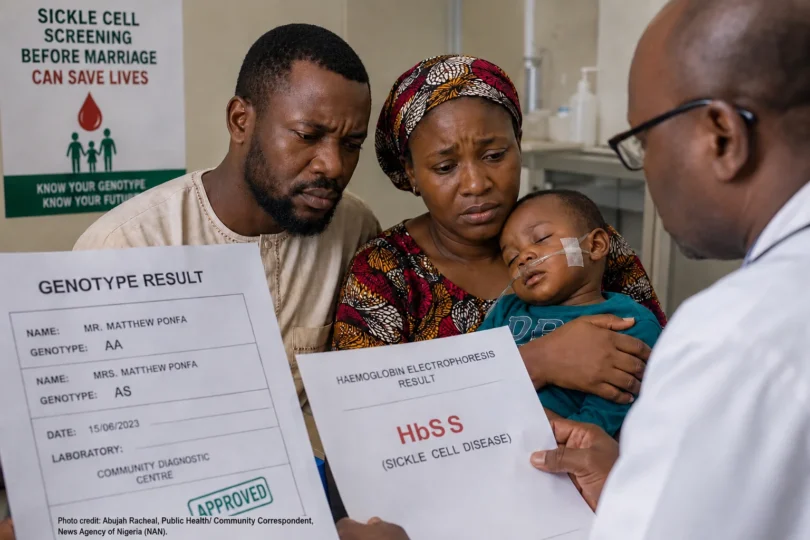
By Abujah Racheal
For Mr and Mrs Matthew Ponfa, a routine hospital visit became the moment their lives changed forever.
Their 11-month-old son had suddenly started crying in severe pain. Nothing they did could calm him.
Worried, the couple rushed him to the hospital, where the doctor asked a simple but important question: “What are the parents’ genotypes?”
The couple immediately showed the doctor the genotype test results they had saved on their phone before marriage.
The report had shown that Matthew was AA, while his wife was AS.
Believing they were genetically compatible, the couple went ahead with their marriage, confident that they had taken the right step to prevent sickle cell disease.
However, the doctor advised them to repeat the test using a more reliable method.
The new result brought a painful discovery.
Matthew was not AA.
He was AS.
Both parents carried the sickle cell trait, and their son had inherited HbSS; the most severe form of sickle cell disease.
For the Ponfas, that moment marked the beginning of a difficult journey of hospital visits, painful crises, emotional stress and financial pressure.
Their experience reflects a wider concern among health experts that inaccurate genotype test results from some laboratories may be adding to Nigeria’s sickle cell burden.
Medical experts say some couples who believe they have taken the right precautions may unknowingly have children with sickle cell disease because of wrong laboratory results.
Read Also:Sokoto neglects Primary Healthcare, disburses just 5% of capital budget in 2025
Mr Timothy Adeoye, a medical laboratory scientist, said genotype testing must be handled with the highest level of accuracy.
“Genotype testing is too important to be left to chance. One inaccurate result can alter the course of an entire family’s future,” he said.
Adeoye explained that wrong results may occur because of outdated testing methods, poor quality control, equipment challenges and human errors.
He said modern techniques such as High-Performance Liquid Chromatography (HPLC) and molecular testing provide more accurate results and should be made available in more laboratories.
The issue is significant in Nigeria, which carries one of the highest sickle cell burdens in the world.
According to the World Health Organisation (WHO), between 20 and 30 per cent of Nigerians carry the sickle cell trait, while about 150,000 babies are born with sickle cell disease in the country every year.
Read Also:Kano records 42,000 HIV patients as KSACA raises alarm over low testing rates
Globally, millions of people live with sickle cell disease, with Africa carrying the largest share of the burden.
Experts say many children in low-income countries die early due to late diagnosis, limited access to treatment and weak healthcare systems.