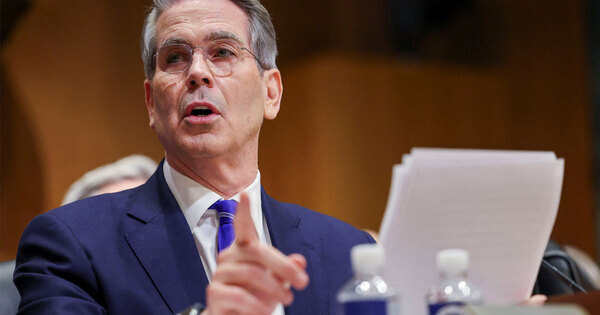
Washington, DC [US], May 5 (ANI): United States Treasury Secretary Scott Bessent has hit out at China for ‘funding the largest state sponsor of terrorism’ by maintaining energy ties with Iran, asserting that Beijing must support Washington’s initiatives to ‘reopen the Strait of Hormuz’, according to a report by Fox News.
The Treasury Secretary’s sharp critique of the Beijing-Tehran relationship comes just days before US President Donald Trump’s scheduled visit to Beijing to meet with President Xi Jinping.
Bessent argued that China’s significant energy imports are directly sustaining the Iranian regime. ‘Iran is the largest state sponsor of terrorism, and China has been buying 90 per cent of their energy, so they are funding the largest state sponsor of terrorism,’ Bessent told the news outlet on Monday.
Despite the escalating rhetoric, the US official urged Beijing to shift its stance and participate in the Washington-led campaign to secure the strategic waterway, which currently remains ‘blocked by Iran’.
Highlighting the regional disruption, Bessent stated, ‘The attacks from Iran have closed the strait. We are reopening it. So I would urge the Chinese to join us in supporting this international operation.’
This call to action follows President Trump’s recent announcement of ‘Project Freedom’, an operation designed to ‘guide’ vessels currently trapped in the waterway. Trump has previously warned Tehran against any attempts to disrupt the mission.
Bessent further asserted that the US is sending a clear signal that the Iranians ‘do not have control’ over the critical maritime artery. ‘We have absolute control of the strait,’ he added.
The Treasury Secretary suggested that China should leverage its influence over Tehran to achieve a diplomatic breakthrough. ‘Let’s see them step up with some diplomacy and get the Iranians to open the strait,’ he said.
The demand for cooperation follows a stalemate at the United Nations, where China and Russia recently used their veto power to block efforts to ‘condemn the Iranian blockade of Hormuz’ at the Security Council.
Defending the veto, Chinese Ambassador Fu Cong argued that the proposed draft ‘failed to capture the root causes and the full picture of the conflict in a comprehensive and balanced manner’, citing a lack of focus on US and Israeli actions.
Washington has consistently sought to ‘choke off’ Iranian energy exports since 2018 through a ‘maximum pressure’ campaign following the US withdrawal from the nuclear deal, known as the Joint Comprehensive Plan of Action (JCPOA).
While the agreement originally saw Tehran ‘drastically scale back its nuclear programme’ for sanctions relief, Beijing has continued to import Iranian oil despite the deal’s collapse and subsequent US penalties.
Responding to recent sanctions on Chinese firms, Chinese Foreign Ministry spokesperson Lin Jian stated that Beijing ‘opposes illicit unilateral sanctions that have no basis in international law’ and warned the US to stop using ‘long-arm jurisdiction’.
The current friction over West Asian security arises amidst a broader context where the US has long viewed China as its ‘top global competitor’, with historical disputes ranging from trade and the South China Sea to the status of Taiwan.
However, since the start of the new administration in January 2025, there have been indications of a shift in focus toward the Western Hemisphere rather than direct ‘competition in the Asia-Pacific region’.
Bessent noted that the upcoming high-level summit will facilitate a direct dialogue between the two leaders. ‘We’ve had great stability in the relationship, and again, that comes from the two leaders having great respect for each other,’ he added. (ANI)