
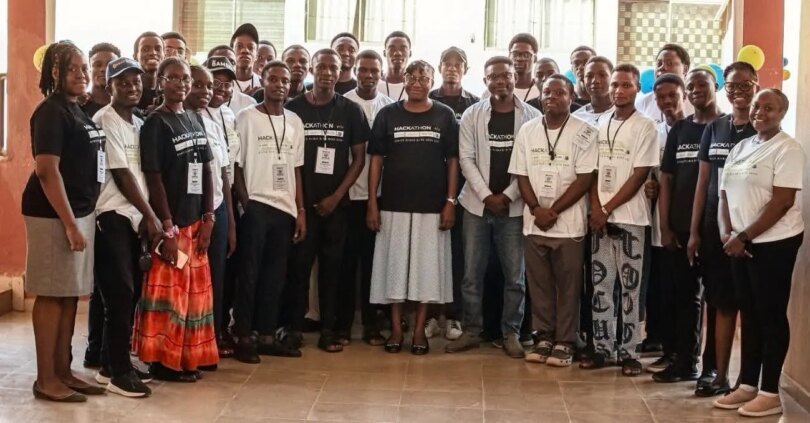
The successful conclusion of the HealthTrace Data Hackathon 2026 has reaffirmed the Federal University of Technology, Akure’s FUTA commitment to research excellence, innovation, and the development of Artificial Intelligence (AI)-driven solutions to address pressing public health challenges. The three-day national hackathon, held from 15–17 June 2026 at the School of Computing, FUTA, brought together talented undergraduate students from universities across Nigeria to develop innovative solutions using real-world health datasets from the HealthTrace (Tracy IoT) research initiative. The programme provided participants with an opportunity to apply knowledge in artificial intelligence, machine learning, data analytics, software engineering, and digital health to solve real societal problems.
The competition attracted 188 applications from students across the country. Following a rigorous merit-based selection process, 30 participants were selected and organised into ten teams across three challenge tracks: Data Analysis & Visualisation, Predictive Modelling, and System Design & Innovation. Throughout the hackathon, participants worked closely with mentors and researchers to analyse data, develop innovative solutions, and present practical prototypes capable of strengthening disease surveillance and improving public health decision-making.
Following presentations before a distinguished panel of judges comprising academics and professionals, entries were assessed based on innovation, relevance, technical accuracy, creativity, and presentation quality.
Team Gradient emerged as the overall winner in the System Design & Innovation track with Lafiya, an innovative Infectious Disease Surveillance and Response Platform that incorporates encrypted Bluetooth Low Energy (BLE) peer-to-peer communication, enabling information exchange even in locations without internet connectivity. The winning team comprised: Oluwaferanmi Oladepo, Information and Communication Engineering FUTA, Adebisi Quadri Abidemi, Statistics, FUTMINNA ,and Olamilekan Oluwatosin Aleshinloye, Computer Science ,University of Ibadan.
The second prize went to Team Seaborn, competing in the Data Analysis & Visualisation track. The team developed a composite early-warning framework capable of transforming HealthTrace datasets into actionable insights for healthcare professionals and public health decision-makers. Ikuomola David Iyanuoluwa, Public Health, FUTA, Nunsi Shiaki, Information Systems FUTA, and Okoroafor Kelechi Divine, Mathematics ,Federal University of Technology and Environmental Sciences, Iyin-Ekiti won for Team Seaborn.
Team Tensor finished in third place in the Predictive Modelling track with Tracy Alert, an intelligent Exposure Risk Prediction System designed to predict disease exposure risk while identifying anomalies that may occur due to device failure during disease outbreaks. The team comprised Ojo David Winner, Data Science , Federal University of Technology and Environmental Sciences, Iyin-Ekiti, Paul Daniel Oluwapelumi, Computer Science , Elizade University and Aderiye Peter Olaoluwa Computer Science , Adekunle Ajasin University.
Speaking on the outcome of the competition, Professor Bolanle Ojokoh, from FUTA who leads the HealthTrace research initiative, commended all participants for their creativity, resilience, and commitment throughout the competition. She noted that the quality of the solutions produced reflects the growing capacity of young Nigerians to develop innovative technologies capable of addressing national and global healthcare challenges. She further stated that the hackathon represents an important component of FUTA’s vision of translating research into practical innovations that create measurable societal impact while nurturing the next generation of AI researchers, innovators, and technology leaders.
Professor Ojokoh expressed appreciation to the leadership of the School of Computing, the judges, mentors, volunteers, and technical support teams for their dedication to the success of the event. She also acknowledged the valuable support of ValueBridge and Jemirae (Japan), whose partnership contributed to the successful organisation of the hackathon.
Following the success of the inaugural edition, plans are already underway to expand future editions of the HealthTrace Data Hackathon by increasing participation, attracting more industry and international partners, strengthening mentorship opportunities, and supporting the further development of outstanding hackathon projects into research outputs and deployable digital health solutions.
The outcomes of the HealthTrace Data Hackathon 2026 further strengthen FUTA’s reputation as a leading institution in research, innovation, artificial intelligence, and digital health. By empowering students to develop technology-driven solutions to real-world challenges, the University continues to demonstrate its commitment to producing graduates equipped to contribute meaningfully to national development and the global knowledge economy.
Beyond recognising outstanding teams, the hackathon demonstrated the enormous potential of Nigerian students to leverage emerging technologies for societal impact. Participants from different academic backgrounds and institutions collaborated effectively to develop practical AI-powered solutions addressing disease surveillance, outbreak prediction, health data visualisation, and digital public health.
The event also fostered peer learning, interdisciplinary collaboration, critical thinking, and problem-solving, equipping participants with valuable experience in working with real-world datasets under realistic project conditions. Feedback from participants indicated that many considered the hackathon a transformative learning experience that strengthened both their technical and collaborative skills.
What do you think about this?
Drop your opinion in the comment section.
FOLLOW US & Share this with someone who needs to see this.