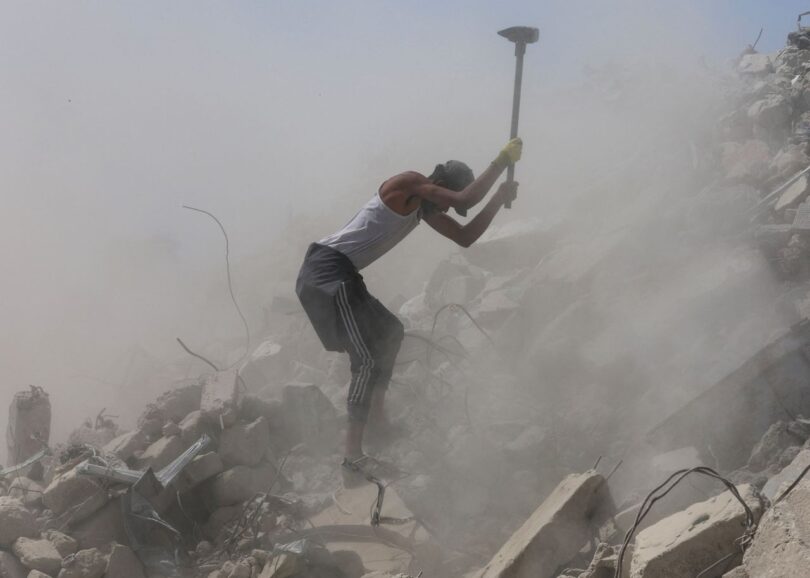
In Gaza, Palestinians are rebuilding what they can with what remains – salvaging concrete from rubble, patching damaged homes and setting up makeshift schools from scrap materials — as large-scale reconstruction remains largely stalled nearly seven months into a fragile ceasefire.
Despite the scale of destruction, rebuilding efforts remain largely frozen, with experts pointing to Israeli restrictions on construction materials and unresolved political disputes as key obstacles.
A new international assessment estimates the enclave will require $71.4 billion over the next decade to recover.
The final Gaza Rapid Damage and Needs Assessment (RDNA), released last month by the European Union, the United Nations and the World Bank, said $26.3 billion will be needed in the first 18 months alone to restore essential services, repair critical infrastructure and support economic recovery.
It estimated physical infrastructure damage at $35.2 billion, while economic and social losses reached $22.7 billion, with housing, health care, education, commerce and agriculture among the hardest-hit sectors.
Blockade hampers rebuilding
Israel’s war on Gaza since October 7, 2023, has devastated much of the enclave, leaving entire neighbourhoods in ruins.
Despite the ceasefire, Mamoun Besaiso, an adviser to the United Nations on Gaza’s reconstruction, said Israel continues to restrict the entry of cement, steel and other essential materials, forcing residents and aid agencies to rely on debris from destroyed buildings.
“The United Nations Development Programme (UNDP) started months ago recycling rubble, and from this recycled rubble we get some construction material. And they use this construction material in repair or not in new construction, repair,” he told Anadolu.
The recycled materials are being used to fix hospitals, schools and water infrastructure, but not for new building projects, he said.
Across Gaza, makeshift schools have been built from metal sheets and wooden pallets, while some universities have partially resumed face-to-face teaching in damaged classrooms or tents.
Existing materials are being used to repair hospitals, schools and water infrastructure, including pipes and wells, but no new large-scale reconstruction has begun, Besaiso added.
Housing crisis deepens
With hundreds of thousands still displaced, shelter remains among the most urgent needs.
A UN report estimates that between October 2023 and October 2025, at least 92 percent of Gaza’s housing units were either destroyed or damaged.
More than 90 percent of the population has been displaced, while over 86% of the territory has been designated as displacement zones or incorporated into Israeli militarised areas.
Even before the war, Gaza faced a chronic housing shortage due to years of blockade, repeated military assaults and economic stagnation. Around 2.3 million people lived in just 365 square kilometres (140 square miles), making it one of the most densely populated places in the world.
“Now, most displaced people are living in tents … very miserable tents,” Besaiso said.
He noted that the UNDP has managed to bring in a limited number of prefabricated housing units.