While Operation Al Aqsa Flood on October 7, 2023, shattered long-standing security assumptions and exposed the fragility of the regional balance of power, it also marked the beginning of a genocide unfolding in full view of the international community.
However, aerial bombing and advancing tanks are not the only forces decimating the civilian population in Gaza and the occupied West Bank.
In this conflict, water—the source of life and humanity’s most fundamental shared value—has been deployed directly to the front lines as a silent yet mass weapon of destruction.
For decades, Israel has maintained what scholars describe as a system of “hydro-hegemony” in the Palestinian territories—a framework of control over water resources, infrastructure, and access.
Related
Since October 7, however, critics argue that this longstanding system has taken on a far more destructive dimension.
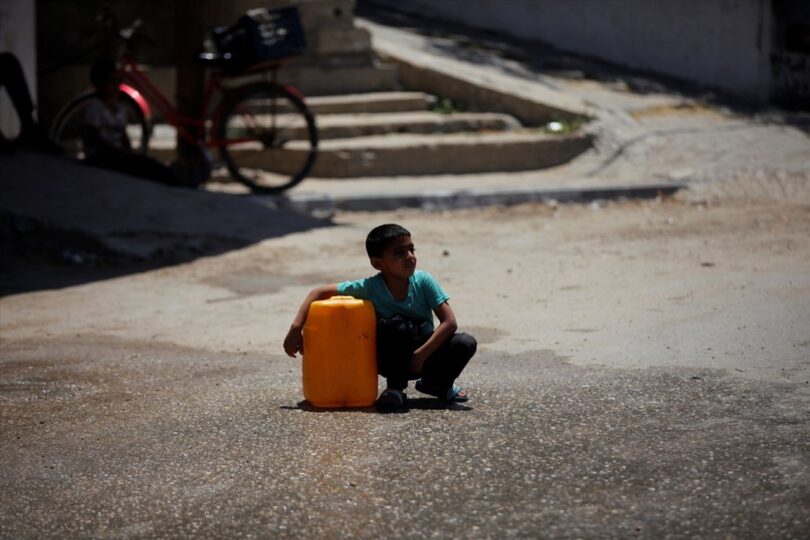
In Gaza in particular, restrictions on water access, damage to water infrastructure, and fuel shortages for desalination and sanitation facilities have contributed to severe clean-water shortages, increasing the risk of dehydration, disease outbreaks, and broader public health crises among the civilian population.
‘Making the desert bloom’
In the international relations literature, “hydro-hegemony”—as conceptualised by Mark Zeitoun—refers to the asymmetric dominance exercised by a powerful actor over transboundary water resources, rendering the weaker actor dependent.
Although Israel’s water politics began with the construction of an agricultural and societal identity rooted in the Zionist myth of “making the desert bloom,” in practice it became a mechanism for expropriating Palestinian water.
The roots of this process did not begin on October 7.
Following the Arab-Israeli War in 1967, military orders directly subjected Palestinians in the occupied territories to Israeli permission for drilling water wells, establishing infrastructure, and even collecting rainwater, as documented in Amnesty International reports.
At this point, the securitisation theory from the Copenhagen School serves as a key indicator.
Israel has cast the Palestinian quest for sovereignty over their own water resources as a “security threat” and used this perception of threat to justify extraordinary, extrajudicial military interventions.
This mentality, which absolutises Israel’s security, has become a guise for completely eliminating the most fundamental human right of the Palestinian people.
This apartheid water regime has been implemented through different mechanisms in the occupied West Bank and Gaza.
In the occupied West Bank, Palestinians have largely been excluded from meaningful control over major water resources and often rely on costly purchased water, while illegal Israeli settlers enjoy significantly greater access.
In Gaza, by contrast, water deprivation has been shaped by years of blockade and isolation, severely weakening the territory’s water and sanitation infrastructure and deepening the humanitarian crisis.
‘Malicious hegemon’
Zeitoun states that hegemonic powers can be either “benign” or “malicious”.
In the Palestinian context, Israel has always adopted an oppressive, restrictive “malicious hegemon” model; however, the events following October 7 entered a phase that transcends the boundaries of international law by deliberately depriving the civilian population of the conditions of life.
The most concrete step of this strategy came on October 9, when the Israeli administration announced a total cutoff of water pipelines, electricity, and fuel to Gaza.
Without electricity and fuel, neither can the brackish water in the Coastal Aquifer Basin—the region’s only local source—be desalinated, nor can existing facilities operate.
According to a report published by the Centre for Strategic and International Studies (CSIS), more than 700 of 1,100 water wells, 5 wastewater treatment plants, and 65 sewage pumping stations in Gaza were targeted and rendered inoperable during the war on the blockaded Palestinian enclave.