
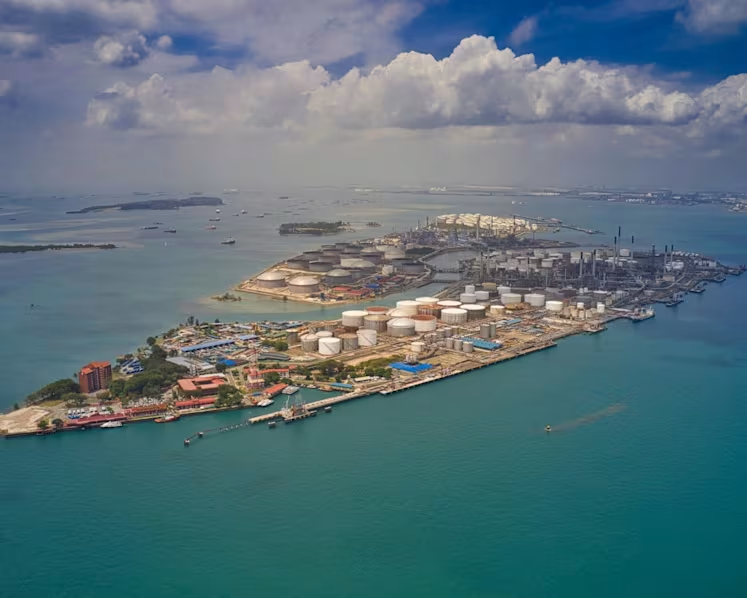
Singapore is looking at new ways to create more land as it prepares for major reclamation projects in the coming decades.
About 28 per cent of Singapore’s current land area has already been reclaimed. The country has grown from around 581.5 sq km in 1965 to about 744 sq km today.
Prime Minister Lawrence Wong recently announced that Singapore is considering merging several islands south of Jurong Island to create a larger western island.
The proposed island could provide space for future industries, energy infrastructure and other national needs.
Singapore is also preparing for its massive “Long Island” project off the East Coast.
Preparatory work is expected to begin at the end of 2026. The project could eventually create about 800 hectares of new land while helping protect Singapore from rising sea levels.
But creating new land is becoming more difficult and expensive.
In the past, Singapore used soil taken from hills for reclamation. As those sources became limited, the country began importing sand.
Professor Chu Jian from Nanyang Technological University explained:
“For later years of land reclamation, we don’t have hills to cut anymore, so we start to import sand.”
However, sand has become more expensive and harder to obtain.
“Ideally, sand should be used because it’s easy to handle, and also sand is less compressible. If you use clay, it’s very difficult to treat … the cost of improvements will also be higher,” Prof Chu said.
“But of course, the cost of sand is getting higher and higher, and also, it may not be easily available.”
The amount of material required can also be huge.
David Ng from the Institution of Engineers, Singapore estimated that if the seabed around Long Island averages 20 metres deep, the 800-hectare project could require at least 160 million cubic metres of filling material.
That is roughly equal to the volume of 64,000 Olympic-sized swimming pools.
Singapore has therefore started exploring other methods.
One option is the polder method, which involves surrounding an area with dikes and pumping water out to create usable land below sea level.
Singapore recently used the method to reclaim about 800 hectares at Pulau Tekong. It reduced the amount of sand required by almost half, although experts say the method is more complicated and costs more to maintain.
“The polder method cuts sand volume demands significantly, but it carries higher engineering complexity and ongoing long-term operational costs due to the need for continuous pumping systems and dike maintenance,” Associate Professor Darren Chian said.
For Long Island, engineers could use a hybrid polder system to reduce the amount of filling material needed.
The proposed western island could follow a different approach. Experts believe Singapore could build structures connecting several existing islands before filling the shallow waters between them, similar to how Jurong Island was created.
Environmental concerns are another major issue.
Large reclamation projects can damage marine habitats and cause biodiversity loss. Waters surrounding some of the western islands contain coral reefs and other marine life.
Singapore’s Ministry of National Development said it recognises the area’s biodiversity and will carry out technical and environmental studies before deciding how development should proceed.
“Definitely, we cannot completely avoid environmental impact. However, there are methods for us to reduce the environmental impact,” Prof Chu said.
Experts are also studying alternatives such as recycled construction materials, floating structures and other methods that could reduce the environmental impact of future reclamation projects.
The projects could take decades, but they could significantly reshape Singapore’s coastline while providing more land for future generations.