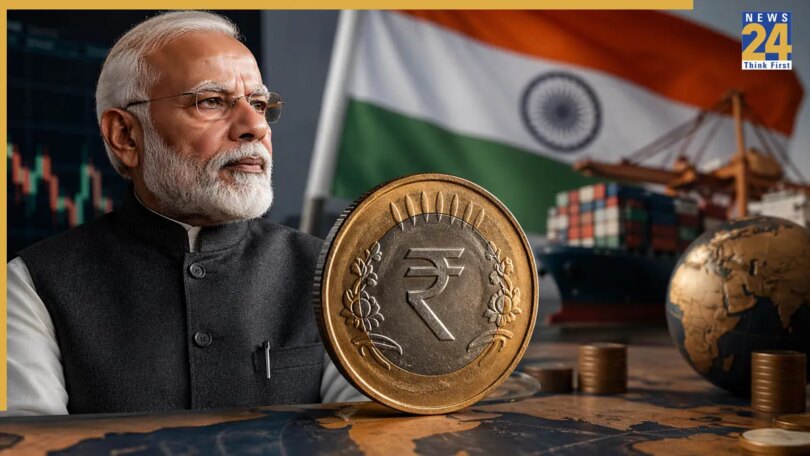
While global attention remains fixed on the US–Israel–Iran conflict, India is quietly making a bigger strategic move. The war has strengthened the dollar, weakened the rupee, and pushed crude prices higher, sending ripples across the global economy. Anticipating such shocks, India has already taken a significant step by expanding the use of the rupee in international trade. Today, the country is trading with 24 nations in its own currency, reducing dependence on the dollar and building a more resilient economic position.
Economic challenges in de-dollarization
Countries like Russia, China, and Iran that have challenged the dominance of the dollar have often faced economic pressure from the United States. In contrast, India has taken a more balanced approach by expanding rupee-based trade, especially with neighbours like Bhutan and Nepal, where the currency is already widely accepted. Gradually, this approach has extended beyond the region, with even some European nations adopting rupee-based trade mechanisms, strengthening India’s position without direct confrontation.
How India developed alternative to SWIFT?
In a significant move, the Reserve Bank of India introduced the Special Rupee Vostro Account framework in 2022. It is a mechanism that puts India a step ahead in global trade. It works like a rupee wallet that a foreign bank opens with an Indian bank. Through this system, trade payments are settled directly in rupees, eliminating the need for dollar transactions and reducing dependence on networks like the SWIFT (Society for Worldwide Interbank Financial Telecommunication).
Special Rupee Vostro Account partners
| Country | Status | Primary Use Case |
|---|---|---|
| Russia | Operational | Oil, Gas, and Defense imports |
| Sri Lanka | Operational | Essential commodities and food |
| Mauritius | Operational | Financial services and investment |
| Germany | Approved | Engineering and machinery |
| Singapore | Approved | Corporate trade settlement |
| United Kingdom | Approved | Professional services and trade |
| Israel | Approved | Defense and Technology |
| Malaysia | Approved | Palm oil and electronics |
| Oman | Approved | Energy and fertilizers |
| Bangladesh | Approved | Cross-border retail and bulk trade |
Speaking on this strategic move, ASSOCHAM Chief Economist S. P. Sharma said, “The composition of India’s forex reserves shows that the share of foreign currency assets has declined from 93% in 2020–21 to 79.9% in 2025–26. On the other hand, the share of gold has increased from 5.9% to 16.7%, indicating the RBI’s growing inclination toward gold as a strong reserve asset.”
Also Read: Why your car insurance gets often rejected
Expansion of UPI
Alongside Special Rupee Vostro Accounts, country is expanding the Unified Payments Interface (UPI) globally. Countries like the United Arab Emirates have partnered with India to enable UPI acceptance, especially for merchant payments and cross-border transactions. However, most countries have not fully adopted UPI; instead, they are integrating it with their local payment systems, allowing limited but gradually increasing usage.
India’s UPI Partners
| Country | Partner System | Usage |
|---|---|---|
| Bhutan | BHIM UPI | First country to adopt UPI standards |
| Singapore | PayNow | Instant real-time remittances (P2P) |
| UAE | AANI / NEOPAY | QR payments at malls and merchants |
| Nepal | Fonepay | QR payments for tourists and traders |
| France | Lyra Network | Payments at Eiffel Tower and retail |
| Mauritius | MauCAS | Tourist payments and local RuPay cards |
| Sri Lanka | LankaPay | QR-based merchant payments |
| Qatar | NIPL | Acceptance at Duty Free and malls |
Trade through local currency
India’s push toward the rupee does not stop here. The country is already settling trade with several partners in local currencies, creating a system that reduces reliance on the dollar. This helps in conserving dollar reserves, keeping costs under control, and supporting the currencies of partner countries.
Also Read: About the early withdrawal rules of Sukanya Samriddhi Yojana
Countries trading in local currency with India
| Country | Local Currency | Key Focus |
|---|---|---|
| UAE | Dirham (AED) | Crude oil and gold trade |
| Indonesia | Rupiah (IDR) | Bilateral commercial trade |
| Maldives | Rufiyaa (MVR) | Regional economic stability |
| Bangladesh | Taka (BDT) | Essential goods and border trade |
| Bhutan | Ngultrum (BTN) | Full integration with Indian Rupee |
| Nepal | Nepalese Rupee (NPR) | Cross-border trade and lending |
Price stability
According to S. P. Sharma, “One of the biggest advantages of reducing dependence on the dollar is greater price stability. During conflicts or global uncertainty, the dollar tends to fluctuate sharply against the rupee, impacting import costs and inflation.”
However, when trade is settled in local currencies, these external shocks have a limited impact, as such currencies usually remain more stable unless there is an extreme event. In this way, de-dollarization is helping keep a significant portion of India’s trade relatively stable.