Washington, DC [US], July 10 (ANI): Merely a fortnight after celebrating a peace deal with Iran as a significant diplomatic breakthrough, US President Donald Trump abruptly decided to walk away from the framework, triggering a massive military escalation in the region.
Hours before departing for the NATO summit in Turkey, the American leader was anticipated to focus heavily on diplomacy. Instead, an urgent high-level meeting inside the Oval Office entirely altered the trajectory of the ongoing Iran conflict.
According to The Wall Street Journal, fresh intelligence exposing Iranian assaults against commercial vessels in the strategic Strait of Hormuz convinced President Trump that Tehran was no longer committed to the fragile ceasefire. By the time Air Force One touched down in Ankara, the White House had already initiated the process of dismantling major components of the agreement.
The WSJ reported that US Secretary of State Marco Rubio and Secretary of War Pete Hegseth walked into the Oval Office on Monday evening, shortly before President Trump’s departure for Turkey.
The senior officials informed the President that Iran had deployed anti-ship cruise missiles and one-way attack drones against commercial vessels attempting to navigate the Strait of Hormuz via the southern shipping route. Three maritime vessels were reportedly struck within a span of a few hours, including a liquefied natural gas tanker.
The intelligence briefing reportedly left President Trump furious, leading him to repeatedly question whether Iran possessed any genuine interest in negotiating a permanent settlement. Following intense consultations with his senior national security apparatus, the President concluded that Tehran was no longer acting in good faith.
The decision has marked a drastic turning point in Washington’s strategic approach. Within hours, the Trump administration began systematically rolling back multiple concessions previously extended under the interim peace framework signed at France’s Palace of Versailles.
The White House promptly revoked Iran’s licence to sell oil, authorised successive rounds of military strikes on Iranian assets around the Strait of Hormuz, and issued stern warnings that even civilian infrastructure could face targeting if hostilities persist.
Among the sites President Trump explicitly cited were desalination plants and electricity facilities, though he noted he hoped such actions would not be required.
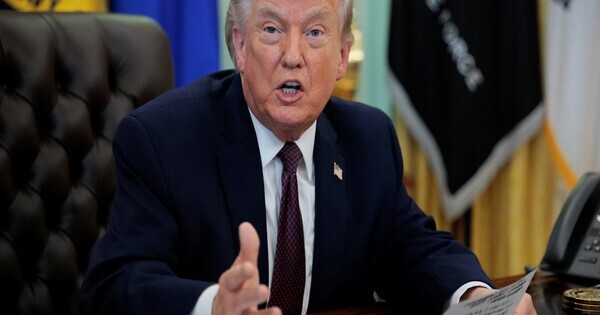
Speaking at the NATO summit in Ankara, President Trump made it unequivocally clear that he no longer believed the diplomatic accord could survive.
‘To me, I think it’s over,’ President Trump stated. ‘I don’t want to deal with them. They’re liars, they’re cheats, they’re sick people.’
Conversely, Iran has strongly rejected the American version of events. An Iranian diplomat told the WSJ that Washington had breached the pact by unilaterally establishing a shipping lane through the Strait of Hormuz without prior coordination with Tehran.
The diplomat argued that the decision violated understandings reached under the memorandum of understanding, thereby justifying Iran’s retaliation against vessels utilising the route.
The bitter disagreement has exposed a fundamental structural weakness in the interim accord. While the document guaranteed freedom of navigation through the Strait of Hormuz, it failed to clearly define which authority would manage, coordinate or police commercial shipping through the vital global waterway.
At the absolute core of the dispute is control over a maritime trade route that handles roughly one-fifth of global oil shipments, ensuring any operational disruption triggers immediate shockwaves across international markets.
According to US officials, the American Navy had been quietly assisting commercial vessels to navigate the southern route along Oman’s coastline for several weeks, with more than 125 vessels reportedly completing the transit under American guidance.
The operation was largely executed under the cover of night, with ships switching off their automatic identification systems while maintaining direct radio contact with naval assets and shipping operators.
Washington maintained that the deployment was designed entirely to shield commercial traffic from hostile attacks. Tehran, however, fiercely opposed the arrangement, insisting that vessels should instead utilise the northern route closer to the Iranian coastline while warning that the southern corridor was unsafe.
Following the latest maritime strikes, the US military launched extensive counter-operations targeting Iranian military infrastructure near the Strait of Hormuz. US Central Command stated that the actions were aimed at diminishing Iran’s capability to threaten international shipping lanes.
US forces have pounded more than 170 Iranian military targets over a two-day period.
Secretary of War Pete Hegseth warned that the kinetic campaign could expand significantly, stating that the military would strike ‘even more, and even deeper’ if conditions necessitate.
Vice President JD Vance strongly echoed the administration’s hard-line warning during a political event in Milwaukee.
‘The deal is very simple,’ Vice President Vance said. ‘If they shoot at ships, we’re going to knock the hell out of them.’
President Trump later revealed that Iran’s military manoeuvres had particularly angered him because he believed he had already granted Tehran additional time by pausing active negotiations for a week to accommodate the funeral ceremonies of the late Supreme Leader Ayatollah Ali Khamenei.
‘Instead of that, they start shooting rockets at ships,’ President Trump remarked.
In retaliatory moves, Iran has launched targeted attacks against US military installations across Bahrain, Kuwait, Qatar and Jordan, leaving the peace deal that once promised to stabilise the volatile flashpoint hanging by a thread. (ANI)